UC Selected as One of 11 Nationwide Hubs for Emergency Care Clinical Trial

A typical depiction of medical research features scientists in lab coats intently peering into microscopes or beakers filled with strange-colored liquids. However, research in the field of emergency critical care can happen at the scene of an accident, as well as in hospital emergency departments, and the University of Cincinnati (UC) Department of Emergency Medicine is playing a major role in this emerging field.
UC has been selected as one of 11 hubs across the United States to serve within a network designed to improve emergency care clinical trials.
The network, funded by the National Institutes of Health (NIH), is called Strategies to Innovate Emergency Care Clinical Trials Network (SIREN). SIREN is the evolution of two emergency care clinical trial networks funded by the NIH: Resuscitation Outcomes Consortium (ROC), and Neurological Emergency Treatment Trials (NETT).
ROC, funded by the National Heart, Lung, and Blood Institute, (NHLBI), ran from 2004 to 2015 and funded nine clinical trials at a cost of $143 million. NETT, operated under the auspices of the National Institute of Neurological Disorders and Stroke (NINDS), ran from 2006 to 2016 with a budget of $151 million, overseeing six clinical trials.
"Both of those networks were highly successful in advancing the science of resuscitation research. Ultimately, the institutes decided to partner together to leverage what had been done by ROC and NETT into a new network of emergency care research covering both NHLBI and NINDS priorities, says Opeolu Adeoye, MD, associate professor in the Department of Emergency Medicine at the UC College of Medicine.
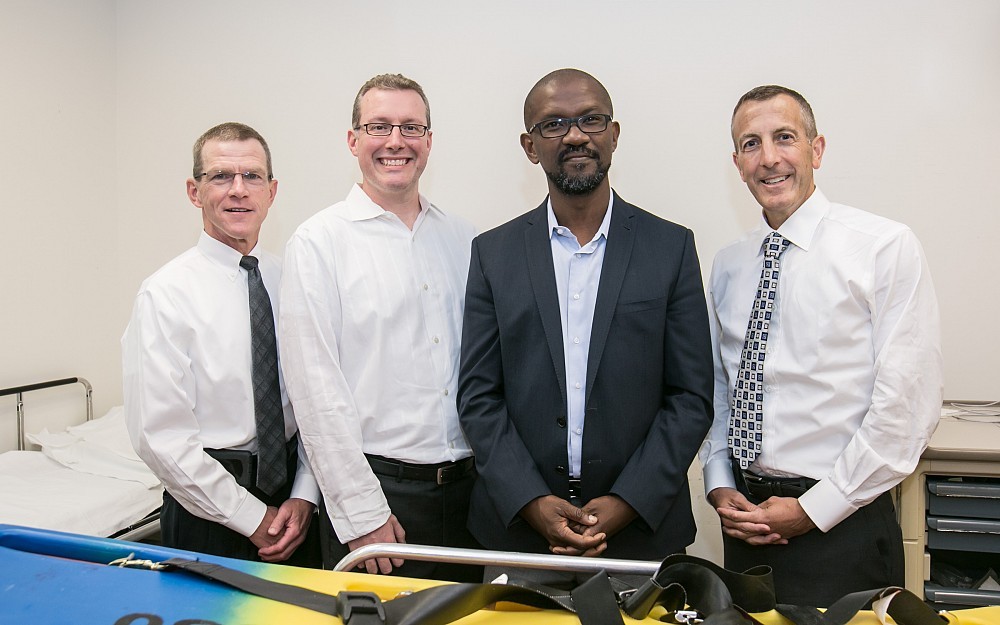
The multidisciplinary principal investigator group includes Adeoye, Jason McMullan, MD, associate professor in the Department of Emergency Medicine, Jay Johannigman, MD, professor in the Department of Surgery at the UC College of Medicine, and Gregory Fermann, MD, vice chairman and medical director of the Department of Emergency Medicine.
Among the goals of SIREN is improving patient outcomes around cardiac, hematologic, neurologic, respiratory and trauma emergencies by determining the most effective treatments administered in the crucial first three hours of critical care. The network is designed to run multiple studies simultaneously, taking advantage of the spokes and hubs in the system.
"For the last decade, we have been a highly successful NETT hub and we have been a highly successful ROC spoke, says McMullan. "We have been very successful in these existing networks so I think that we were a natural fit to be a hub of the unified approach.
As the hub of a regional network, the UC team will tap partners across the region, as trials come along, including academic medical centers at the University of Louisville and University of Kentucky. This will employ the strengths of individual medical facilities while maximizing network strengths to make any individual trial as successful as possible.
"We dont have to rebuild the infrastructure for each trial, the infrastructure exists here, says Fermann. "You simply plug in a trial that studies patients who are in that critical first three hours of emergency care. The commonality will be the fact that its an acute illness or injury and by and large will be under the purview of the NINDS so it will be more neurologically mediated, or, in other cases, more centered on heart, lung, blood or trauma falling under the auspices of NHLBI.
Another potential positive is the ability to conduct large trials, thanks to the architecture of the many other hubs and their regional networks. Studies can be conducted in as many as 100 sites, depending on the nature of the study and which cogs in the system are interested in participating.
"Im personally excited that were breaking out of the traditional silos of science, says McMullan. "In emergency medicine, in pre-hospital care and emergency care, we focus on the person and their problem at hand without predicting what it is. We dont silo our care, so it excites me that we now have a research network that is focused is on the very broad aspect of acute care research, instead of being siloed in a narrow disease-specific focus.
The other 10 clinical hubs in the SIREN network include: Emory University; Massachusetts General Hospital; Medical College of Wisconsin; Oregon Health Sciences University; Temple University; University of California, Los Angeles, University of Minnesota, University of Pittsburgh; University of Washington; and Wayne State University with the University of Michigan serving as the clinical coordinating center.
"Cincinnati had the first fire and EMS in the nation and the UC Department of Emergency Medicine was the first of its type in the nation, so I think we are able to lean heavily on that justifiably strong, historical evidence of expertise in this whole arena, says Johannigman. "Just as University of Cincinnati Medical Center was built as the first-ever teaching hospital, this is the first emergency medicine residency, and SIREN is another important first for this group.
Related Stories
UC radiation oncologist speaks with Local 12 news about clinical trial for head and neck cancer treatment
August 10, 2026

Dr. Sara Medek, a UC radiation oncology professor, speaks with Local 12 news about a new clinical trial aimed at reducing radiation in certain areas while still treating cancer effectively but with fewer painful side effects.
Cancer Center director charts future based on collaboration, AI
August 10, 2026

David Gius, MD, PhD, was featured in a Cincinnati Business Courier article and The Cancer Letter’s “The Directors" podcast discussing his priorities and goals as he recently took the helm as director of the University of Cincinnati Cancer Center.
UC graduates cross finish line at commencement
August 7, 2026
The University of Cincinnati recognized 2,125 graduates in two ceremonies at summer commencement Friday on campus at Fifth Third Arena.