New Human Lab at UC Brings Collaborative Model to Neurorecovery

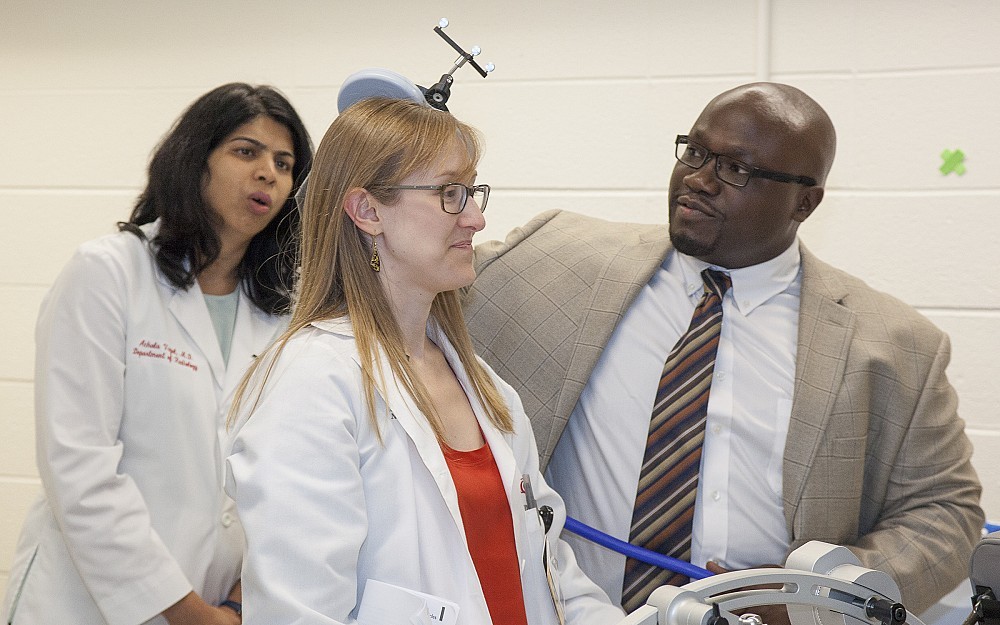
Move over microscopes and test tubes, and make room for treadmills and simulators. On Sept. 1, 2017, University of Cincinnati officially opened its new Neurorecovery Laboratory, the first lab in the Medical Sciences Building (Room G-351) to house clinical trials. This unique comprehensive research space dedicated to translational and clinical studies aims to bring innovative recovery research to patients with neurological injuries.
The new space fosters cross-specialty collaboration with four departments across three colleges: Neurology and Rehabilitation Medicine in the College of Medicine, Rehabilitation Sciences and Communication Sciences and Disorders Departments within the College of Allied Health Sciences, and the College of Nursing. Co-directors of the laboratory are Oluwole Awosika, MD (Medicine) and Pierce Boyne, DPT and Aimee Dietz, PhD (Allied Health).
There are at least eight ongoing studies using the lab, focused on stroke recovery interventions to manage aphasia, reach and grasp, walking and other mobility issues stemming from neurological injury.
"Creation of this lab space was really an interdisciplinary effort. Just a year ago this was a locker room, transformed for our rehabilitation research center efforts, to devise novel and practical therapeutic interventions for stroke, TBI (traumatic brain injury) and spinal cord injury research, says Awosika.
"Whats unique is that this is our first lab of this sort in the MSB facility, which is primarily home to basic research labs. What we really hope to do here is to translate researchfrom basic to clinicaland bring patients from the clinics and rehab centers to this central location to be part of this dynamic research process.
Boyne, a physical therapist, says for years there were separate lab spaces. "Thanks to the long-term efforts of Brett Kissela and Kari Dunning, they really founded this idea to have an interdisciplinary lab we started it out at the Drake Center ( Daniel Drake Center for Post-Acute Care) and now were here at UC, where we can all collaborate in this shared space.
"The main thrust for this lab right now is studies targeting better recovery from stroke, including improved walking ability, arm function and language. One unifying theme underlying all of our current studies is working to better understand how the brain rewires to deal with damage like a stroke and how we can maximize the brains potential for plasticity to facilitate the most meaningful recovery possible, says Boyne. "By working together across disciplines, we can combine the knowledge and perspectives from our different fields to accelerate discovery, answer more fundamental questions about recovery from neurologic disorders and more comprehensively address patients goals.
Brett Kissela, MD, Albert Barnes Voorheis Chair and professor of Neurology and Rehabilitation Medicine at UC College of Medicine, says this collaborative lab space is important for many reasons.
"There is a large focus on stroke, but our intent is to look at all types of brain disease and recovery from it, so TBI, Parkinsons we really hope to make this a platform for all forms of those recovery and research and treatments for neurologic disease and find new ways to help the brain get better, recover and have better quality of life.
"This space really puts us up on the national level along with the grants and research the faculty here are doing.
Dietz, a lab co-director and a speech pathologist whose work focuses on aphasia and language disorders, agrees.
"This was a long time coming and to be able to have a shared space and a shared vision is going to be exciting, she says.
In December 2016, the Oliver Family Foundation made a pledge of $500,000 to the UC Gardner Neuroscience Institute in support of research and care for patients with spinal cord injury, traumatic brain injury, stroke and other neurological disorders. The Oliver Family Neurorecovery Lab Fund will cover gaps in funding between projects, facilitate research and provide for new, leading-edge equipment for the lab.
Related Stories
UC radiation oncologist speaks with Local 12 news about clinical trial for head and neck cancer treatment
August 10, 2026

Dr. Sara Medek, a UC radiation oncology professor, speaks with Local 12 news about a new clinical trial aimed at reducing radiation in certain areas while still treating cancer effectively but with fewer painful side effects.
Cancer Center director charts future based on collaboration, AI
August 10, 2026

David Gius, MD, PhD, was featured in a Cincinnati Business Courier article and The Cancer Letter’s “The Directors" podcast discussing his priorities and goals as he recently took the helm as director of the University of Cincinnati Cancer Center.
UC graduates cross finish line at commencement
August 7, 2026
The University of Cincinnati recognized 2,125 graduates in two ceremonies at summer commencement Friday on campus at Fifth Third Arena.