Researchers Advocate for Single-Cell Diagnostics for Breast Cancer

CINCINNATIWomen diagnosed with breast cancer may benefit from having the molecular subtype of different cells within their tumors identified, say University of Cincinnati (UC) researchers in an opinion article published Oct. 24 in the journal Trends in Cancer.
While breast cancer is often treated as a whole, they discuss the growing consensus that cancer cells within a tumor can have multiple origins and respond variably to treatment. The authors advocate for the development of more accurate diagnostic tests to capture molecular irregularities between tumor cells.
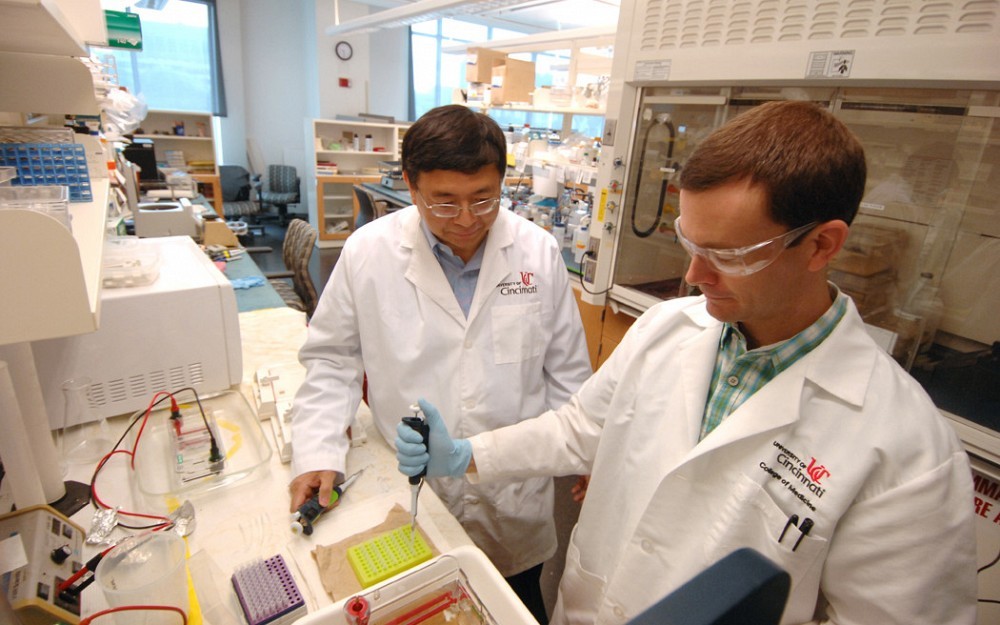
"Breast tumors are moving targets because they are really versatile, says Jun-Lin Guan, PhD, Francis Brunning Professor and Chair of the Department of Cancer at the UC College of Medicine and member of both the Cincinnati Cancer Center and UC Cancer Institute who co-authored the paper with postdoctoral fellow Syn Kok Yeo, PhD. "If you use a treatment thats targeting one subtype, which kills one type of breast cancer, often the other kind will actually expand. That defeats the purpose of treatment.
Breast cancer cells differ by the types of molecular markers, some of which are found on their surface, which physicians can test to understand the characteristics of a patients cancer and devise the best treatment strategy. For example, women with the HER2+ breast cancer subtype generally have a poorer prognosis than those with the luminal A tumors because of how quickly the cells multiply. Often tumor samples are taken and screened for the most common markers present, but Guan and Yeos analysis of human and animal studies raise the possibility that overlapping subtypes are being missed.
They advocate for diagnostic testing to be combined with single-cell technologies, in which individual cells, rather than a collection, are screened for molecular markers. However, as they currently exist, single-cell approaches are expensive and require specialized expertise and so would not be realistic for regular patient screenings.
"What were talking about is still not widely used in practicetheres a gap between basic cancer research and the clinics that do the diagnoses, Guan says. "However, single cell technologies are advancing very quickly, so its possible that we can see them being used in the near future.
The researchers say that the co-existence of distinct breast cancer subtypes within tumors happen because a fraction of breast cancer cells retain many stem cell-like qualities and thus reserve the capability to easily change. This has been observed in human cancer cells and in rodent studies but has yet to be confirmed in patients. Single-cell analysis could assess whether this problem is common or rare in humans.
This work was supported by the National Institutes of Health.
Related Stories
Cancer Center plays key role in lab research, clinical trials for new pancreatic cancer drug
September 1, 2026

WLWT and WCPO highlighted the contributions of University of Cincinnati Cancer Center researchers that helped lead to the recent FDA approval of daraxonrasib, a new treatment for pancreatic cancer.
Cancer Center physician receives $150,000 New Investigator Research Grant to study treatment-resistant leukemia
September 1, 2026
The University of Cincinnati Cancer Center’s Sarah Skuli, MD, PhD, received a two‑year, $150,000 Leukemia Research Foundation New Investigator Grant to study TP53‑mutated leukemia, a treatment‑resistant subtype with very poor outcomes.
Heavy social media use linked to depression
August 31, 2026

U.S. News and World Report, Yahoo! News, MSN, USA Today and other national media highlight a new study by the University of Cincinnati and Northwestern University that found a correlation between heavy social media use and depression in adults.