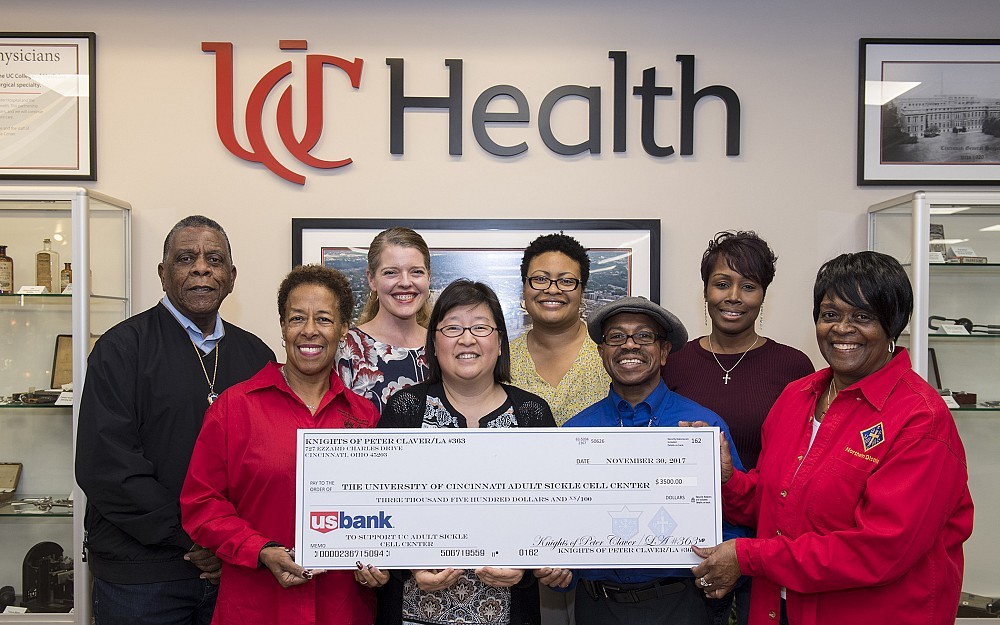
Knights of Peter Claver Raise Funds for UCMC Adult Sickle Cell Center

The Knights of Peter Claver and Ladies Auxiliary St. Joseph of the West End Council/Court 363 in Cincinnati have donated $3,500 to the Adult Sickle Cell Center at University of Cincinnati Medical Center (UCMC). The funds were raised during a Sept. 30 gala dedicated to raising awareness about sickle cell at the Crowne Plaza Hotel in Blue Ash.
"Sickle Cell is a charity that the Knights of Peter Claver supports nationally, said Ronald Garvin, who is a grand knight in the fraternal organization. "Here in Cincinnati we got together to try to do something on our own to help individuals with the disease.
Garvin along with Reginald Lee and Tommie Pritchett, co-chairs of the Knights of Peter Claver, and Denise Stockstill, who represented the Ladies Auxiliary St. Joseph of the West End Council/Court 363, presented a check to Hyon Kim, MD, director of the Adult Sickle Center at UCMC, and Tiffiny Diers, MD, associate professor of internal medicine in the UC College of Medicine.
Erica Sanderson was on hand to represent the support group for individuals with sickle cell disease known as Supportive Community of Educators Living Life (SCELL).
The Blue Ash gala, "Overcoming Lifes Daily Challenges attracted more than 125 people and allowed physicians to discuss sickle cell and adults living with the disease to share their personal struggles with the illness. Sickle cell disease (SCD) describes a group of inherited red blood cell disorders. People with SCD have abnormal hemoglobin, called hemoglobin S or sickle hemoglobin, in their red blood cells, according to the website of the National Heart, Lung and Blood Institute (NHLBI).
The genetic disease is most common among people of African and Mediterranean descent and affects 90,000 to 100,000 individuals nationally, according to the Centers for Disease Control and Prevention (CDC).
Sickle hemoglobin can form stiff roads within the red blood cell changing it into a crescent or sickle shape. Sickle-shaped cells are not flexible and can stick to vessel walls, causing a blockage that slows or stops the flow of blood and that happens oxygen cant reach nearby tissues, according to the NHLBI website.
The lack of tissue oxygen can cause attacks of sudden, severe pain, called pain crises. These pain attacks can occur without warning, and a person often needs to go to the hospital for effective treatment, according to the NHLBI website.
People who have SCD inherit two abnormal hemoglobin genes, one from each parent, according to the NHLBI. Individuals with just one gene have sickle cell trait and usually dont have any symptoms of sickle cell disease, but can pass their genetic background to their children, according to the CDC.
Kim, also an assistant professor in the Division of Hematology Oncology at the UC College of Medicine, said about one in 10 African-Americans Greater Cincinnati carry the sickle cell trait and that health systems in the region treat about 650 patients. At UCMC about 200 patients are treated at the Adult Sickle Cell Center.
"The population is not as large as those affected by diabetes or heart disease, but there is a lot of pain for many individuals and some patients have frequent hospitalizations and emergency department visits so sickle cell still affects our community in a big way, said Kim.
Individuals are typically diagnosed at birth as a result of universal newborn screening in the United States. Sickle cell disease is considered a life-long disorder.
"One of the biggest challenges for adults with sickle cell is having gainful employment and because of the illness you cant work as much as you should, said Sanderson, who has been part of SCELL for the past two years. "The bills pile up and some have it worse than others.
SCELL meets monthly and offers support and advocacy for individuals with sickle cell, said Sanderson.
Kim said possible treatments for sickle cell include a bone marrow transplant, but it is usually reserved for younger patients and has some risks. Physicians treat sickle cell patients from birth to early age with antibiotics to prevent infections such as pneumonia and offer pain-relieving medications during sickle cell crises.
Blood transfusions for sickle cell patients are also a possibility, but research for a cure continues, said Kim.
Related Stories
Cancer Center plays key role in lab research, clinical trials for new pancreatic cancer drug
September 1, 2026

WLWT and WCPO highlighted the contributions of University of Cincinnati Cancer Center researchers that helped lead to the recent FDA approval of daraxonrasib, a new treatment for pancreatic cancer.
Cancer Center physician receives $150,000 New Investigator Research Grant to study treatment-resistant leukemia
September 1, 2026
The University of Cincinnati Cancer Center’s Sarah Skuli, MD, PhD, received a two‑year, $150,000 Leukemia Research Foundation New Investigator Grant to study TP53‑mutated leukemia, a treatment‑resistant subtype with very poor outcomes.
Heavy social media use linked to depression
August 31, 2026

U.S. News and World Report, Yahoo! News, MSN, USA Today and other national media highlight a new study by the University of Cincinnati and Northwestern University that found a correlation between heavy social media use and depression in adults.