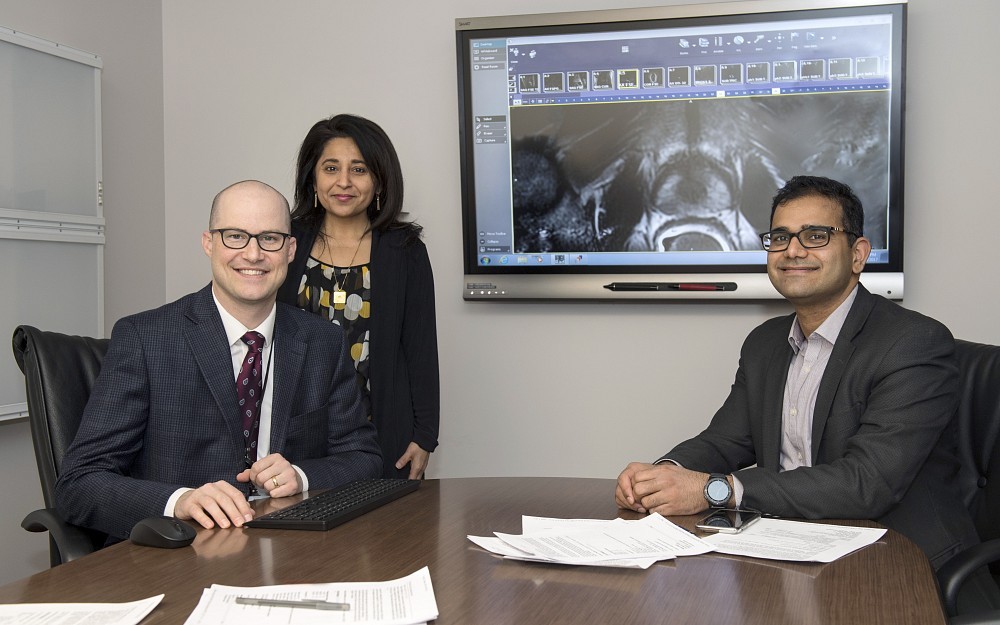
Multidisciplinary Prostate Cancer Clinic Educates Patients, Gives Options

CINCINNATIHaving choices is a good thing, in most cases, but in health care, "the doctor knows best is oftentimes an accepted standard, eliminating choices for patients and their families.
This is why Abhinav Sidana, MD, assistant professor of surgery in the Division of Urology, and Timothy Struve, MD, assistant professor in the Department of Radiation Oncology, both at the University of Cincinnati (UC) College of Medicine, members of the UC Cancer Institute and UC Health physicians, have created a multidisciplinary prostate cancer clinic for patients to learn about options for treatment and make a decision based on what works best for them.
Sidana says this model is the first-of-its-kind locally.
"Prostate cancer, while the most common cancer in men in the United States, after skin cancer, is a slow growing cancer, he says. "Most men with prostate cancer are older than 65 years and do not die from the disease; it is not like other cancers in that there is an urgency to remove or treat the cancer, and in some cases, active surveillance is all that is needed for an extended amount of time. Since someone could live 20 to 30 years after their diagnosis, we want them to be able to weigh all of their options before either jumping into surgery or radiation without realizing that there were other choices available.
Sidana and Struve along with Sadhna Verma, MD, adjunct professor in the Department of Radiology at the UC College of Medicine, meet on Fridays to review each patients case before they are seen in the UC Health Barrett Cancer Center, the primary adult outpatient treatment facility of the UC Cancer Institute.
"Dr. Verma is known internationally as a leader in multi-parametric magnetic resonance imaging scans for cancer detection and MRI as a guidance tool for prostate biopsies, Sidana says. "These tools can help physicians decide whether to remove or spare delicate neurovascular bundles that surround the prostate gland. Our team reviews the patients clinical history, images and histology to determine the eligibility for certain treatmentsprimarily, treatment for cancer patients involves surgery or radiation. We ultimately let the patient make that decision and help them weigh the pros and cons of each option. However, there are clinical trials and other outside of the box treatment options as wellwe want them to know about them all.
Sidana says focal therapy, an emerging treatment for targeted, localized prostate cancer, is also being offered.
"Its similar to a lumpectomy in breast cancer, he says.
Sidana says he and Struve see each patient for an hourSidana explains options involving surgery for half of the time and Struve explains radiotherapy options for the remainder of the visit. The patient has opportunities to ask questions and come to a decision about his treatment plan and is sent home with educational materials.
"We plan to add a pathologist and medical oncologist to our team, Sidana says, adding that clinic is held from 1 to 4 p.m. on the third Friday of every month. "We are excited to be offering this unique clinic locally, to serve as a portal for giving patients control over their care plan and making the best decision for their lifestyle.
To schedule an appointment, call 513-475-8787.
Related Stories
Cancer Center plays key role in lab research, clinical trials for new pancreatic cancer drug
September 1, 2026

WLWT and WCPO highlighted the contributions of University of Cincinnati Cancer Center researchers that helped lead to the recent FDA approval of daraxonrasib, a new treatment for pancreatic cancer.
Cancer Center physician receives $150,000 New Investigator Research Grant to study treatment-resistant leukemia
September 1, 2026
The University of Cincinnati Cancer Center’s Sarah Skuli, MD, PhD, received a two‑year, $150,000 Leukemia Research Foundation New Investigator Grant to study TP53‑mutated leukemia, a treatment‑resistant subtype with very poor outcomes.
Heavy social media use linked to depression
August 31, 2026

U.S. News and World Report, Yahoo! News, MSN, USA Today and other national media highlight a new study by the University of Cincinnati and Northwestern University that found a correlation between heavy social media use and depression in adults.