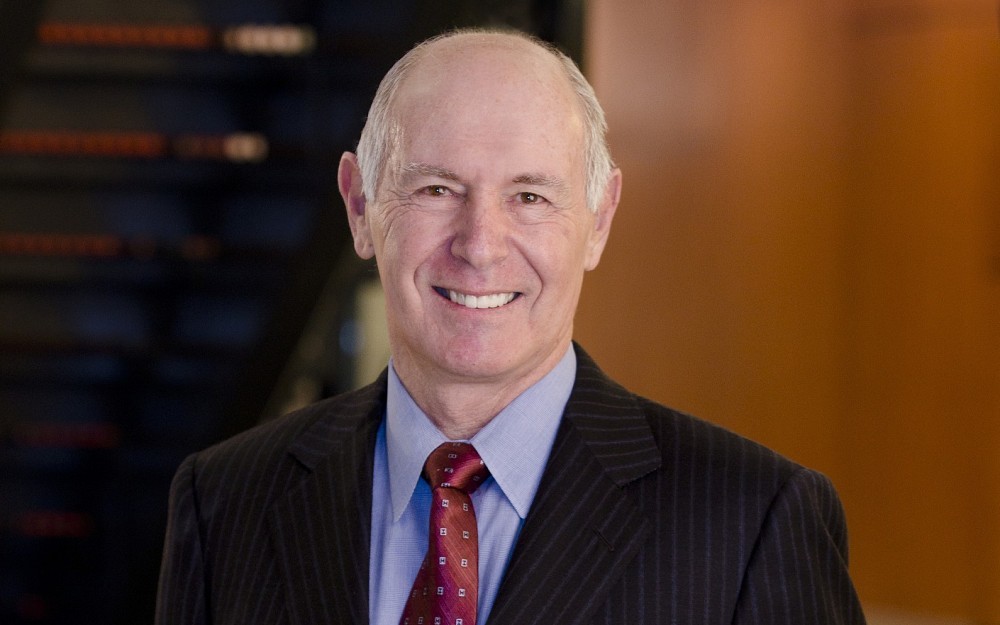
Hoxworth Director Leaving Behind a Legacy of Research and Growth

After more than 17 years as the director of the University of Cincinnati (UC) Hoxworth Blood Center, Ronald Sacher, MD, professor of internal medicine and pathology at the UC College of Medicine, is stepping down effective Jan. 31, 2018. During his tenure, he fostered a mission of Hoxworth enhancing the well-being of patients in the community by assuring a reliable and economical supply of the safest possible blood while also providing innovative hematotherapy services and promoting research and education programs in transfusion medicine.
Before coming to Hoxworth, Sacher served as chairman of the department of laboratory medicine at Georgetown University, where he started a stem cell engineering lab and was interested in exploring other therapies that a blood center could implement. Shortly after arriving in 2000, Sacher reorganized the research components of Hoxworth, focusing on red cell preservation research. He even served as interim dean of the UC College of Medicine from Sept. 7, 2004 through July 31, 2005.
Sacher developed and facilitated expansion of the Hoxworth clinical trials program and made investments in the cellular engineering, cell therapy and regenerative medicine programs.
"Im really proud of our research division and our Cellular Therapy and Regenerative Medicine Division, says Sacher. "Im proud of the fact that weve diversified and maintained our academic activities, rather than being solely a community blood bank. There are a number of community blood banks and what makes us special for one is we are the only blood center thats owned and operated by a university.
An announcement on new leadership at Hoxworth is expected soon.
"I feel comfortable that Im leaving Hoxworth in a positive mode and I think that there really needs to be new blood taking over from me, Sacher says.
Under Sachers guidance, Hoxworth donor frequency increased from 1.63 donations per donor per year to 1.78 donations per donor per year. For every 10,000 donors, that means an additional 1,200 units from reliable donors. From 2004 to 2017, Hoxworth blood drives increased 25 percent, from 1,201 to 1,500 annually.
Hoxworths donor diversity also increased during Sachers stewardship. From 2001 to 2017, gains were made in the percentage of donations coming from minority groups.
The Transplantation Immunology Division at Hoxworth saw dramatic increases in several areas from 2001 to 2017. The average test volume per month jumped from 800 to 3,500 while the monthly revenue increased 420 percent.
From 2001 to 2017, Hoxworths Cellular Therapies Division saw increases of 100 percent or more in the number of transplant programs served, the number of transplants supported annually and the number of employees.
Research dollars and revenue also saw major increases during Sachers 17 years as Hoxworth director. Research Division awards went from less than $500,000 in 2001 to nearly $2 million in 2017 while total revenue jumped from just over $25 million to more than $43 million.
Sacher may be leaving his day-to-day duties at Hoxworth behind, but he doesnt have a rocking chair on a porch in a cabin in the woods in his near future. He plans to maintain his clinical practice and continue to give lectures and teach.
"I think this is the most exciting time in medicine ever because of the explosion of informatics and the ability to analyze big data, Sacher says. "Another fascinating area is mining of the human genome, particularly in cancer, where there are new and novel therapies that are emerging. Researchers are manipulating the immune system. I think thats an area that is just really exploding day by day.
Sacher will also keep busy in his role as president of the American Clinical and Climatological Association (ACCA). "The ACCA is a multidisciplinary organization of people who have leadership in American medicine, says Sacher. "Its a very prestigious organization. This is truly one of the highlights of my career.
Related Stories
Cancer Center plays key role in lab research, clinical trials for new pancreatic cancer drug
September 1, 2026

WLWT and WCPO highlighted the contributions of University of Cincinnati Cancer Center researchers that helped lead to the recent FDA approval of daraxonrasib, a new treatment for pancreatic cancer.
Cancer Center physician receives $150,000 New Investigator Research Grant to study treatment-resistant leukemia
September 1, 2026
The University of Cincinnati Cancer Center’s Sarah Skuli, MD, PhD, received a two‑year, $150,000 Leukemia Research Foundation New Investigator Grant to study TP53‑mutated leukemia, a treatment‑resistant subtype with very poor outcomes.
Heavy social media use linked to depression
August 31, 2026

U.S. News and World Report, Yahoo! News, MSN, USA Today and other national media highlight a new study by the University of Cincinnati and Northwestern University that found a correlation between heavy social media use and depression in adults.