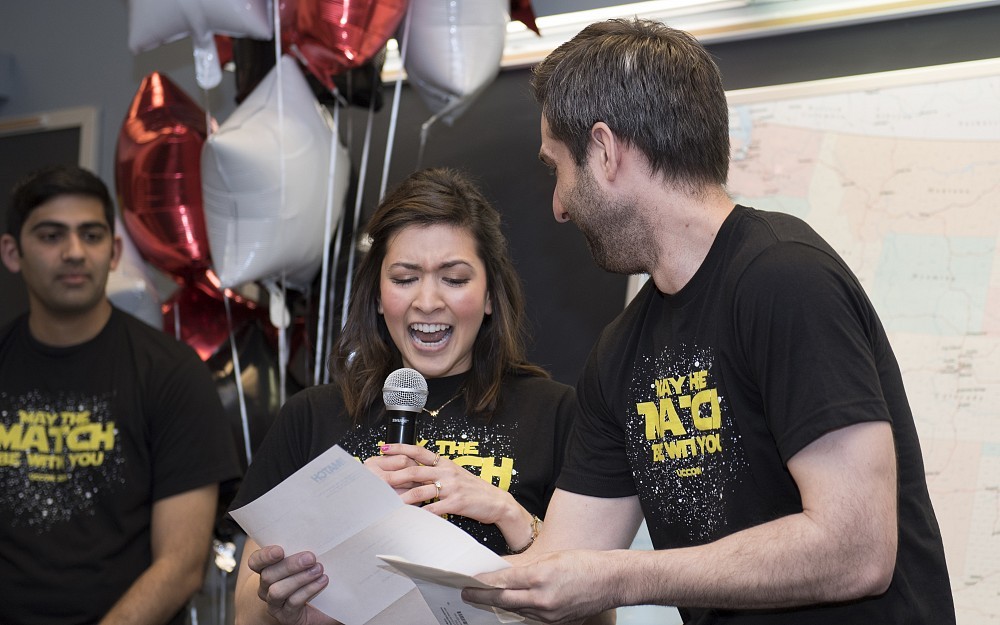
UC College of Medicine Results Are in For Match Day 2018

Ryan Gamlin, 37, of Antioch, Illinois, got his first choice.
He will spend the next four years in residency training in anesthesiology at Ronald Reagan UCLA Medical Center. Gamlin was among the fourth-year medical students at the University of Cincinnati (UC) College of Medicine who learned Friday afternoon where they will do their residencies in medicine.
"The suspense is not easy, said an excited Gamlin, who held his 3-year-old son, Soren. "When you finally hear your name its a welcomed moment because you know it is all going to end either way. I opened the envelope and I was glad it ended the way it did.
Fourth-year medical students at the UC College of Medicine joined students at medical schools around the country to learn where they will spend anywhere from three to seven years in residency training. It was all part of Match Day, an annual event managed by the National Residency Matching Program (NRMP), which pairs the preference of medical students with those of residency programs to create optimal matches.
"We are extremely excited for our class of 2018, said Aurora Bennett, MD, associate dean of student affairs in the UC College of Medicine. "They had wonderful match results with many of them going to top programs in the country and certainly their top choices. A hundred percent of our couples got to stay together in the same vicinity, which is a wonderful day. We are very proud of our students.
Results from UC indicate that:
Of the 146 matched students, 29 will do at least part of their residency in Greater Cincinnati.
Of those, 10 will do their residency at University of Cincinnati Medical Center and seven will complete pediatric residency at Cincinnati Childrens. The rest matched at Jewish, Christ, Good Samaritan, and Bethesda.
The most popular primary residency for UC students was pediatrics with 20 students and family medicine with 19 students. Other popular matches included internal medicine with 17 students for primary residency and anesthesiology with 16 students.
Some specialties require students to complete preliminary residencies of one or two years of training prior to entering an advanced period of specialty training. These preliminary residences may also be counted in the final Match Day tally.

Taylor Kantor, a fourth-year medical student, matched into thoracic surgery at University of Michigan Hospitals during Match Day 2018.

Jonathan Etter, a fourth-year medical student, matched into physical medicine and rehabilitation at the University of Michigan in Ann Arbor. He is joined by his wife Alison and their young son, JM.

Michael Zhou is going to Rush University Medical Center for Radiation Oncology. He was joined during UC Match Day 2018 by his fiancée, Sarah Vore, who will be going to Northwestern University and Ann & Robert H. Lurie Children's Hospital for pediatrics.

College of Medicine Dean William Ball pulls the first envelope during UC Match Day 2018. Aurora Bennett, MD, and Bruce Giffin, PhD, look on.

Fourth-year medical student Juline Asamoah (far right) matched into internal medicine pediatrics at Wayne State University/Detroit Medical Center during UC Match Day 2018.
Related Stories
Cancer Center plays key role in lab research, clinical trials for new pancreatic cancer drug
September 1, 2026

WLWT and WCPO highlighted the contributions of University of Cincinnati Cancer Center researchers that helped lead to the recent FDA approval of daraxonrasib, a new treatment for pancreatic cancer.
Cancer Center physician receives $150,000 New Investigator Research Grant to study treatment-resistant leukemia
September 1, 2026
The University of Cincinnati Cancer Center’s Sarah Skuli, MD, PhD, received a two‑year, $150,000 Leukemia Research Foundation New Investigator Grant to study TP53‑mutated leukemia, a treatment‑resistant subtype with very poor outcomes.
Heavy social media use linked to depression
August 31, 2026

U.S. News and World Report, Yahoo! News, MSN, USA Today and other national media highlight a new study by the University of Cincinnati and Northwestern University that found a correlation between heavy social media use and depression in adults.