Cancer Clinical Trial Coordinators Head to Medical School

Clinical trials can offer patients a chance to improve their health or quality of life and offer physicians clues to advancements in treatment.
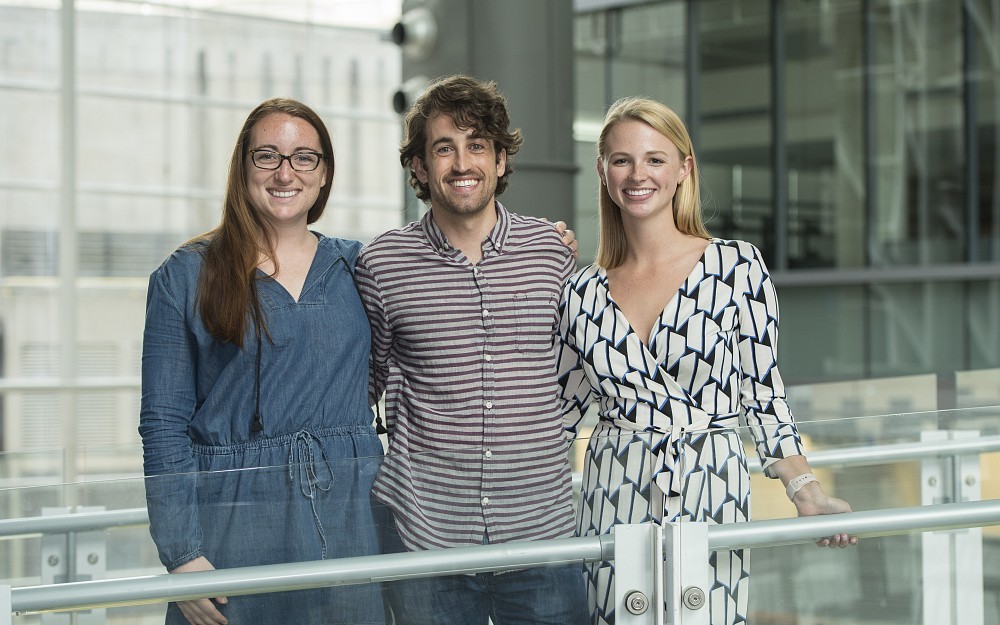
For University of Cincinnati (UC) Cancer Institute Clinical Trials Coordinators Jenna Braun, 23, Camden Martin, 26, and Audrey McCartney, 23, clinical trials and the work they do offered a pathway that inspired them to pursue their passion of practicing medicine.
Braun, Martin and McCartney will leave their UC jobs this summer and begin their journeys as medical students. Braun will attend Boonshoft School of Medicine at Wright State University, Martin will attend Ohio State Universitys College of Medicine and McCartney will attend UC College of Medicine.
"Individuals who interview for the clinical trials office often have different aspirations, says Trisha Wise-Draper, MD, PhD, assistant professor in the Division of Hematology Oncology at the UC College of Medicine and clinical research director of the UC Cancer Institute. "We have some employees who plan to pursue a career in coordinating clinical trials, but some use the position as a stepping stone, which we do our best to facilitate in order for them to achieve their goals. We are all very proud that all three employees who applied to medical this year were accepted. We wish them our best."
Jenna Braun
Braun, a Cincinnati native with a bachelors degree in food and nutrition science from Ohio University (OU), hopes to pursue a career as a pediatrician. She started her job with the UC Cancer Institutes Clinical Trials Office in August, but she said very excited to start this new career path.
"I did a lot of community research at OU, and Im really looking forward to doing more clinical research, she says. "I didnt have any expectations when I started this job, but Im leaving with a knowledge about how to interact with patients and deal with a big hospital system.
"Its really important to put the patients first.
Braun works with patients who have head and neck cancer, and she says shes learned so much just by her daily interaction with them.
"I just dont know how these people who are coming for so many doctors visits and are dealing with so much stay so positive, she says. "Its inspiring.
Braun adds that her time with the clinical trials office has taught her to multitasksomething shell certainly need to do in medical school.
"I had such a fantastic mentor in Dr. (Trisha) Wise-Draper, she says, adding that Muhammad Kashif Riaz, MD, and Lisa Gebhart, a certified nurse practitioner, were huge supporters as well. "Work in the clinical trials office is having 100 little things, but important things, to do and keeping them all straight. It was definitely a learning experience in time management.
Camden Martin
Martin, a San Diego native who first received a bachelors degree in art history at Vanderbilt University and then a masters degree in physiology at UC, took a non-traditional route to medicine.
But his desire to purse it as a career was based on personal experiences.
"I have chronic kidney disease, which I was diagnosed with at the age of 14, he says, adding that he had both positive and negative experiences with physicians and their treatment of him as a patient and a person throughout the years. "I remember when I finally had a physician sit down on my bed and look me in the eye and actually talk to me about my condition and treatment, and it really just struck me. That is what a physician is supposed to be, and that is the type of physician I want to bea doctor who is truly empathetic.
Martin says he chose art history because hed always loved it and knew that college would be the only time in his life hed be able to pursue it. But he feels that this part of his training can also be applied to medicine.
"It teaches you how to take in the whole picture, he says. "Things arent always black and white in medicine; theres an uncertainty. Art history teaches you how to observe, much like you have to do in medicinetaking in the details about a patients medical history or symptoms.
Martin also didnt get his acceptance letter to medical school on his first try, but he didnt give up, and decided instead to purse his masters degree and "prove he could succeed in the sciences.
He joined the UC Cancer Institute Clinical Trials office in November 2017 and has worked with patients at the Cincinnati Childrens/UC Health Proton Therapy Center since then.
"It has just been amazing to be around that fascinating technology, he says. "The Proton Therapy Center is only one of about 26 facilities of its kind in the country, and has the countrys only research gantry. Its a great opportunity to learn about the future of radiation oncology. Oh and I also learned a lot about insurance.
Martin hopes to pursue nephrology or urology, but his options are open. One thing is for sure, though, his time with the Clinical Trials Office will always stick with him.
"The patient interactions are what will stay with me, he says. "I had a patient who completed treatment at the Proton Therapy Center who came up to me and told me how much my daily greetings and our quick conversations during each treatment meant so much; the person even wrote me a thank you card. It taught me that every interaction matters.
Audrey McCartney
McCartney, a Cincinnati native with a bachelors of arts degree in history from Dartmouth, says she already had some cancer research experience under her belt when she applied to medical school.
"Id worked in a lab that was looking at oxygen levels in solid tumors during my time as an undergraduate, she says.
However, she wanted to gain more experience in clinical research, and so, as a gap year between the Medical College Admissions Test and applications, she decided to apply for a job in the UC Cancer Institutes Clinical Trials Office.
McCartney, who has been in the UC Cancer Institutes Clinical Trials Office for about a year and a half, says that working at UC showed her the strength of its medical program, and she knew she wanted to stay close to home, so shes thrilled to be a Bearcat.
Currently, shes working with patients in the Brain Tumor Center.
"Ive loved working with this patient population and the ins and outs of the disease, she says. "Dr. (Rekha) Chaudhary has been wonderful to work withshe even wrote me a letter of recommendation for medical schooland I just know shes going to be a life-long mentor. Im looking forward to being able to learn from and work more closely with physicians Ive met in my time here.
McCartney mirrors her colleagues sentiments about the impact patient interaction has had on her.
"Ive really been able to work on my patient interaction skills and to figure out how to say the appropriate things, she says. "Ive seen how patients really hang on the words of their physicians, and Ive learned that its important to choose your words wisely.
She adds that shes also learned a lot about the behind the scenes work needed to run clinical trials.
"There are a lot of rules and regulations, she says.
Rachel Podell, a first-year student at the UC College of Medicine who also worked in the UC Cancer Institutes Clinical Trials Office for roughly a year before leaping into medical school, can attest that this work easily translates into what shes learning now.
"Working in the clinical trials office exposed me to many things I have already encountered in medical school, she says. "We start learning about cancer processes pretty early on in our education, and having had some experiences with cancer patients helped reinforce my classroom learning.
"I worked mainly on the data team in the office, and through that work, I learned a lot about specific cancer types and treatments, some of which I have already learned about in school. Its so interesting to me to see the connection.

UC Cancer Institute Clinical Trials Coordinators Jenna Braun, 23, Camden Martin, 26, and Audrey McCartney, 23, will begin their journeys as medical students this summer.
Related Stories
Cancer Center plays key role in lab research, clinical trials for new pancreatic cancer drug
September 1, 2026

WLWT and WCPO highlighted the contributions of University of Cincinnati Cancer Center researchers that helped lead to the recent FDA approval of daraxonrasib, a new treatment for pancreatic cancer.
Cancer Center physician receives $150,000 New Investigator Research Grant to study treatment-resistant leukemia
September 1, 2026
The University of Cincinnati Cancer Center’s Sarah Skuli, MD, PhD, received a two‑year, $150,000 Leukemia Research Foundation New Investigator Grant to study TP53‑mutated leukemia, a treatment‑resistant subtype with very poor outcomes.
Heavy social media use linked to depression
August 31, 2026

U.S. News and World Report, Yahoo! News, MSN, USA Today and other national media highlight a new study by the University of Cincinnati and Northwestern University that found a correlation between heavy social media use and depression in adults.