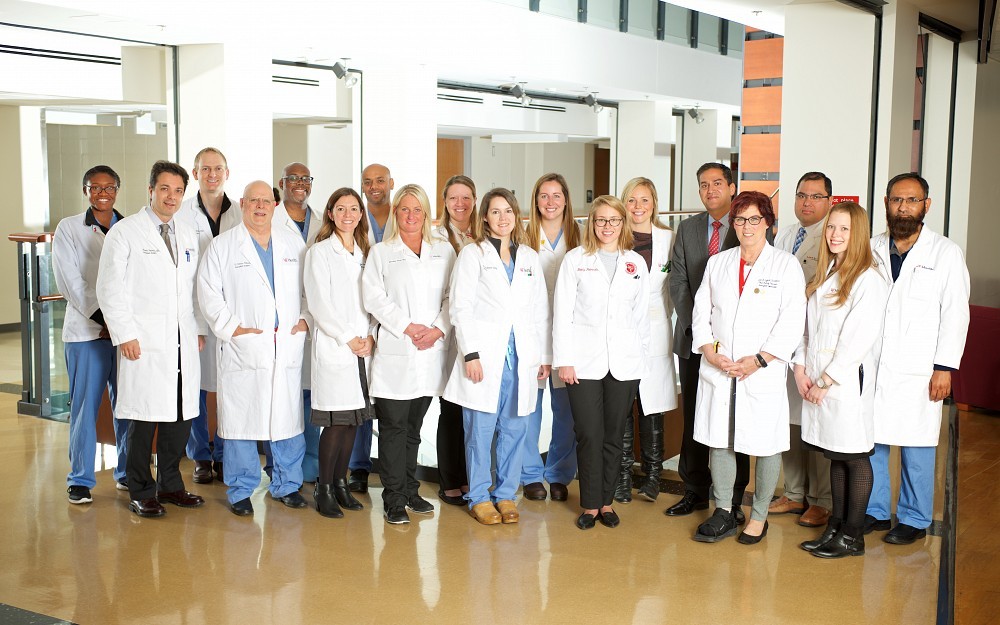
UC Research Widely Represented at 2018 American Transplant Congress

For decades, the University of Cincinnati (UC) College of Medicine Transplant Program has broken new ground in the field of organ transplantation through research that has significantly advanced the field and through outstanding clinical activities and patient care.
That performance continues at the 2018 American Transplant Congress, the annual gathering of the top scientific and clinical minds in the field of transplant science. UC physician researchers will present academic and clinical research in several different areas, including seven ongoing research projects in the field of immunosuppression and anti-rejection medication, a field in which UC is known as a leading research facility. The American Transplant Congress is June 2-6 in Seattle, Washington.
"Our strength is not only in the number of presentations, but also in the quality and diversity of research our teams will present at the American Transplant Congress, said E. Steve Woodle, MD, director of solid organ transplantation within UC Health and holder of the William A. Altemeier Endowed Chair in Surgery at the UC College of Medicine.
UC investigators had 17 abstracts accepted for presentation by junior and senior investigators across six areas of research: immunosuppressive drug development, Hepatitis C, outcomes research, metabolic surgery in transplant patients, transplantation oncology and immunobiology.
These include the first-ever public disclosure of the BEST trial, a prospective, randomized, controlled, multi-center trial sponsored and coordinated by UC investigators Woodle; Rita Alloway, PharmD, research professor in the Division of Nephrology and Hypertension, Department of Internal Medicine; and Adele Rike Shields, PharmD, research associate professor in the Department of Surgery.
This study sets a historic precedent in the field, Woodle says. Utilizing the drug belatacept, researchers were able to demonstrate that an immunosuppressive regimen free of calcineurin inhibitors and corticosteroids resulted in similar efficacy without the negative effects of standard immunosuppressive drug regimens.
Calcineuin inhibitors are potent immunosuppressants, but they can have adverse events such as kidney toxicity, and increased blood sugar, blood pressure and cholesterol. Belatacept is a protein that works by blocking the interactions between cells that can cause a persons immune system to reject a transplanted organ.
"We are proud to present this milestone in transplant immunosuppression, which demonstrates that calcineurin inhibitors and corticosteroids can be safely and effectively eliminated simultaneously, Woodle says. "The BEST trial brought together considerable immunobiology expertise from UC and Cincinnati Childrens Hospital Medical Center and clinical research expertise, allowing us to achieve this important breakthrough.
UC researchers will also present new advancements they have made regarding Hepatitis C and transplantation and about new therapies that target plasma cells as a means of eliminating antibody-mediated rejection, which is the major cause of rejection among kidney transplant recipients.
Related Stories
Cancer Center plays key role in lab research, clinical trials for new pancreatic cancer drug
September 1, 2026

WLWT and WCPO highlighted the contributions of University of Cincinnati Cancer Center researchers that helped lead to the recent FDA approval of daraxonrasib, a new treatment for pancreatic cancer.
Cancer Center physician receives $150,000 New Investigator Research Grant to study treatment-resistant leukemia
September 1, 2026
The University of Cincinnati Cancer Center’s Sarah Skuli, MD, PhD, received a two‑year, $150,000 Leukemia Research Foundation New Investigator Grant to study TP53‑mutated leukemia, a treatment‑resistant subtype with very poor outcomes.
Heavy social media use linked to depression
August 31, 2026

U.S. News and World Report, Yahoo! News, MSN, USA Today and other national media highlight a new study by the University of Cincinnati and Northwestern University that found a correlation between heavy social media use and depression in adults.