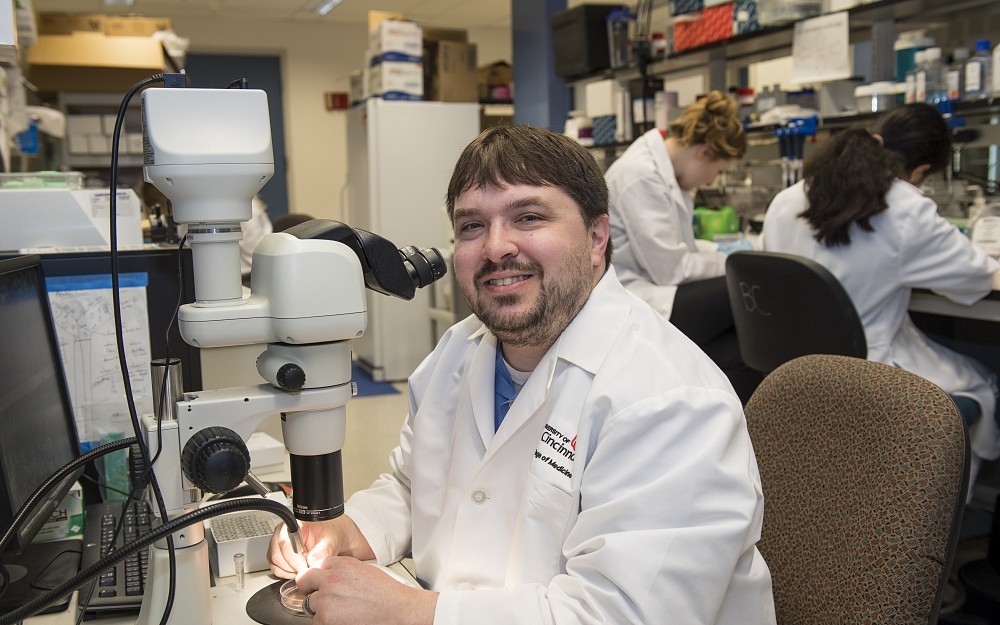
UC Scientist Receives $2 Million Grant to Study Atherosclerosis

CINCINNATIResearch scientist Phillip Owens III, PhD, hopes to find a better treatment for a leading cause of heart disease by unlocking how a cell associated receptorprotease-activated receptor 2 (PAR2) elicits cellular change and inflammation leading to atherosclerosis.
"Atherosclerosis, the narrowing of arteries because of the build-up of fats and cholesterol, is a major cause of coronary heart disease, stroke, heart attack and chronic kidney disease, explains Owens, assistant professor in the University of Cincinnati (UC) College of Medicines Division of Cardiovascular Health and Disease.
"Each year an estimated 17.7 million people die of cardiovascular diseases, says Owens. "More than 7.4 million deaths worldwide, representing 13 percent of all global deaths, are attributed to atherosclerotic disease. Even with our advances in treating coronary artery disease the number of atherosclerotic-related deaths is expected to surpass 10 million by 2030 due to an increase in the elderly population and because our increasingly poor lifestyle choices. Novel pharmaceutical targets and therapies need to be the focus of the scientific and medical community.
Owens is the principal investigator on a $2 million five-year grant from the National Heart, Lung and Blood Institute (NHLBI) of the National Institutes of Health (R01HL141404) to advance our knowledge of PAR2 and its role in atherosclerosis. "PAR 2 is involved in a lot of immunologic processes, says Owens. "It is tied to rheumatoid arthritis, sickle cell disease and other inflammatory disorders so it is not surprising it plays a role in atherosclerosis.
Previous studies have demonstrated high cholesterol significantly increases the risk of arterial thrombosis via modification of coagulation proteins, says Owens, who is a member of UC Heart, Lung and Vascular Institute.
These effects occur through oxidation of lipoproteins and subsequent uptake or activation by inflammatory signaling receptors, explains Owens. Tissue factor (TF), the cellular activator of the clotting cascade, is upregulated via oxidized lipoproteins induced by the inflammatory state in atherosclerotic plaques. This allows for accumulation and concentration of TF in atherosclerotic lesions. Importantly, while TF can create a thrombotic event via plaque rupture and exposure to blood; TF can also activate and signal through PAR2, says Owens.
Owens says his laboratory has presented extensive preliminary studies demonstrating PAR2 signaling results in vascular smooth muscle cell (VSMC) growth and proliferation into a myeloid cell as a result of signaling and activation of the transcription factor, krüppel-like factor 4 (KLF4) and the RNA binding protein human antigen R (HuR).
"Our central hypothesis is that PAR2 regulates VSMC-mediated pathology in atherosclerosis, says Owens. "Studies demonstrate the coagulation protein tissue factor is abundantly expressed in atherosclerotic lesions and is correlated with increased severity of disease. PAR 2 is also abundantly expressed in atherosclerotic lesions.
The NHLBI grant will further our understanding of the molecular mechanisms that promote the initiation and progression of atherosclerosis, says Owens. "Ultimately, we hope this will result in improved treatment regiments for patients.
Related Stories
Heavy social media use linked to depression
August 31, 2026

U.S. News and World Report, Yahoo! News, MSN, USA Today and other national media highlight a new study by the University of Cincinnati and Northwestern University that found a correlation between heavy social media use and depression in adults.
On-site training in Speech & Hearing Clinic sets UC’s programs apart
August 27, 2026
At the University of Cincinnati’s Speech & Hearing Clinic, Doctor of Audiology and Speech-Language Pathology graduate students gain real-world experience while providing free speech and hearing services to the community.
Designing with cancer patients' needs in focus
August 27, 2026
Kristina Shin is designing garments that prioritize the comfort, function and confidence of breast cancer patients, addressing a need often overlooked by traditional fashion.