
Smithsonian: A brief history of the Cozy Coupe
Invented by a UC grad, the foot-powered kids toy still outsells engine-powered cars

Can you name the best-selling cars of all time? Think about them carefully. Made your picks? Well, you probably missed an important one — with a University of Cincinnati connection.
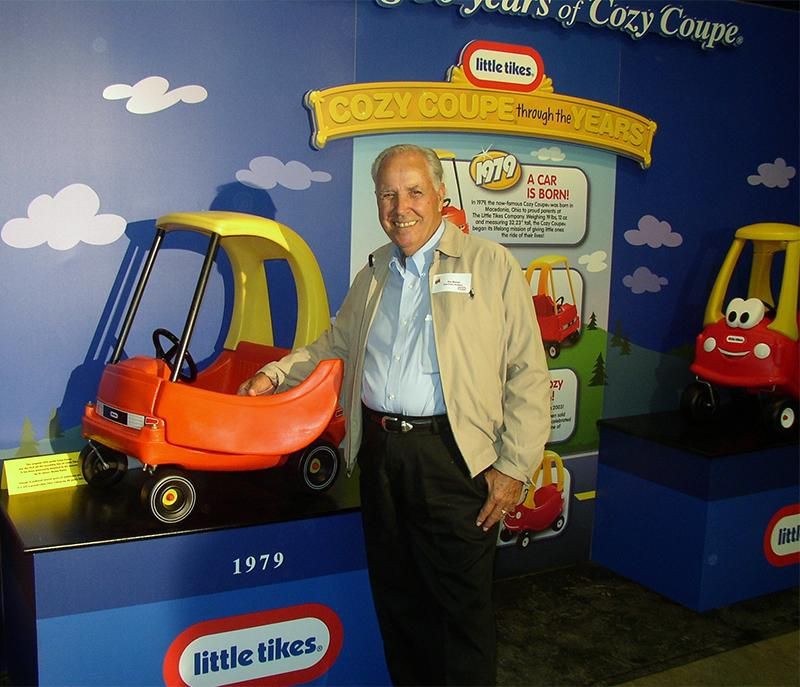
UC grad Jim Mariol poses with an original 1979 Cozy Coupe at the Macedonia Preservation Facility of the Crawford Auto-Aviation Museum in Ohio. Photo/courtesy of Mariol family
Smithsonian magazine reports that while the top three spots worldwide are held by Toyota Corolla, Ford F-Series pickup and Volkswagen Golf, close behind them is Cozy Coupe. Yes, the “Flintstone“-like car produced for children by Little Tikes is a consistent top-seller, year in and year out.
In fact, Cozy Coupe outsold all engine-powered cars in Great Britain in March. More than 85,000 were purchased that month as parents faced the prospect of being trapped at home with energetic toddlers during the COVID-19 lockdown.
The little red car with the yellow roof that is propelled by foot power has been a hit with young children since its creation in 1979. Inventor Jim Mariol, a UC College of Design, Architecture, Art, and Planning alumnus who was granted a design patent for a “Toy Automobile” in 1982, was inspired to create the toy as he scooted around on his office chair one day. It was an “eureka” moment for the former automobile designer, who realized almost immediately that his functional yet fun car would be ideal for kids 18 months and older to scamper around in.
Mariol died earlier this year at age 89.
Related Stories
UC Foundation celebrates 2026 philanthropy winners
October 23, 2026
The University of Cincinnati Foundation recognized its Outstanding Philanthropic Volunteer Award honorees at the George Rieveschl Recognition Dinner on October 22, 2026.
UC expert explains potential impact of Pennsylvania’s new vape product law
October 22, 2026

UC professor Ashley Merianos speaks to the Pittsburgh Post-Gazette about Pennsylvania’s new vape law, youth vaping prevention, enforcement challenges and possible unintended consequences.
UC Biomedical Engineering student launches mobile healthcare platform
October 22, 2026
As a fifth-year biomedical engineering student at the University of Cincinnati College of Engineering and Applied Science, Amelia Wares has been a trailblazer in nearly every area imaginable — and this is only the beginning of her journey.