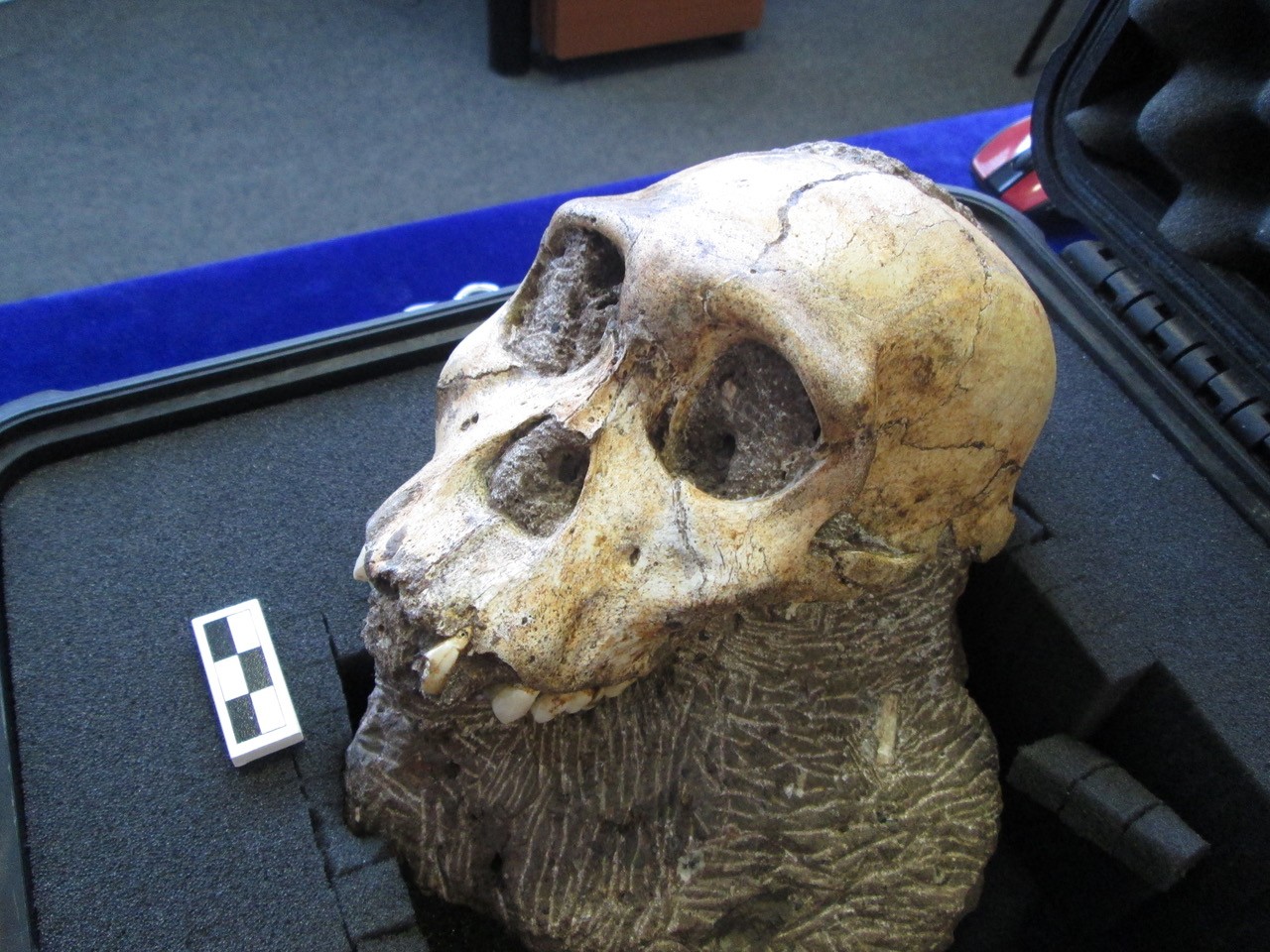
Forensic anthropologist to lecture on hominin findings

Event Information (passed)
Forensic anthropologist James Pokines will lecture on the “Forensic analysis of Australopithecus sediba remains from Malapa, South Africa” at 3:30 p.m., Friday Oct. 5. The lecture will be held at in Room 300 of Braunstein Hall on the University of Cincinnati's uptown campus.
Pokines is an assistant professor in the Department of Anatomy and Neurobiology at Boston University. He has 17 years of experience in the fields of forensic anthropology and archaeology. He wrote the “Manual of Forensic Taphonomy,” which covers the study of how bones record events between the time when the animal dies and its fossilization.
His research includes vertebrate osteology, zooarchaeology, taphonomy, and paleoecology, and he has ongoing archaeological projects in the Bolivian Andes and northern Jordan. Pokines is also the forensic anthropologist for the Commonwealth of Massachusetts, Office of the Chief Medical Examiner, Boston.
Pokines will be talking about an archeological site in Malapa, South Africa, where an early hominin species has been discovered. This finding is relevant to human biological and cultural evolution and provides insight into the history of the human species. The lecture is presented by the Geology department. All students, faculty and staff are invited to attend.
Related Stories
Colleges use 'Odyssey' as opportunity to promote Classics programs
July 24, 2026

Jack Davis, UC's Carl W. Blegen Professor of Greek Archaeology, spoke to the Chronicle of Higher Education about the Christopher Nolan-directed move "The Odyssey," which had the biggest box office showing of any live-action movie this year..
UC selected for federal initiative to use AI to advance scientific discovery
July 22, 2026

A University of Cincinnati project to protect sources of drinking water and identify valuable underground resources is part of a national initiative to harness artificial intelligence to speed scientific breakthroughs.
Ticks that survive pesticides can withstand colder winters
July 17, 2026

Ticks that survive less-than-lethal doses of pesticide are able to withstand dangerous cold, which could help them expand their range farther north, according to researchers at the University of Cincinnati and the U.S. Department of Agriculture.