UC developing test for hi/low risk in breast lesions

Currently, with a pre-malignant breast cancer diagnosis from a biopsy, there are three options: observation, chemoprevention or surgery, all of which require a patient to make decisions while operating from a place of fear and unknown outcomes. Some patients, for example, with early breast cancer indications, might choose to have mastectomies, rather than live in uncertainty, when the disease state may not have progressed.
That is why researchers at the University of Cincinnati (UC) are investigating a molecular diagnostic test to determine whether, after biopsy, someone is at high or low risk for actually developing malignant breast cancer.
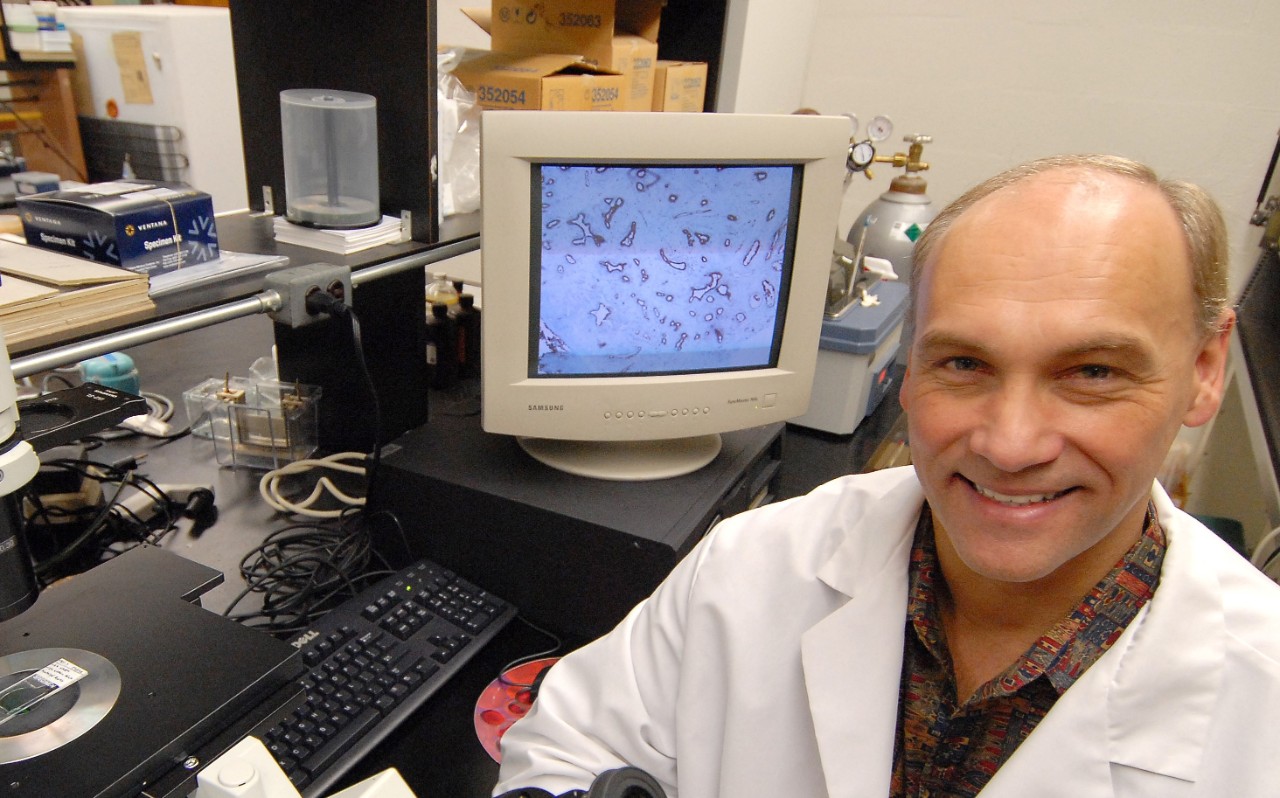
“The test aids in the decision whether to treat aggressively or wait,” says cancer researcher and principal investigator Georg Weber, MD, PhD, a professor at UC’s James L. Winkle College of Pharmacy.
The study, “Osteopontin and Premalignant Breast Lesions,” appears in the Oct. 24, 2018 issue of The British Journal of Cancer.
In the study, Weber, co-author Elyse Lower, MD, professor of medicine at the UC College of Medicine, director of the UC Cancer Institute’s Breast Cancer Center and UC Health oncologist, and colleagues at Wroclaw Medical University in Poland, analyzed variants of the biomarker Osteopontin (OPN) in 434 women with premalignant breast lesions.
From the sample, they determined that the presence of Osteopontin variants can very reliably assess the risk group a patient belongs to, thus aiding in the decision on how to proceed. “The value lies in being able to examine invasive potential,” says Weber, adding that prognostic biomarkers inform on the probable disease course while predictive biomarkers provide upfront information regarding how likely a patient is to benefit from a specific treatment, and hence may guide the choice of available therapies.
Weber attended medical school in Würzburg, Germany. He worked at the Dana-Farber Cancer Institute, Harvard Medical School from 1990 through 2000. He has published over 100 scientific reports, including many in the most respected professional journals, plus various monographs, including textbooks on molecular oncology and anti-cancer drugs. He holds eight patents and has additional applications pending. His research has made key contributions to understanding the molecular mechanisms of metastasis.
This research was funded by the Marlene Harris-Ride Cincinnati/Pilot Program. Biostatical support was provided by the University of Cincinnati Center for Clinical and Translational Science and Training (CCTST) with funding from the National Center for Advancing Translational Sciences of the National Institutes of Health (Award # 5UL1TR))1425-03).
The authors cite no conflict of interest.
Related Stories
President Pinto’s 2nd glow party brings first-year Bearcats together
September 20, 2026
UC President Neville Pinto and team hosted the second annual Bright Beginnings glow party for first-year students
Scholarships expand one student’s world and ‘pharmacy vision’
September 17, 2026
Fall campaign story - 2026 - James L. Winkle College of Pharmacy.
Record enrollment continues at the University of Cincinnati
September 9, 2026
The University of Cincinnati recorded its largest enrollment ever in fall 2026 with more than 54,400 students, driven by record first-year enrollment, growth at UC Blue Ash and rising College Credit Plus participation.