Engineer of the month for September
Austin Wessels pilots UAVs and teaches others to fly

University of Cincinnati student Austin Wessels (aerospace engineering, ’19) has been selected as Engineer of the Month for September 2018.
Austin Wessels spent two co-op terms at Meggitt Polymers and Composites in Erlanger, Ky. Riley Eschenbach, project engineer at Meggitt, was impressed by Wessels' ability to contribute in much the way a full-time engineer would be expected—even as a student working on a limited timeline.
“Austin was able to establish himself as a hard worker with a vast knowledge base, who will see a job to its completion. Austin was confident, motivated, technically sound, relatable, organized and dedicated to getting the job done right. In my opinion, Austin displays every trait an engineer should have, and only shows the promise to improve,” Eschenbach said.
Wessels spent the next co-op terms in a research lab at UC. Wessels has been working the UAV MASTER Labs, under the direction of Kelly Cohen, Ph.D., interim head of the department of aerospace engineering and engineering mechanics (AEEM), and his team.
Good engineers are adaptable when faced with different problems.
Austin Wessels, aerospace engineering, '19
The labs are a cooperative effort between the aerospace and mechanical Engineering departments that focus on unmanned aerial systems. The lab builds and operates unmanned aerial vehicles (UAVs) to solve a host of human problems.
“Good engineers are adaptable when faced with different problems. When we go out testing, rarely is it smooth sailing. We always have to adapt to different scenarios, whether in flight or before we even get in the air,” Wessels said.
One project Wessels worked on in the lab is the development of custom heavy lift, long endurance multirotor vehicles. Building a multirotor from scratch is a multidisciplinary task. It requires knowledge from multiple engineering subjects including: controls, structures, computer science, and electrical engineering. This knowledge can only take you so far, said Wessels; it is crucial to understand how these elements function together.
“Through my five plus years of flying experience I have gained an understanding of how these multirotors function. This experience is beneficial to the lab’s work, as I am able to quickly diagnose issues with our UAVs. Sometimes just the sound of the multirotor is all I need to diagnose the issue,” Wessels explained.
Wessels has served as teaching assistant for Cohen’s AEEM Honors seminar, where he taught fellow undergraduate students to build and fly UAV. “It was very rewarding to see the students pick up on that knowledge and have fun doing what I have had fun doing for so many years,” Wessels said.
Wessels has become an FAA-approved UAV pilot and serves CEAS when Cohen’s team deploys for UAV flight testing funded by the Ohio Department of Transportation and the National Science Foundation.
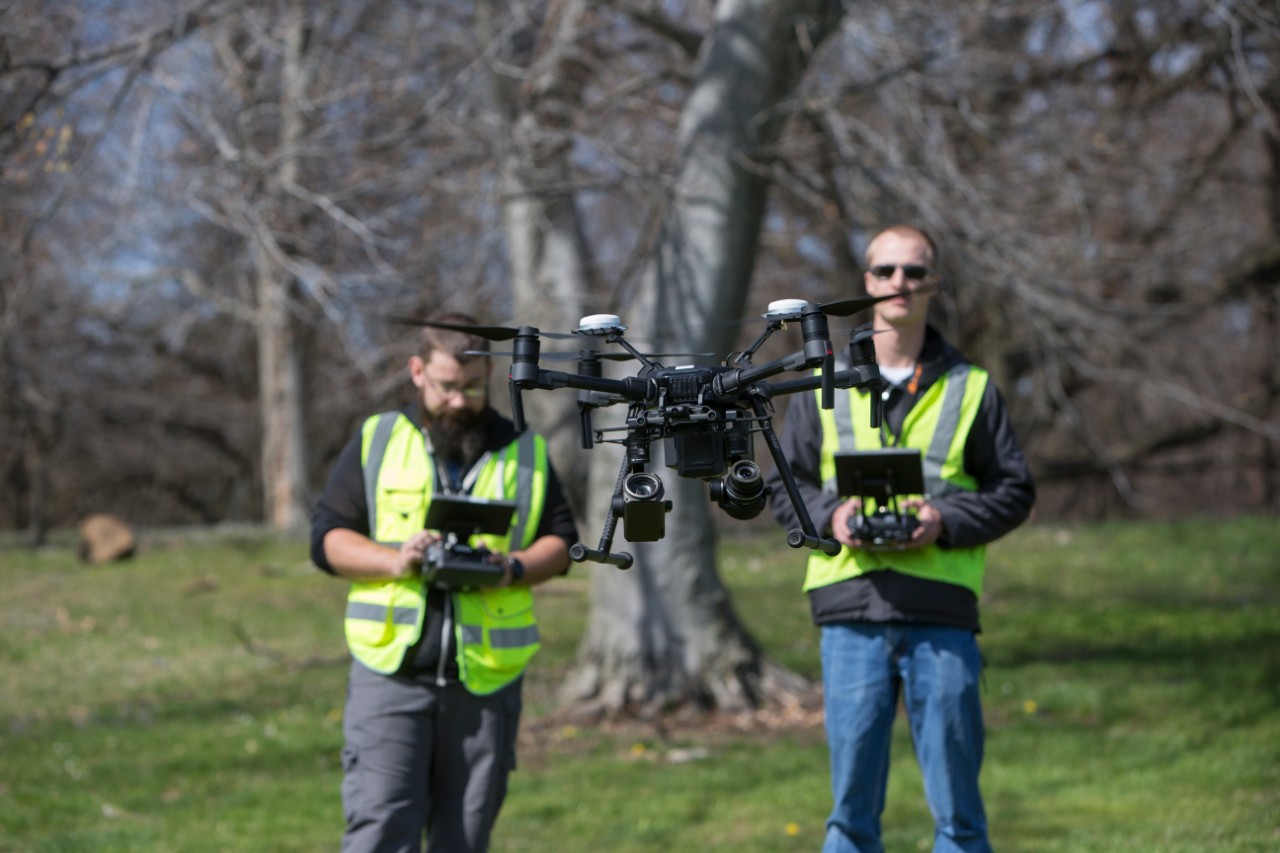
Featured image at top: Austin Wessels and Bryan Brown fly a UAV. Photo/Andrew Higley/UC Creative Services.
Related Stories
UC doctoral student shares his journey with Spectrum News
July 27, 2026

UC doctoral student Amota Ataneka spoke with Spectrum News about his educational journey. Ataneka, a native of the Pacific island nation of Kiribati, is one of 35 emerging scholars across the United States to win the National Academy of Education/Spencer Dissertation Fellowship.
How scammers can persuade you with AI
July 27, 2026
Spectrum News recently dove into how cloning voices with artificial intelligence is making it easier to scam people over the phone. The news outlet spoke with Kimberly Hyun, assistant professor of marketing at UC’s Lindner College of Business, to examine why AI is making it so much easier to trick people.
Claude now available in BearcatsGPT AI platform
July 27, 2026
The University of Cincinnati has added Claude as a model option within BearcatsGPT, UC’s generative AI platform. Claude availability in BearcatsGPT marks another step forward in expanding access to dependable, enterprise-supported AI tools for teaching, research, operations, and administrative work.