National Geographic: UC professor discusses ancient spiders
UC biology professor Nathan Morehouse says fossils suggest ancient spiders were night predators

A University of Cincinnati biology professor spoke to National Geographic about the recent discovery of spider fossils in South Korea.
The discovery by the Korea Polar Research Institute suggests ancient spiders had reflective eyes like many of today’s spiders.
If you shine a flashlight in your grassy back yard, you’re likely to see tiny eyes shining back at you. These are the glowing eyes of wolf spiders, which have an iridescent lens called a tapetum that reflects light.
According to National Geographic, paleontologists discovered nearly a dozen inch-long fossils of ancient spiders dating back more than 106 million years during the Cretaceous Period. These spiders, too, have reflective lenses that capture more light for animals that are active at night. Their findings were published in the Journal of Systematic Paleontology.
“These fossils are extraordinary,” UC biology professor Nathan Morehouse told National Geographic.
“It’s always a thrill when something of the visual system is preserved,” he said. “More exciting to me and other vision scientists is the glimpse that the tapetum offers into the lifestyle of these ancient animals. They were likely nocturnal hunters!”
Morehouse has been studying the vision and behavior of spiders, particularly jumping spiders, in UC’s McMicken College of Arts and Sciences. He is using a National Science Foundation grant to study spider vision around the world.

UC biology professor Nathan Morehouse talks about his spider research in his lab. Photo/Jay Yocis/UC Creative Services
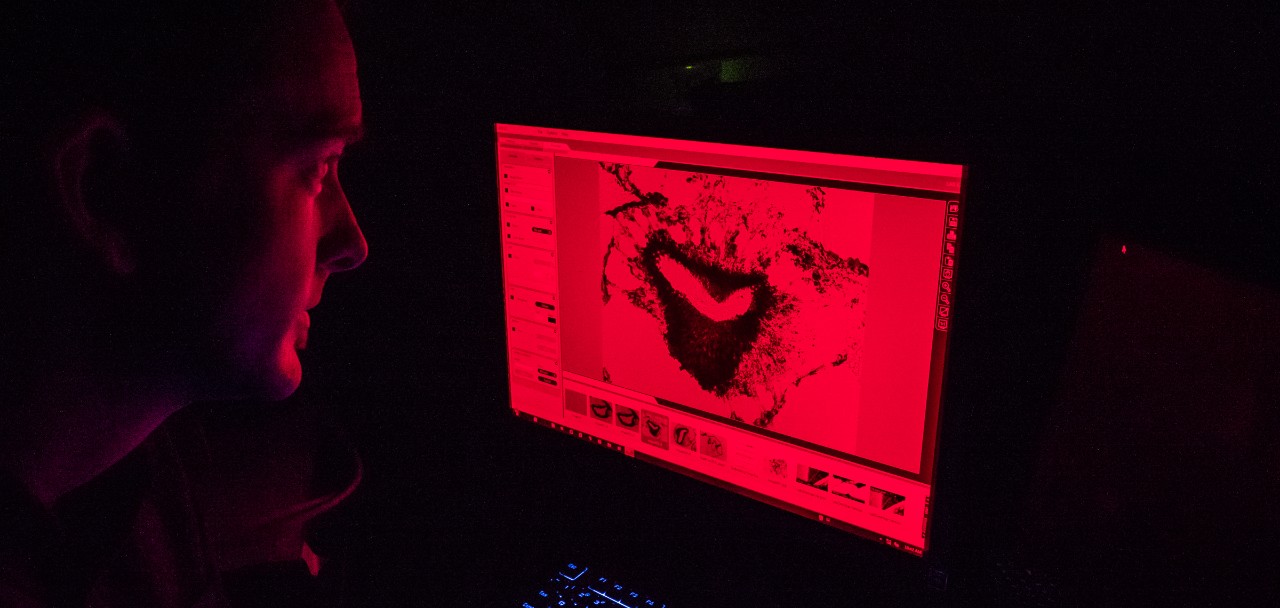
Featured image at top: UC biology professor Nathan Morehouse uses micro-spectrophotometry to measure how the photoreceptor cells in spiders absorb light. Photo/Jay Yocis/UC Creative Services
Related Stories
More Applicants, Broader Reach: inside UC Klekamp Law’s incoming class
August 21, 2026
The University of Cincinnati Donald P. Klekamp College of Law is welcoming a new generation of students across its JD, LLM and MLS programs amid a significant increase in interest in a UC Klekamp Law education, with JD applications reaching their highest level in a decade.
UC study shows lack of awareness for lung cancer screenings across country
August 21, 2026
University of Cincinnati Cancer Center researchers have published a study in the American Journal of Surgery that found only 15% of eligible American adults have discussed lung cancer screening with their doctors.This research emphasizes the need to spread awareness and better educate the public about screening through low-dose computed tomography.
UC's Taft Research Center names two new Taft distinguished professors to advance humanities research with public impact
August 20, 2026
The University of Cincinnati's Charles Phelps Taft Research Center has named Erynn Masi de Casanova and Muhammad U. Faruque as the newest Taft Distinguished Professors. Recognized for their outstanding records of scholarly distinction, engagement across multiple fields, and continued promise, Casanova and Faruque will hold the title for the next five years, delivering inaugural public lectures and events on campus this fall.