UC hosts national engineering competition

On Mar. 13, the University of Cincinnati hosted nearly 300 high school students for an engineering competition. TEAMS (Tests of Engineering Aptitude, Mathematics and Science) is a national competition designed by the Technology Student Association that challenges students to apply math and science to real-world problems.
Thirty-one teams representing 13 high schools participated in the event, which was coordinated by the College of Engineering and Applied Science Office of Undergraduate Enrollment.
“The event really pushes students toward developing their interest and their skills in STEM [science, technology, engineering and mathematics],” said UC program coordinator Clayton Trette, who organized this year’s competition.
UC is committed to engaging with and empowering students in the local community. The TEAMS event reflects the urban impact platform of UC’s strategic direction, Next Lives Here.

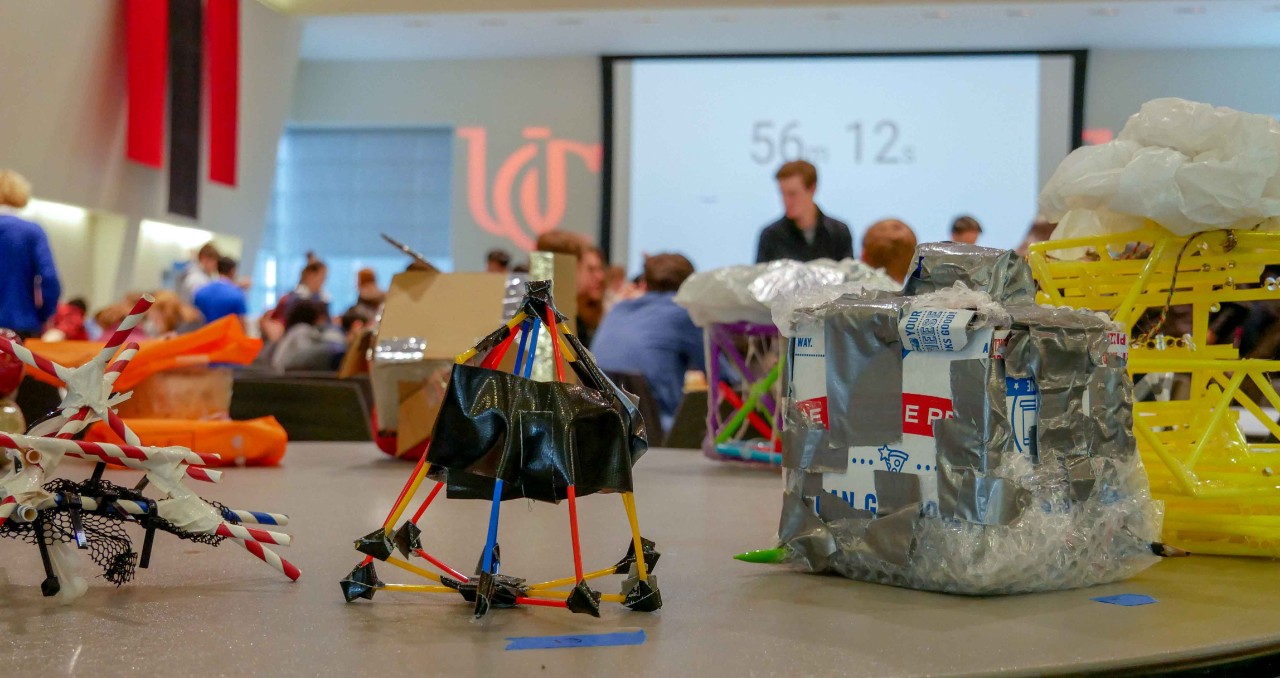
The design challenge required students to build a robotic arm to pick up a stuffed animal bear, simulating the engineering aspects of an animal rescue mission. Photo/Corrie Stookey/CEAS Marketing
Teams of eight students prepared weeks in advance for the competition, studying competition materials with their teachers. In addition to gaining STEM skills, students learned to work as a team.
“The core mission of it all is to show individual skills are good, but being able to work together on a project is really where you’re going to shine,” said Trette.
The day of the competition consisted of two parts: a multiple choice test and a hands-on design challenge. The design challenge required students to build a robotic arm to pick up a stuffed animal bear, simulating the engineering aspects of an animal rescue mission.
The core mission of it all is to show individual skills are good, but being able to work together on a project is really where you’re going to shine.
Clayton Trette UC program coordinator
In addition to proctoring the tests and design challenge, UC also provided information about college life through tables and college tours. Engineering Tribunal, the student governing body of the college, also hosted an egg drop.
New this year was a presentation given by representatives from the 1819 Innovation Hub. UC representatives focused on the hub’s Venture Lab, a startup ecosystem that accelerates the process of getting UC technologies to market.
The event concluded with an awards ceremony; UC rewarded teams with college scholarships ranging from several hundred to several thousand dollars.
“TEAMS is a really good event to be a part of,” said Trette. “It’s great to be able to support students as early as their freshman year continue to pursue STEM throughout high school.”
Featured image at top: Engineering Tribunal, the student governing body of the college, hosted an egg drop as part of the day's events. Photo/Corrie Stookey/CEAS Marketing
Urban Impact
UC is committed to engaging with and empowering students in the local community. The TEAMS event reflects the urban impact platform of UC’s strategic direction, Next Lives Here.
Related Stories
Why is there a statue of Stephen Foster in Cincinnati?
June 26, 2026

Even if you don't know American parlor composer Stephen Foster, you’ve probably heard his music. His mid-19th century folk songs, including “Camptown Races” and “Oh Susanna,” make appearances in pop culture to this day. There’s a statue of Foster overlooking the Ohio river in Alms Park that prompted WVXU's Bill Rinehart to feature him in his Cincinnati mysteries segment, OKI Wanna Know. WVXU turned to University of Cincinnati music history expert Kristy Swift for a peek into Foster’s life and impact in the region.
World Cup watch parties unite fans, communities
June 26, 2026

UC Assistant Professor Letisha Brown tells Spectrum News that watch parties for sporting events and entertainment are popular because people feed on others' excitement.
Drone-delivered groceries descending into Cincinnati
June 25, 2026

Walmart is bringing drone delivery to Cincinnati, as reported by 700WLW. Host Scott Sloan spoke with Michael Jones, associate professor of economics at the University of Cincinnati's Lindner College of Business, for a look at what it means for Cincinnati shoppers.