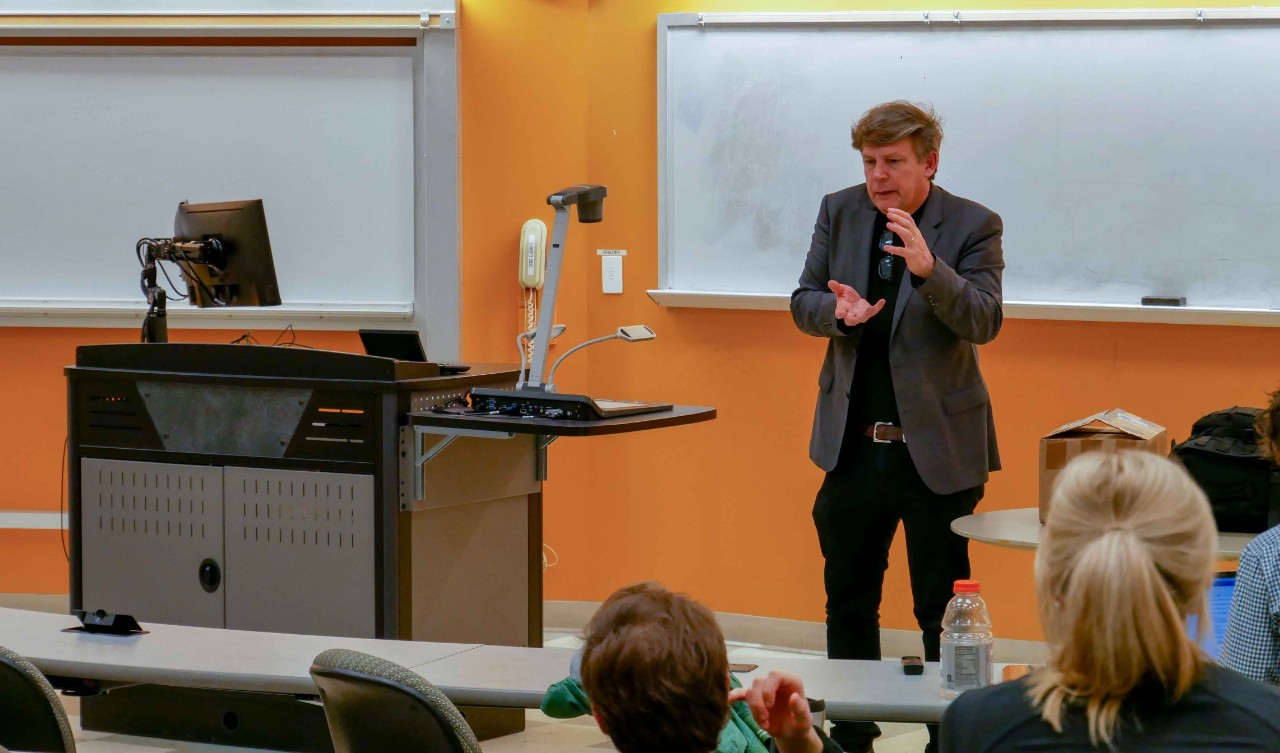
TV show host and entrepreneur gives talk on science communication

Chuck Pell has built his career on making the complicated language of science accessible to the general public.
Pell is host of the 2018 Emmy Award-winning public science TV show Xploration Earth 2050, CSO of the surgical robotics company Physcient, Inc. and founder of five start-up companies.
Pell brought his knowledge of science communication to University of Cincinnati students, faculty and staff during a presentation March 14. His talk was hosted by UC's McMicken College of Arts and Sciences and supported by a Group/Interdisciplinary Award from the Office of the Provost.
The seminar reflected UC’s commitment to academic excellence, a platform of the university’s strategic direction Next Lives Here.
Pell, a self-described “congenital science freak,” said his work in science communication started with physical models.

TV show host and entrepreneur Chuck Pell explains the dynamics of a boomerang to exemplify science communication at work. Pell's talk was hosted by the College of Arts and Sciences and supported by a Group/Interdisciplinary Award from the Office of the Provost. Photo/Corrie Stookey/CEAS Marketing
Physical models surprise us with the insights they give us into a scientific phenomenon, he said. Because they can visually tell a story, models are a staple for both learning about a system and communicating how that system works. Models, however, run counter to what many scientists get bogged down in, and what many non-scientists don’t understand: jargon.
“Jargon allows you to develop precision in language,” said Pell, “but to anyone who is not initiated in that world or realm, jargon sounds like gibberish.”
The goal of a good science communicator, said Pell, is to remove exclusive jargon from science while maintaining science’s factual accuracy.
“You have to abstract what you’re doing and distill it down, without distorting what you’re getting across,” Pell said. “And you have to have a way to say it that’s still cool and interesting without doing [the science] a disservice.”
Jargon allows you to develop precision in language, but to anyone who is not initiated in that world or realm, jargon sounds like gibberish.
Chuck Pell, TV show host and entrepreneur
The process of science communication includes many people, from researchers conducting the work to journalists reporting on their progress to editors deciding how the reports reach the public. Good science communicators recognize these different goals and tailor their communications with these interests in mind, said Pell.
When science communication works, agencies fund research, scientists collaborate across disciplines and society is more prepared to tackle complicated problems.
Pell ended his talk at 5 p.m., the same time Hamilton County issued a tornado warning. As sirens and phones went off, attendees of the talk left the room and went down the stairs. Huddled in a small classroom in the basement, Pell used the reaction to the tornado warning as another example of good science communication.
“When disaster hits, people want science,” he said. “We’re in this room right now because we’ve learned from science how tornadoes work and what they do to buildings.”
In other words, good science communication can even save lives.
Featured image at top: Chuck Pell gives talk on science communcation to UC faculty, staff and students. Photo/Corrie Stookey/CEAS Marketing
Next Lives Here
The University of Cincinnati is classified as a Research 1 institution by the Carnegie Commission and is ranked in the National Science Foundation's Top-35 public research universities. UC's graduate students and faculty investigate problems and innovate solutions with real-world impact. Next Lives Here.
Related Stories
UC climbs to No. 3 in the nation for co-ops and internships in 2027 U.S. News rankings
September 22, 2026
In U.S. News & World Report’s 2027 Best Colleges rankings, the University of Cincinnati rises to No. 3 in the nation for co-ops and internships — No. 1 among public institutions — and posts gains in undergraduate business, computer science and psychology.
'Discovery, mentorship, momentum': UC College of Medicine's graduate programs celebrate year of success
September 22, 2026
From new mentorship honors to a growing research pipeline, see how the University of Cincinnati College of Medicine's graduate programs made this a standout year.
Engineering graduate student developing intelligent AI systems
September 21, 2026
Artificial Intelligence is on the rise, and researchers are working harder than ever to understand, develop, and improve it. Aneesh Deshmukh, computer science M.S. student at the University of Cincinnati, is working on AI systems modeled after human brain functionality. Deshmukh's goal is to help these robots understand their surroundings and take this knowledge to navigate unfamiliar environments in the future. For this work, he has been named Graduate Student Engineer of the Month by the College of Engineering and Applied Science.