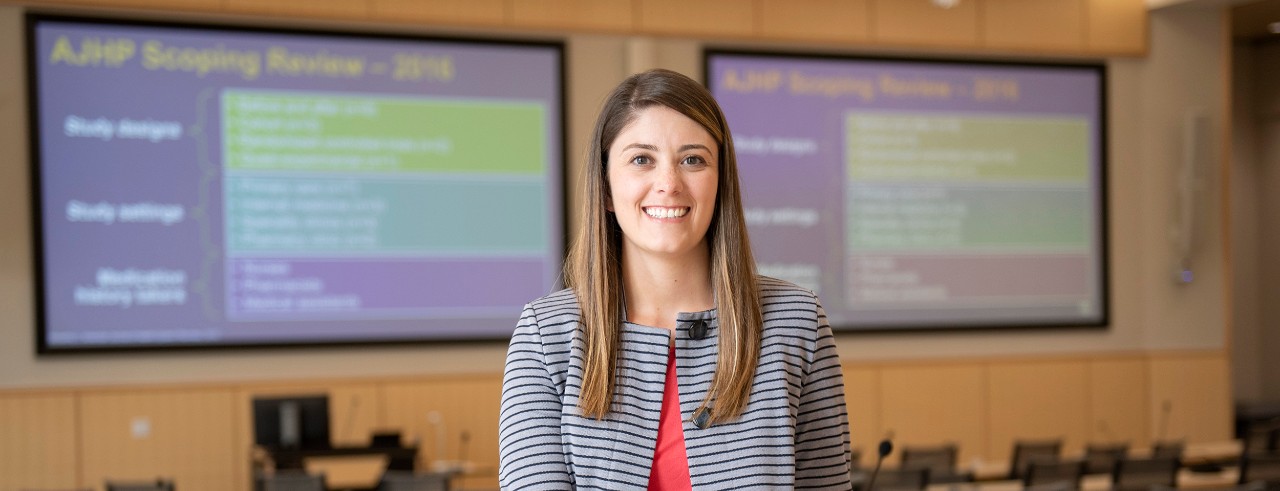
Focus on new faculty: Elizabeth Berryman, PharmD

The James L. Winkle College of Pharmacy welcomes new faculty member Elizabeth Berryman, PharmD, assistant professor of pharmacy practice and administrative sciences.
Berryman has a varied professional background and personal interests:
What is your background?
I spent my formative years in Lexington and Winchester, Kentucky, and then completed my undergraduate course work at Centre College in Danville, Kentucky, and graduated with a bachelor’s degree in history. I then completed my Doctor of Pharmacy coursework at Lipscomb University in Nashville, Tennessee. I completed my first year of residency in pharmacy practice and second year in ambulatory care pharmacy at St. Elizabeth Healthcare in Northern Kentucky. During this residency I also completed the Teaching Certificate Program through the UC James L. Winkle College of Pharmacy.
Do you have any areas of focus?
My main area of focus will be in population health, which is focusing on a specific community or group of people to develop and implement initiatives to improve the health of the entire group.
Why did you choose academia over private enterprise pharmacy?
I am and want to continue to be a lifelong learner and academia really focuses on this through teaching aspiring pharmacists and research. I also have a passion for clinical practice and academia as a clinical faculty member offers a healthy combination of both teaching and clinical practice. I have also been actively involved in the American Society of Health-System Pharmacists (ASHP) and am continuing to expand my role in this organization, which is supported and encouraged in an academic setting.
Why did you choose UC?
I think this is a very exciting time at UC with a lot of innovative leaders moving the university forward. Additionally, every colleague I have who attended or worked at UC has an incredible pride and spirit of community that is infectious and demonstrates that it is a great place to be.
Is this your first trip to the city, the campus? Impression?
Being originally from a bordering state, I was familiar with UC, but had not really visited campus until my residency at St. Elizabeth. I have been very impressed by both the renovations in Kowalewski Hall and across the entire medical campus.
What website do you find yourself visiting most of the time?
Pinterest and Etsy are favorites when looking for some creative inspiration. I probably shouldn't say this, but when researching things outside of the academic setting, I use Wikipedia a lot. I almost always have some event, place or person pulled up on my phone to learn a little snippet of information especially when traveling.
What is something few people know about you?
From age 9 to 18 I was active in the 4-H youth program in Kentucky where I showed cattle and participated in livestock judging and was a camp counselor for several years.
What do you do when you're not working?
When at home I like to play, hike and/or cuddle with my Brittany Spaniel, Si. I watch a lot of documentaries, and like to try new restaurants. I also love to travel pretty much anywhere including big cities, rural or outdoorsy destinations, beaches or other countries.
Related Stories
How phone scammers use your own voice against you
September 18, 2026

The Wall Street Journal recently did a deep dive on how artificial intelligence is making scamming people over the phone much easier, citing research by Kimberly Hyun, assistant professor of marketing at UC’s Lindner College of Business.
Gas prices spike... Again
September 18, 2026

UC economist Gary Painter goes through the tactics companies use to keep their consumer bases amid rising oil costs.
This September, give blood for local patients fighting cancer and sickle cell disease
September 18, 2026
September is dedicated to raising awareness of several serious diseases, including sickle cell disease and childhood cancer. For patients in Greater Cincinnati fighting these diseases, awareness is only part of the equation. They also need lifesaving blood products.