
Pink: a color for fighters
In October, we wear pink, but everyday, UC fights cancer

Pink is such a cheerful color, but over the past few decades, it’s become symbolic of so much more.
It’s become a color for fighters.
In October, the nation brings awareness to a condition that affects 1 in 8 women in the U.S.: breast cancer. But at UC, researchers and clinicians are fighting the good fight year-round through lab research and clinical trials that may help thousands of women win their battle with the disease:
Researchers like Georg Weber, a professor in the James L. Winkle College of Pharmacy, who is investigating a molecular diagnostic test to determine whether, after biopsy, someone is at high or low risk for actually developing malignant breast cancer.
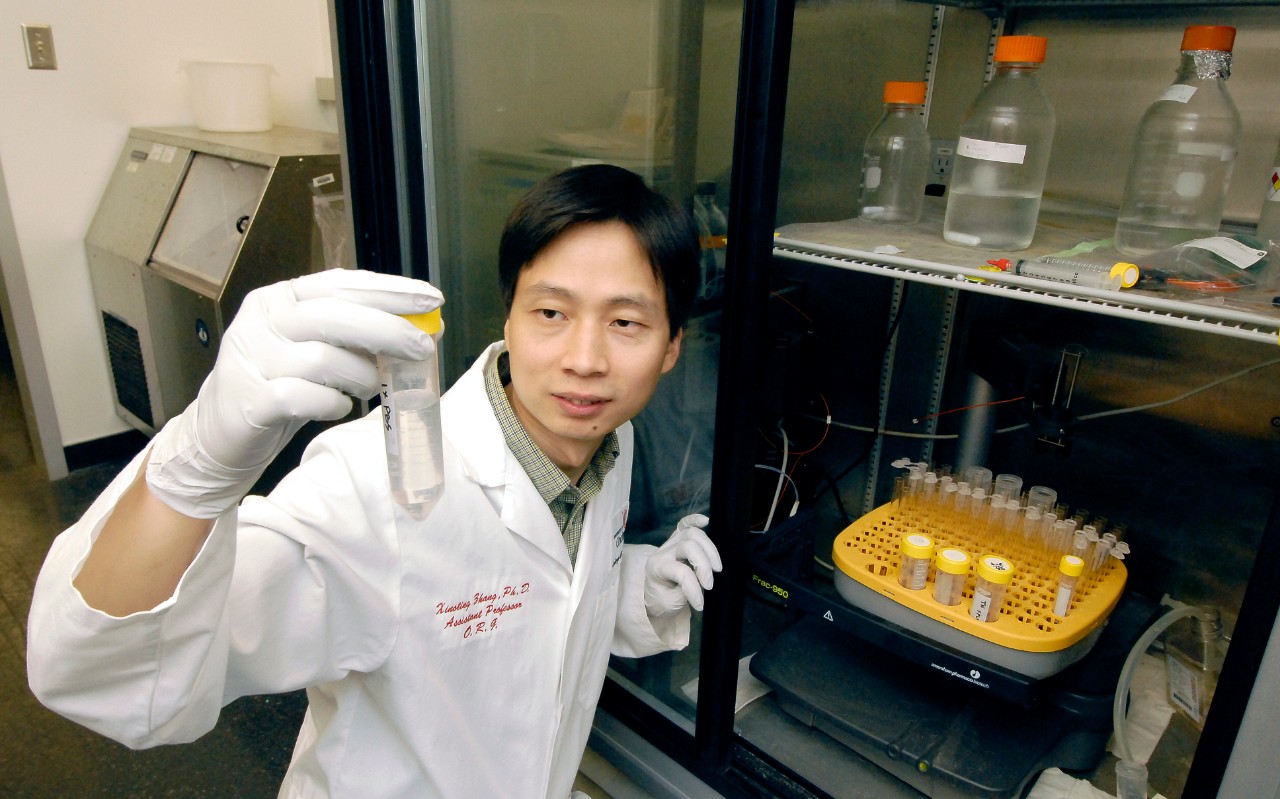
Xiaoting Zhang is studying the use of nanoparticles in treating breast cancer that is resistant to therapy. Photo credit: Dan Davenport
Nalinikanth Kotagiri, an assistant professor in the Winkle College of Pharmacy, is studying ways ultraviolet light can activate light-sensitive drugs to treat metastatic breast cancer.
And Xiaoting Zhang, professor of cancer biology, who “graduated” in September from the sixth UC Venture Lab pre-accelerator program, continues to study the use of nanoparticles in treating breast cancer that is resistant to standard therapy.
Recently, Zhang received federal funding, an R01 grant from the National Cancer Institute, to study certain genetic material, known as small RNAs, in breast cancer metastasis (or spread). RNAs serve as messengers, carrying instructions from DNA for controlling the function and production of proteins; recently, small non-coding RNAs have been found to be potential key treatment targets in certain cancers.
This is the second research grant of this level Zhang has received from the National Cancer Institute. Zhang’s lab will use this funding to continue research examining molecular causes for treatment resistance and metastasis of ER-positive breast cancer, which makes up about 75% of breast cancers worldwide. ER-positive breast cancer means the cancer cells grow in response to the hormone estrogen. Zhang will look at the role of microRNAs in the production of a key breast cancer protein (MED1) and how it controls another type of small RNA called enhancer RNA in breast cancer. He will further use an RNA nanotechnology-based approach to target these small RNAs to combat breast cancer resistance and metastasis.
Zhang says he hopes that findings from this study will fill a knowledge gap in understanding small RNA function and how they impact the way cancer is treated and spreads. He adds that this could lead to a new and better treatment strategy for a patient population that doesn’t have many choices.
Researchers who are also physicians at UC Health continue to conduct clinical trials to better understand the best ways to detect and treat the disease as well as help patients live a fuller, better life.
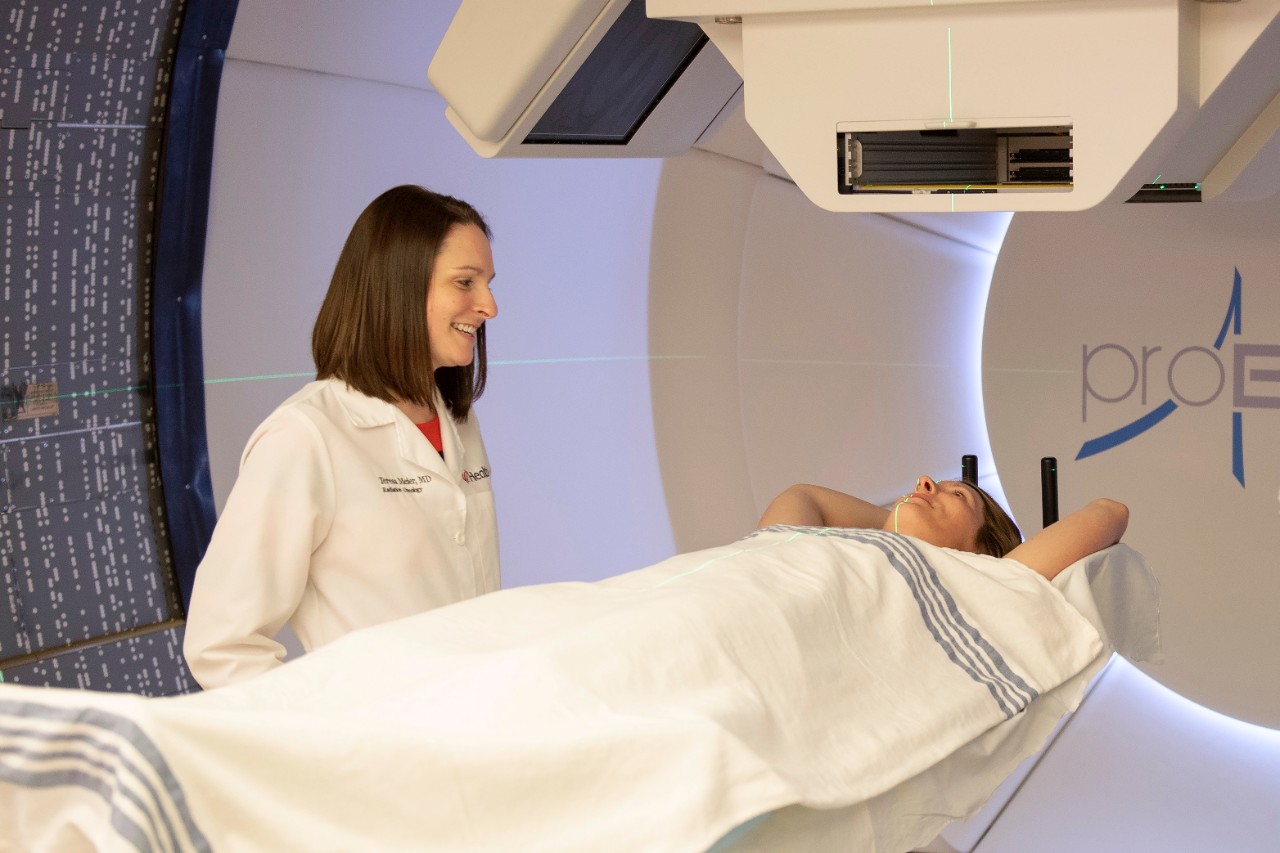
Dr. Teresa Meier is leading a national clinical trial involving proton therapy and early-stage breast cancer. Photo credit: Colleen Kelley / UC Creative Services
Dr. Lawrence Sobel, assistant professor in the Department of Radiology and director of breast imaging for UC Health, is leading a local trial comparing two types of digital mammography — 2D images versus 3D images — to determine which is most effective effective in the diagnosis of breast cancers.
Dr. Teresa Meier, assistant professor of radiation oncology and a UC Health radiation oncologist, is also leading a clinical trial, not being offered anywhere else, to determine how the use of proton radiotherapy can be used for patients with early stage breast cancer. It will evaluate efficacy and cosmetic outcome of this treatment option.
To learn more about these projects as well as other research and patient options only offered at UC, the UC Cancer Institute’s Breast Cancer Center offers several educational events.
- Breast Reconstruction Awareness Day, being held from 5-7 p.m. Wednesday, Oct. 16, at the UC Gardner Neuroscience Institute, 3113 Bellevue Ave.
Beth Fairchild, medical tattooist, president of METAvivor and metastatic breast cancer patient, will present “Medical Tattooing and the Art of 3D Areola Nipple Tattoos” from 6-6:30 p.m.
- Breast Health Prevention, Detection and Treatment: Innovations Around Every Corner, being held from 9 a.m. to 3 p.m. Saturday, Nov. 2, at the Kingsgate Hotel, 151 Goodman St.
Feature photo courtesy of Drew Hays/Unsplash
Next Lives Here
Powered by knowledge, ideas and minds, UC's strategic direction Next Lives Here amplifies the university's core missions of teaching, research and service — from preparing faculty to “teach tomorrow” to pioneering the next cure to solving human-centered problems in the far corners of the globe. Learn more.
Related Stories
UC researcher to launch national study with $2.5 million NIH grant
October 9, 2026

A University of Cincinnati researcher has received a $2.5 million National Institutes of Health grant to conduct research during the next five years. Natalie Kreitzer, MD, a University of Cincinnati College of Medicine physician-researcher, received an R01 independent research grant from the NIH's Eunice Kennedy Shriver National Institute of Child Health and Human Development. The funding will support a test program for caregivers of patients with traumatic brain injury, as reported by the Cincinnati Business Courier.
New vending machine helps people with addiction
October 8, 2026

The University of Cincinnati's Daniel Arendt was featured in a Spectrum News report on a new harm reduction vending machine installed at the IPM Food Pantry in partnership with the Hamilton County Mental Health and Recovery Services Board.
UC study correlates increased physical activity with slower Parkinson’s progression
October 7, 2026
Higher levels of physical activity were associated with slower declines in thinking and memory as well as slower worsening of movement symptoms for people with Parkinson’s disease, according to a new study led by University of Cincinnati researchers published Oct. 7, 2026, in Neurology.