NY Post: Men more likely than women to be scared of bugs
UC biologist Joshua Benoit talks about a surprising poll that found Americans don't know very much about common insects

The New York Post turned to University of Cincinnati biologist Joshua Benoit to explain why a new poll shows Americans simply don't know much about common bugs.
Procter & Gamble Co's. pest-control product Zevo surveyed 2,000 Americans about insects. Just one in three respondents could correctly identify a picture of a wasp. Many confused it with a honeybee.

Joshua Benoit in his lab. Photo/Joseph Fuqua II/UC Creative Services
Just half of men (53%) and even fewer women (43%) correctly identified a tick. And those same percentages correctly identified "entomology" as the study of insects.
The survey found that far more men than women reported being "very scared" of bugs (32% of men compared to just 22% of women).
Despite the mediocre scores, more than half of respondents considered themselves "very knowledgeable" about insects. (Dunning-Kruger effect, perhaps?)
Benoit, an assistant professor of biological sciences in UC's McMicken College of Arts and Sciences, studies ticks, mosquitoes, cockroaches and other insects and arthropods in his lab. He has conducted research in places as remote as Antarctica, home to a bizarre wingless fly.
Benoit helped conduct biological tests for Zevo products in his lab.
"Some insect pests can be highly prolific under favorable conditions," Benoit told the Post.
The good news, Benoit said, is most insects don't want to cohabitate with people.
"Few people realize that the indoor biome is a specific habitat that only certain insects can tolerate," he said.
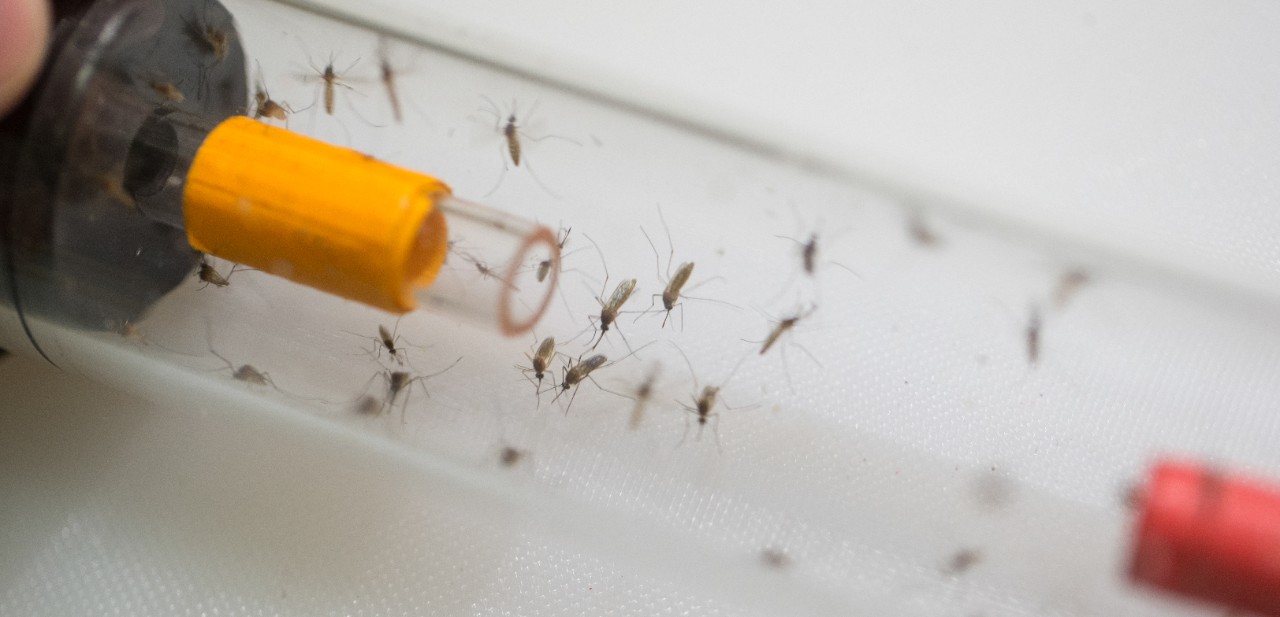
Featured image at top: A vial of mosquitoes in UC professor Joshua Benoit's lab. Photo/Andrew Higley/UC Creative Services

UC assistant professor Joshua Benoit has studied insects as far away as Antarctica. Photo/Provided
Related Stories
Ad spending ramps up in Senate race
June 8, 2026

Spectrum News turns to a University of Cincinnati political science professor to explain the national interest in the U.S. Senate campaign in Ohio.
UC expert explains how provocateurs try to manipulate conflict
June 4, 2026

UC Professor Jeffrey Blevins talks to the Dallas Morning News about how outside agitators seize on tragedy to push their agendas.
UC researcher secures $3.3M grant to study microplastics’ impact on heart
June 2, 2026
The National Institute of Environmental Health Sciences awarded a $3.3M grant to University of Cincinnati researcher Hong‑Sheng Wang, PhD, to study how microplastics and nanoplastics affect cardiovascular health.