Columbus Dispatch: Can Ohio end wrongful convictions?
UC’s efforts to free wrongfully convicted aids in new state task force on wrongful convictions

As wrongful convictions continue to plague Ohio’s criminal justice system, one of the state’s top jurists is taking action. The Columbus Dispatch reports Supreme Court Chief Justice Maureen O’Connor is establishing a Task Force on Conviction Integrity and Postconviction Review, with members to be named this week and recommendations due by the end of the year. The story highlights the work of Mark Godsey, director of the Ohio Innocence Project (OIP) at the University of Cincinnati College of Law, and his team of lawyers and students whose efforts have led to freedom for 28 wrongfully convicted people.
The OIP’s work is, as the Dispatch notes, sometimes “against the odds,” such as with the case of Ricky Jackson, who, when released at age 57 in 2014 after wrongly serving more than 39 years in prison, held the record for the longest time an innocent man had spent behind bars in the U.S. “For every single one of them, you could say but for this miracle and that miracle ... we found the right person at the last moment ... every single one of them required coincidence after coincidence,” Godsey said in the story.
Read the full story here.
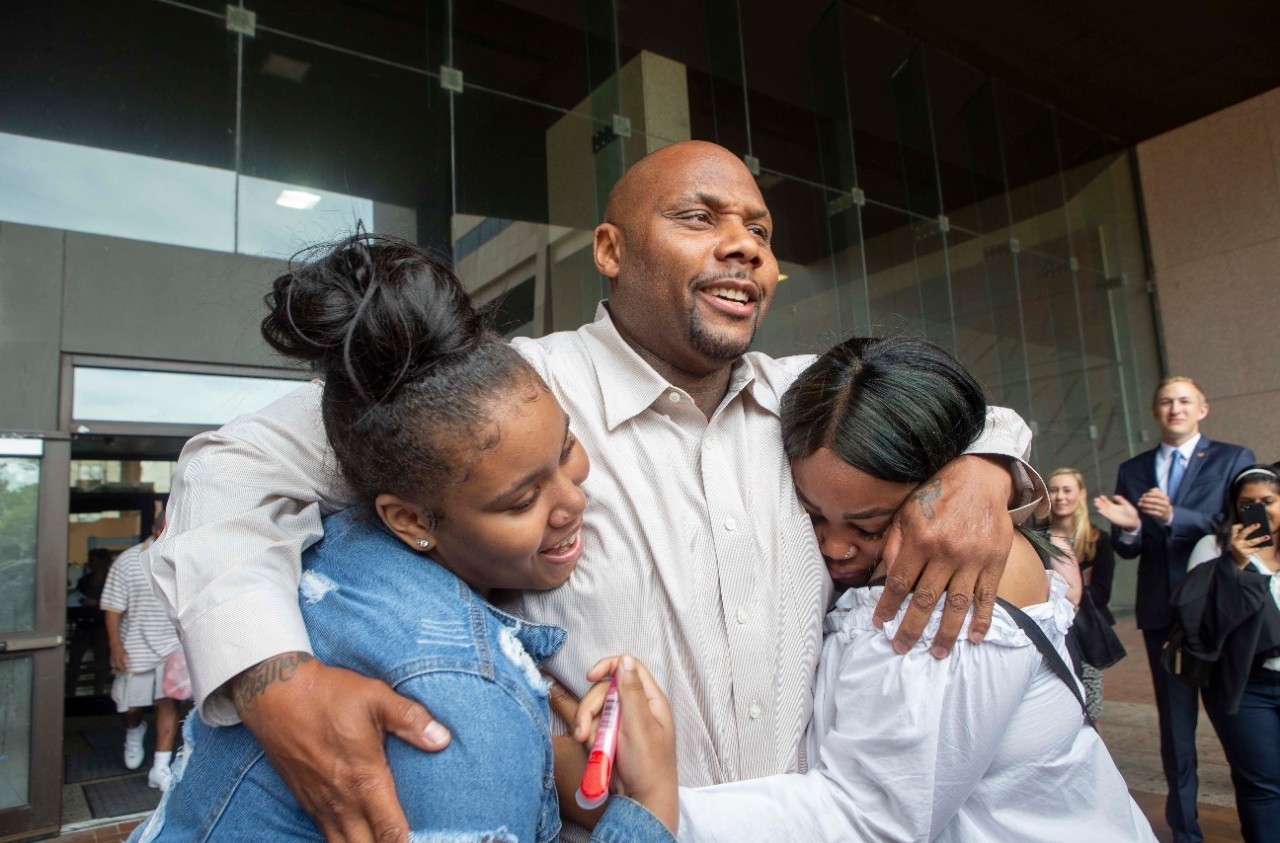
Featured image at top: Christopher Miller hugs his daughters De'Nazha, left, and Chareale outside the Cuyahoga County Justice Center on June 21, 2018. Miller was exonerated with help from UC's College of Law after spending 17 years in prison for crimes he did not commit.
Related Stories
This September, give blood for local patients fighting cancer and sickle cell disease
September 18, 2026
September is dedicated to raising awareness of several serious diseases, including sickle cell disease and childhood cancer. For patients in Greater Cincinnati fighting these diseases, awareness is only part of the equation. They also need lifesaving blood products.
UC emergency medicine physicians safely eliminate thousands of unnecessary CT scans
September 18, 2026
A University of Cincinnati emergency medicine quality improvement campaign avoids 3,500-plus head and cervical spine CT scans, saving $6.2 million in patient charges, more than 14,000 hours of waiting time and significant radiation exposure with no patient harm.
From curiosity to career
September 17, 2026
Fall campaign story 2026 - College of Education, Criminal Justice, and Human Services.