Business Courier: UC grad says poetry can help people cope
Cincinnati poet laureate Manuel Iris says people need poetry more than ever in pandemic

University of Cincinnati graduate Manuel Iris says people can turn to poetry to cope with the stresses of COVID-19, quarantines and the uncertain times.
Iris spoke to The Business Courier about the role poetry can play in a crisis. In the profile, Iris
"This is the moment for the arts," he told The Courier. "Our souls need to be fed."
Iris is Cincinnati's poet laureate and a graduate of UC's College of Art and Sciences, where he earned a doctorate in Romance Languages and Literature. He grew up in Mexico where he fostered an appreciation for creative writing. He teaches writing and literature at DePaul Cristo Rey High School near UC's campus and coaches a poetry slam team.
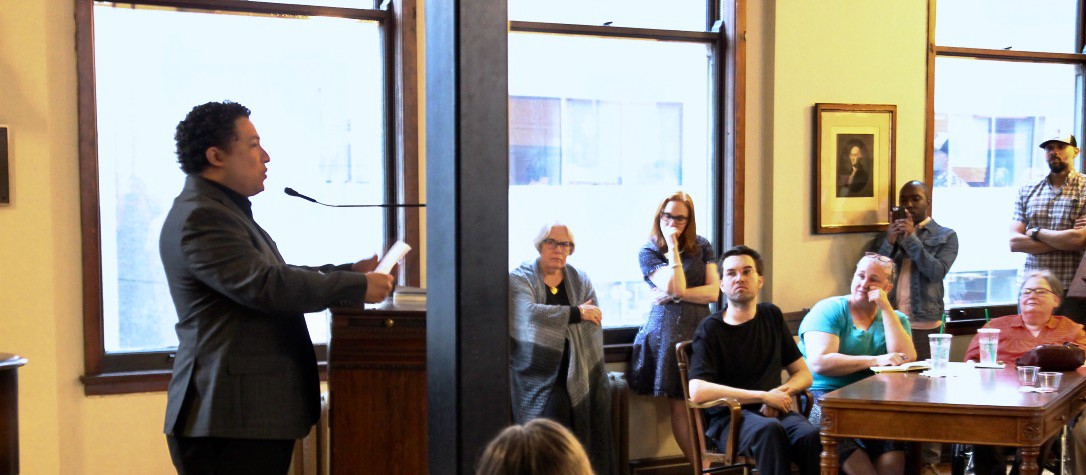
Featured image at top: UC graduate Manuel Iris gives a poetry reading at the Cincinnati Mercantile Library. Photo/Melanie Schefft

UC graduate Manuel Iris, right, talks at a reception at the Cincinnati Mercantile Library. He says poetry can help people cope with stress. Photo/Melanie Schefft
Related Stories
President Pinto’s 2nd glow party brings first-year Bearcats together
September 20, 2026
UC President Neville Pinto and team hosted the second annual Bright Beginnings glow party for first-year students
How phone scammers use your own voice against you
September 18, 2026

The Wall Street Journal recently did a deep dive on how artificial intelligence is making scamming people over the phone much easier, citing research by Kimberly Hyun, assistant professor of marketing at UC’s Lindner College of Business.
Gas prices spike... Again
September 18, 2026

UC economist Gary Painter goes through the tactics companies use to keep their consumer bases amid rising oil costs.