
A village of cancer cells
UC researchers pinpoint hierarchy of breast cancer cells as potential cause for treatment resistance

You might have heard the old proverb, “It takes a village to raise a child.”
University of Cincinnati instructor Syn Yeo, PhD, thinks the same analogy applies when it comes to cells and the growth of cancer, particularly breast cancer.
In his recent study, published in the journal eLife, Yeo, research instructor in the department of cancer biology at the UC College of Medicine and co-lead author, says it can take cells in different forms or “life stages” to cause cancer to grow and spread.

Syn Yeo, PhD, research instructor in the department of cancer biology at the UC College of Medicine who is a member in the lab of Jun-Lin Guan, PhD. Guan is the Francis Brunning Endowed Chair and professor of cancer biology. Photo by UC Creative + Brand.
“Our recent findings emphasize the need to account for the specific cell states that are present within a tumor,” says Yeo, who is a member in the lab of Jun-Lin Guan, PhD, the Francis Brunning Endowed Chair and professor of cancer biology. “This could potentially help determine the combination of drugs that are required to eliminate all the cell states that are present to eliminate treatment resistance.”
Yeo says that when it comes to breast cancers, it is known that cells within a tumor are varied.
“This diversity poses a problem to treating patients because particular subsets of tumor cells may be drug resistant and eventually lead to disease recurrence,” he says. “One of the factors contributing to this diversity is the fact that tumor cells can exist in different cellular states, ranging from more stem-like cells that can become other cell types to more differentiated cells that have been coded to serve a purpose, or do a certain ‘job’ within the system.
“Cancer cells with stem-like properties are known to cause drug resistance, and they are generally seen as being at the top of the tumor hierarchy, like the king or queen of the village, with more differentiated tumor cells towards the bottom of the hierarchy, like the common townspeople.”
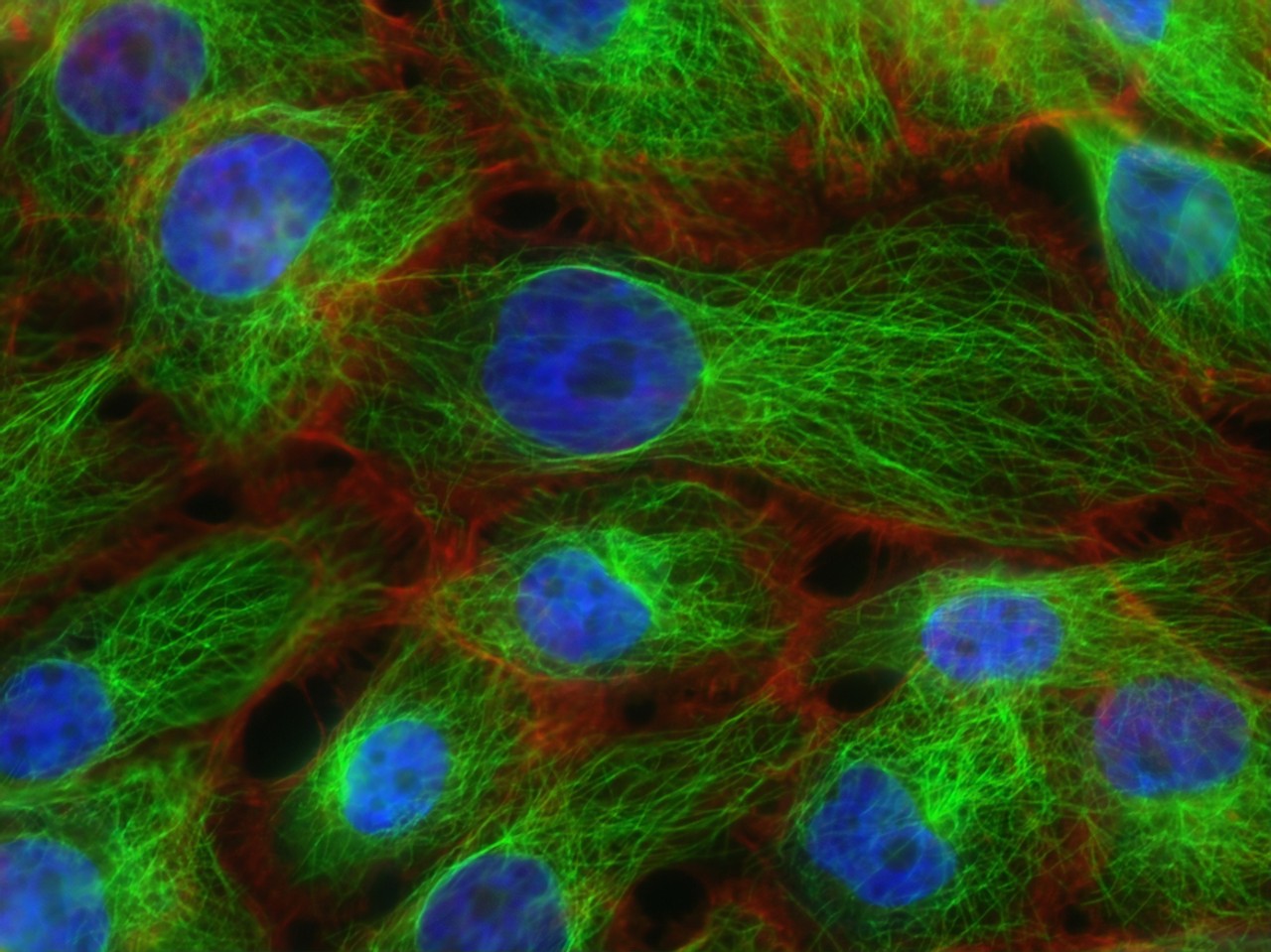
Breast cancer cells courtesy of the National Cancer Institute.
In this study, researchers used breast cancer animal models to determine tumor hierarchies beyond “ruler” and “common people” cells, Yeo says. They identified and categorized singular cells which helped them understand each, individual cell’s purpose. Yeo adds that bulk tumor cell analysis would have masked the cellular details.
“We were able to find a complex spectrum of cell states between different tumor types that can range from stem-cells to the ‘beginner cells’ to more differentiated cells,” he says. “In our village [scenario], these would be the governors and mayors, followed by the common townspeople. Furthermore, depending on the lineage of the tumor, some may show a spectrum of cell states that are higher up in the hierarchy and vice versa.
“These findings are important because they show we need to know more about how these specific cell states contribute to tumor growth so we can target them with combination drug therapies, potentially helping more people who may otherwise experience drug resistance.”
Featured photo courtesy of Unsplash.
Next Lives Here
The University of Cincinnati is classified as a Research 1 institution by the Carnegie Commission and is ranked in the National Science Foundation's Top-35 public research universities. UC's graduate students and faculty investigate problems and innovate solutions with real-world impact. Next Lives Here.
Funding for this research was provided by the National Institutes of Health (R01-CA211066, R01-HL073394 and R01-NS094144). Xiaoting Zhu was the other co-lead author who was partially supported by R01-HL111829. Other contributors include Takako Okamoto, Mingang Hao, Cailian Wang, Peixin Lu, Long Jason Lu and Jun-Lin Guan. Researchers cite no conflict of interest.
Related Stories
Women consistently experience more pain than men across 11 body parts
October 12, 2026

A large global study spanning 118 countries, published in Nature Medicine, has found that women consistently report more pain than men across 11 bodily sites, including the back, head, face, knees, chest, abdomen and hips. The study also found that, across sexes, the sharpest increases in self-reported pain tend to occur before age 55. These findings may inform a new approach to chronic pain prevention and management throughout the lifespan. Shuchita Garg, MD, an associate professor of clinical medicine at the University of Cincinnati College of Medicine, Division of Chronic Pain, within the Department of Anesthesia, and the medical director of the UC Medical Center Pain Clinic, who was not involved in this study, commented on the findings for Medical News Today (MNT).
2026 Daniel Drake Medals awarded to three pioneering physician-scientists
October 12, 2026
The University of Cincinnati College of Medicine awards its highest honor, the 2026 Daniel Drake Medal, to three leaders in transplantation medicine, rare lung disease and heart health.
UC researcher to launch national study with $2.5 million NIH grant
October 9, 2026

A University of Cincinnati researcher has received a $2.5 million National Institutes of Health grant to conduct research during the next five years. Natalie Kreitzer, MD, a University of Cincinnati College of Medicine physician-researcher, received an R01 independent research grant from the NIH's Eunice Kennedy Shriver National Institute of Child Health and Human Development. The funding will support a test program for caregivers of patients with traumatic brain injury, as reported by the Cincinnati Business Courier.