UC Cancer Center retreat focuses on prevention
The annual event looks at minimizing cancer risks in Greater Cincinnati like pollution, smoking

Event Information (passed)
As the pandemic continues to impact public health, cancer remains a constant.
There are certain known ways to try to prevent it, but some of the risks are out of our control.
The University of Cincinnati Cancer Center is dedicating this year’s virtual retreat to looking at prevention as it pertains to our region and beyond.
The seventh annual UC Cancer Center Retreat for Research, Cincinnati Charge Against Cancer, titled “Minimizing the Cancer Burden in Greater Cincinnati: The Role of Prevention,” will feature local and national experts who will talk about a variety of topics ranging from water contaminants and pollution to cannabis use and electronic cigarettes to the HPV vaccine.
The event will be held from 10:30 a.m. to 5 p.m. on Friday, Sept. 25.
Our goal is for Greater Cincinnati to have the lowest cancer incidence in the world by the year 2050.
William Barrett, MD Co-director, UC Cancer Center
“Our goal is for Greater Cincinnati to have the lowest cancer incidence in the world by the year 2050,” says William Barrett, MD, co-director of the UC Cancer Center, professor and chair of the Department of Radiation Oncology at UC and a UC Health radiation oncologist. “We want to prevent cancers in all ways possible, and this retreat will address established and emerging cancer prevention strategies for the good of our community.”
The day’s events will conclude with a talk given by Robert Bilott, a Cincinnati attorney who took on DuPont for contaminating water with toxic chemicals. His story was told in the 2019 movie, “Dark Waters,” starring Mark Ruffalo.

A still from the "Dark Waters" trailer reveals a section of the Ohio River, where the movie is set. Robert Bilott, a Cincinnati attorney who took on DuPont for contaminating water with toxic chemicals and whose story is told in "Dark Waters,” the 2019 movie starring Mark Ruffalo, will speak at the event. Photo provided.
Susan Pinney, PhD, a professor in the UC Department of Environmental Health and director of the UC Center for Environmental Genetics, authored a 2017 study that found that residents of the mid-Ohio River Valley (from Cincinnati north to Huntington, West Virginia) had higher than normal levels of certain chemicals in their blood based on samples collected over a 22-year span. The exposure source was likely from drinking water contaminated by the industrial discharges upriver, as detailed in “Dark Waters.”
Syed Ahmad, MD, co-director of the UC Cancer Center, professor and chief of the division of surgical oncology at UC and a UC Health surgeon, says this research is an example of population health science at UC that is making an impact.
“Population health sciences is about our city and region. It is about the people we take care of,” says Ahmad, the Hayden Family Endowed Chair for Cancer Research. “We are taking steps to specifically understand our demographics, our special populations, high incidence cancers, risk factors and disparities.
“I’m excited about our journey forward. Cancer prevention is and will remain one of the most important missions for our cancer center.”
"While we are making tremendous strides in developing novel treatment strategies for numerous cancers, our goal is to prevent these cancers from ever occurring," adds Thomas Herzog, MD, deputy director of the UC Cancer Center. "We know that well over 80% of cancers have either a direct or partial environmental component in terms of causation. Examining these associations to generate effective strategies to decrease the incidence of cancer in our regional population and beyond is a primary goal of this year’s UC Cancer Center retreat."
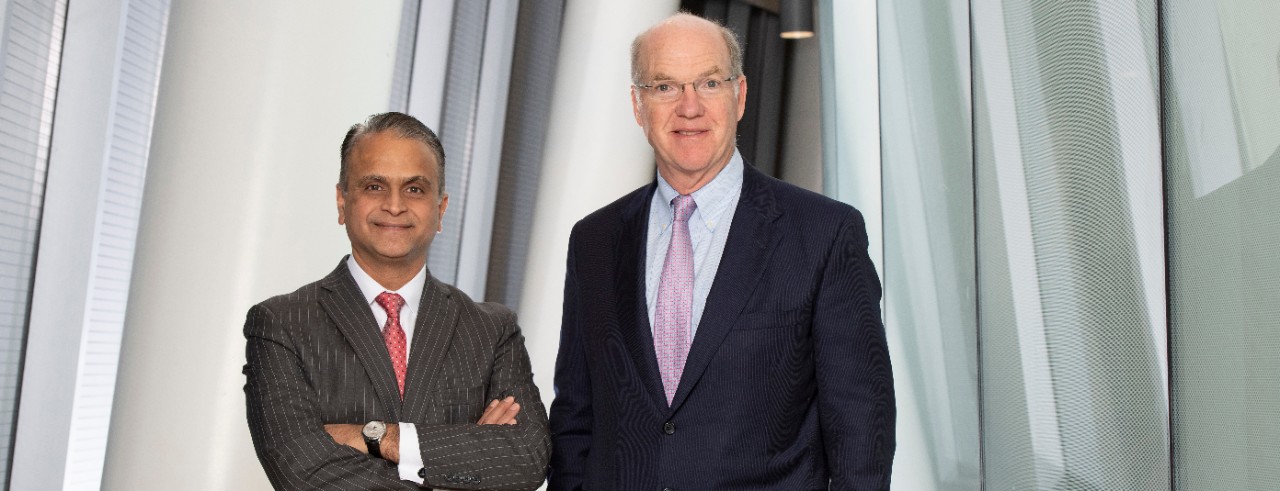
Featured photo of Syed Ahmad, MD, and William Barrett, MD, by Colleen Kelley/UC Creative + Brand.
Next Lives Here
The University of Cincinnati is classified as a Research 1 institution by the Carnegie Commission and is ranked in the National Science Foundation's Top-35 public research universities. UC's graduate students and faculty investigate problems and innovate solutions with real-world impact. Next Lives Here.
Related Stories
On-site training in Speech & Hearing Clinic sets UC’s programs apart
August 27, 2026
At the University of Cincinnati’s Speech & Hearing Clinic, Doctor of Audiology and Speech-Language Pathology graduate students gain real-world experience while providing free speech and hearing services to the community.
DAAP professor and artist turns grass clippings into biodegradable art
August 27, 2026
Through biodegradable bioplastic made from grass clippings, Supermrin shows how creativity can connect science, sustainability and everyday life.
Designing with cancer patients' needs in focus
August 27, 2026
Kristina Shin is designing garments that prioritize the comfort, function and confidence of breast cancer patients, addressing a need often overlooked by traditional fashion.