NY Daily News: UC helps describe new mosasaur
Paleontologist Takuya Konishi is a world expert on ancient marine reptiles

The New York Daily News reported on a newly described species of mosasaur that resembled a crocodile and could chase down some of the ocean's fastest fish.
University of Cincinnati assistant professor Takuya Konishi, who has spent much of his career studying these ancient marine reptiles, was a co-author of a study describing the creature published in the Journal of Systematic Paleontology.
Mosasaurs were widely dispersed marine reptiles that lived alongside dinosaurs more than 66 million years ago. Paleontologists described this one, Gavialimimus almaghribensis, as having a long, narrow snout with interlocking teeth like many species of crocodile today.
"Its long snout reflects that this mosasaur was likely adapted to a specific form of predation, or niche partitioning, within this larger ecosystem," lead author Catie Strong of the University of Alberta said.
The specimen's three-foot-long skull was discovered in a phosphate mine in Morocco.

Gavialimimus almaghribensis, a newly described species of mosasaur, had a narrow snout like some crocodiles. Illustration/Tatsuya Shinmura
Konishi said he has long advanced the theory that different species of mosasaurs evolved to hunt different prey in the same oceans with other mosasaurs. This adaptation for exploiting resources is called niche partitioning.
“Its long snout reflects that this mosasaur was likely adapted to a specific form of predation, or niche partitioning, within this larger ecosystem,” Strong told the Daily News.
Konishi credited Strong with recognizing the specimen was something completely new to science.
"This is a monumental achievement by a former undergraduate student," Konishi said.
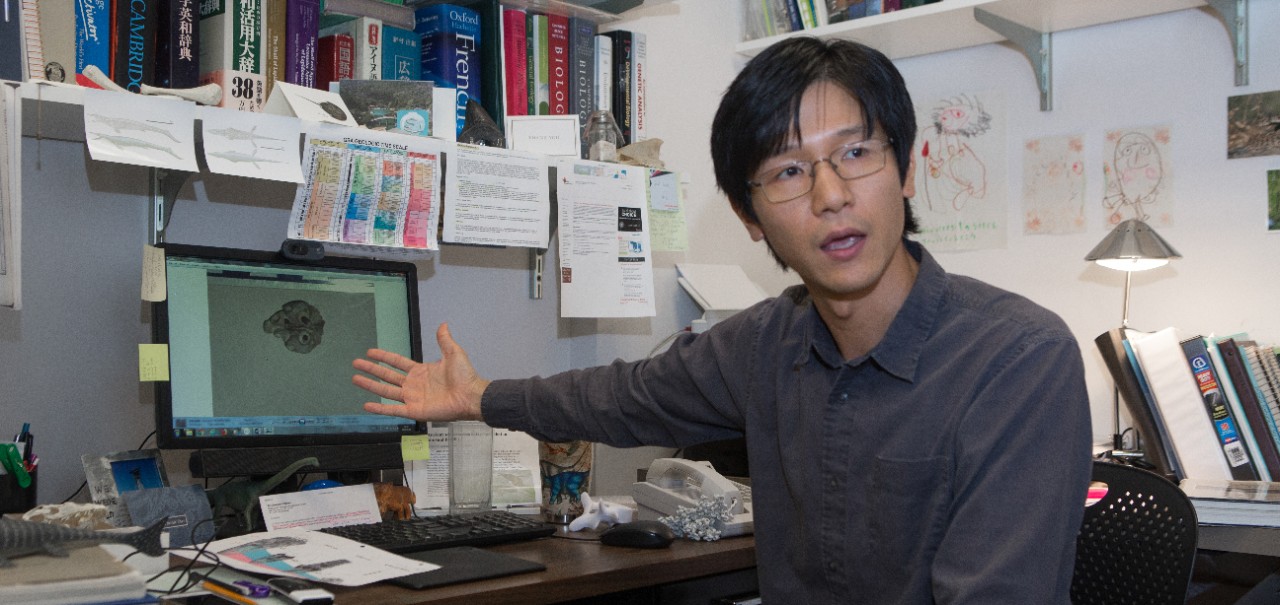
Featured image at top: Takuya Konishi talks about his mosasaur research in his office in this 2018 file photo. Photo/Joseph Fuqua II/UC Creative + Brand

UC assistant professor Takuya Konishi stands in front of a model of a mosasaur in his biology lab in this file photo. He has written numerous research articles about these ancient marine reptiles. Photo/Joseph Fuqua II/UC Creative + Brand
More UC biology in the news

A T-rex cast.
TDNews: Paleontologists identify new species of mosasaur
Science Times: Paleontologists discover new ancient marine reptile
Science Daily: Paleontologists identify new species of mosasaur
Evening Standard: New mosasaur species discovered in Morocco
Yahoo News: New mosasaur species from Morocco had fish-grabbing crocodile snout
New Atlas: New mosasaur had a fish-grabbing snout like a crocodile
Related Stories
These teeny spiders are social media stars
August 28, 2026

The New York Times turned to a University of Cincinnati professor to explain the appeal of jumping spiders on social media.
An internal divide among unions on AI impacts the Wisconsin gubernatorial race
August 28, 2026

Anne Lofaso, a professor in the Donald P. Klekamp College of Law at UC, spoke with Wisconsin Public Radio, about the schism among unions over AI and whether it is a plus, a negative, or somewhere in between when looking at job creation.
UC, NKU renew longstanding partnership supporting Army ROTC cadets
August 26, 2026
The University of Cincinnati Army ROTC and Northern Kentucky University (NKU) have renewed a longstanding partnership that supports students preparing to become Army officers and leaders in their communities. The universities formalized the renewed agreement during a signing event Aug. 11 at NKU.