
First-of-its-kind trial hopes to minimize the effects of brain injury
UC project funded by $4 million Department of Defense grant

For the last 20 years, about a dozen researchers around the world have been learning all they can about a new clinical disease entity, spreading depolarizations. One of the preeminent members of that group is Jed Hartings, PhD, the Vice Chair of Research at the University of Cincinnati Department of Neurosurgery.
The first research to show that spreading depolarizations take place in the injured human brain was published in November 2002, nearly 60 years after their discovery in animals.
Since then, Hartings and colleagues have been studying the relevance of these pathologic brain waves, colloquially known as brain tsunamis, to human disease. Their studies have focused on how to detect and measure the waves, understanding why they occur, and the impact they have on short-term brain function and long-term patient recovery. “We have spent 20 years characterizing this new, potentially revolutionary concept of brain injury pathology,” says Hartings. “We have learned a lot about how brain injuries evolve that we never knew before.”
We have spent 20 years characterizing this new, potentially revolutionary concept of brain injury pathology; we have learned a lot about how brain injuries evolve that we never knew before.
Jed Hartings, PhD
Now, he’ll be taking this knowledge and applying it clinically to improve the care and outcome of patients with brain trauma.
The trial, Improving Neurotrauma by Depolarization Inhibition with Combination Therapy, known as INDICT, will be a small-scale clinical trial of patients with severe traumatic brain injury starting at UC Health this spring. INDICT will be the first interventional trial targeted to treating spreading depolarizations. Hartings elaborates that “We are going to implement a specific protocol for treating patients based on monitoring spreading depolarizations in the brain to see if it positively impacts their outcome compared to standard care.”
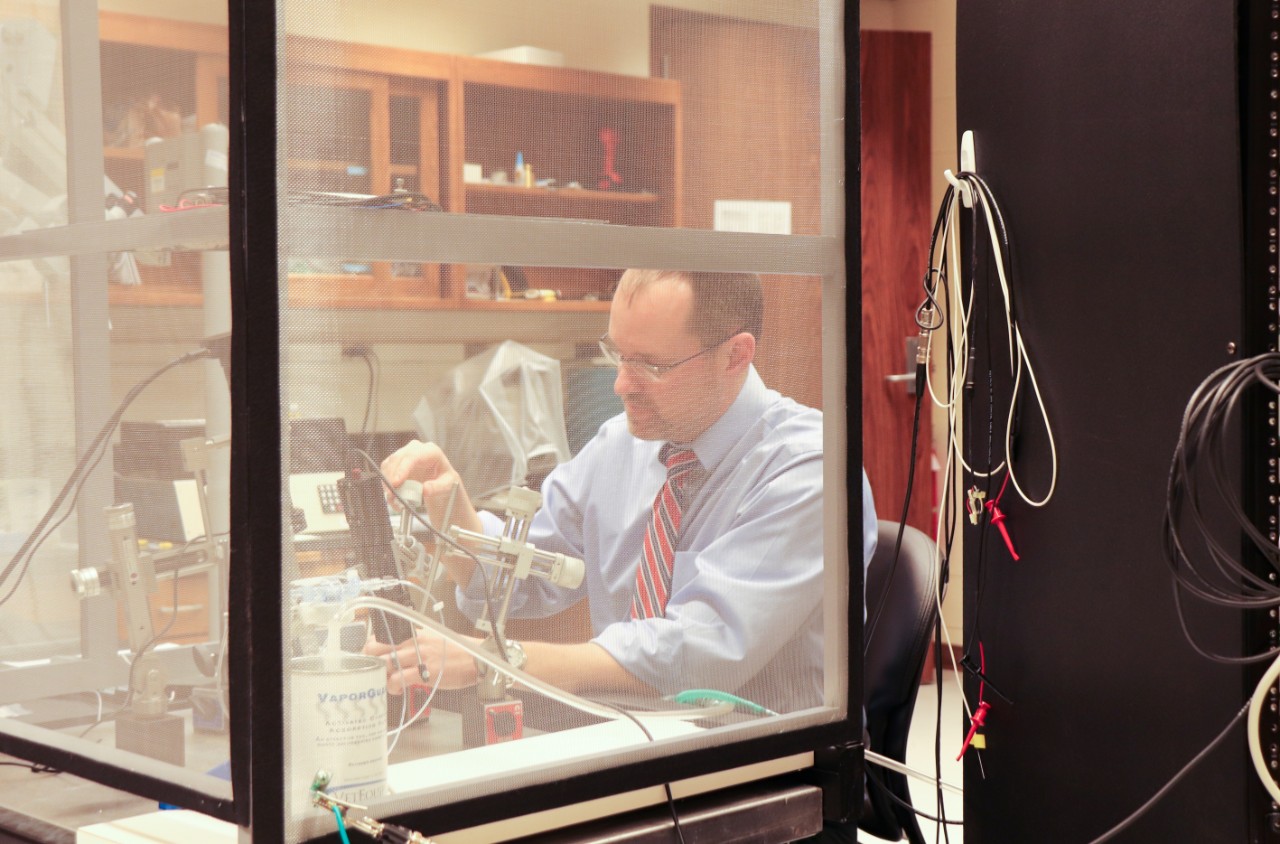
Jed Hartings, PhD, in his lab. Photo/Julie Forbes/University of Cincinnati.
The study will address several of the many factors that contribute to the extent of brain injury and how well patients recover. “What is exciting and novel about this is that we are not just testing a single treatment. Rather, we are testing a new approach to diagnosis that implicates several treatments.” describes Hartings. For example, the trial involves the use of the drug, Ketamine. But it will also target plasma glucose levels, oxygen and carbon dioxide levels and blood pressure. “We're going to be actually listening in to the pathology of the brain in real time and using the occurrence or absence of that pathology as a driver to help make those decisions,” Hartings explains. “It allows for a level of personalized or individualized care that we just weren't capable of doing before.”
This is a phase II feasibility study and will take place at three academic medical centers: University of Cincinnati, University of New Mexico and University of Pennsylvania. In addition to Hartings, Laura Ngwenya, MD, PhD, is the neurosurgical director of the study and Brandon Foreman, MD is the director of neurocritical care. They hope to enroll 75 patients over the course of 3 years. Hartings predicts that patients who receive this specialized treatment will have less brain pathology during their hospitalization than those who do not. If he is correct, the trial will move to either a larger phase II study or a phase III study. “Seventy-five patients is not enough to really determine whether we are impacting outcomes, but it's enough to give us a signal to let us know if this approach has promise worth investigating further,” Hartings says.
Another novelty is that the study will be using machine learning software that will assist in detecting spreading depolarizations in the brain activity recordings. According to Hartings, there are only about a dozen people in the world who are skilled at detecting spreading depolarizations, so they hope to use artificial intelligence to make this treatment method and its algorithm accessible to more providers. The software will perform this analysis automatically and give the results to the bedside clinician.
Related Stories
UC Blue Ash Career Champions make career development part of the everyday experience
October 21, 2026
The University of Cincinnati Blue Ash College is bringing career development into students' everyday experiences through its Career Champions program.
Still the top ‘cat
October 20, 2026

The University of Cincinnati Bearcat mascot was voted Cincinnati’s favorite mascot in a Cincinnati Enquirer reader poll, earning 45.1% of the vote and topping other local favorites.
Researchers test gene therapy as less invasive treatment for hydrocephalus
October 20, 2026

Researchers at the University of Cincinnati College of Medicine say an experimental gene therapy could eventually lead to a less invasive treatment for hydrocephalus, a condition in which excess fluid accumulates in the brain. The early-stage study, led by Agnes (Yu) Luo, PhD, professor and vice chair for research, was published in the journal Fluids and Barriers of the CNS. Yahoo! News recently featured it.