
Nature profiles College of Medicine neuroscience doctoral student Christin Godale

Christin Godale, a doctoral student in the Neuroscience Graduate Program, was recently featured in an article in Nature highlighting her advocacy work for neuroscience funding.
Godale was diagnosed at age 2 with epilepsy, which led to her interest in neuroscience. She works with the Society for Neuroscience and has met with federal policymakers and elected officials to increase funding for research.
“Like many people with epilepsy, I rely on anti-seizure medications, which allow me to pursue my dreams and ambitions. Advocating for basic science is very personal for the epilepsy community and myself. Researchers should consider the voices of patient advocates when performing basic research, writing a grant application or giving a scientific presentation,” she says in the article.
Godale works in the laboratory of Steve Danzer, PhD, associate professor in the Department of Anesthesiology, at Cincinnati Children’s.
Last year Godale was selected as an award recipient of the National Institutes of Health (NIH) Outstanding Scholars in Neuroscience Award Program, which recognizes early-career scientists who are conducting exceptional research and who have great academic potential in their scientific training. She also has received an NIH Predoctoral Fellowship from the National Institute of Neurological Disorders and a Predoctoral Fellowship from the American Epilepsy Society.
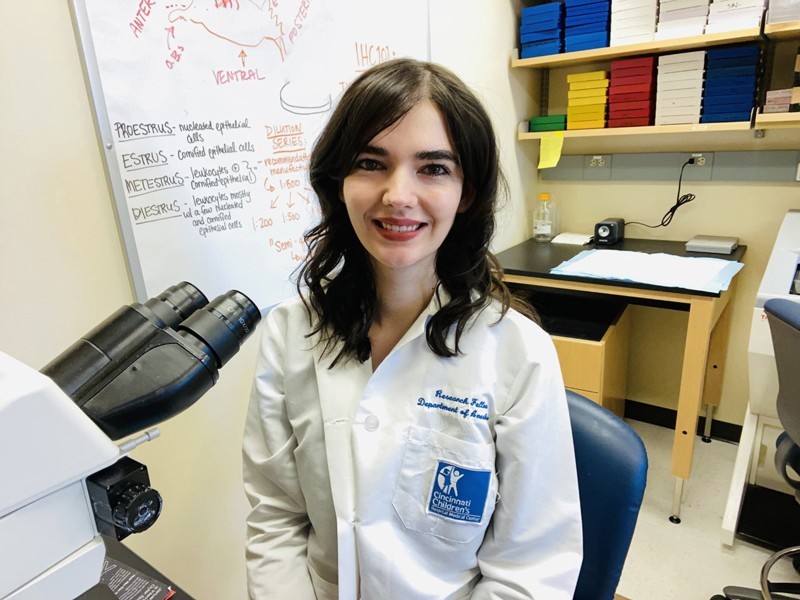
UC College of Medicine graduate student Christin Godale. (Photo courtesy of Cincinnati Children's)
Featured image at top: Christin Godale/Colleen Kelley/UC Creative + Brand.
Tags
Related Stories
Decade of discovery
July 27, 2026
Every summer, UHP Discover has connected undergraduate students in the University Honors Program (UHP) to a unique array of opportunities in original interdisciplinary research. This year, the program celebrates its 10th anniversary.
The subtle changes in hearing you should never ignore
July 24, 2026

It’s easy to dismiss changes in hearing as minor. But as The Washington Post recently reported, these symptoms could also signal a medical emergency that many people don’t recognize — known as sudden sensorineural hearing loss, a rapid decline in hearing that occurs suddenly or over a few days.
UC experts say proper produce washing is key defense against Cyclospora
July 24, 2026

Hamilton County Public Health reports confirmed cases of cyclosporiasis, as concerns persist. Cyclospora is a parasite that can cause a stomach illness lasting days — sometimes even weeks. University of Cincinnati medical experts say it is usually linked to contaminated water or food, often fresh produce.