Journalists might want to nix the term ‘storyteller’ from their bios
Words matter, and UC researchers find the public correlates ‘storytelling’ with deception

Journalists who refer to themselves as “storytellers” diminish the profession in the public eye, says a new study by UC journalism researchers.
The study, which looked at the public’s perception of the term “storyteller” when attached to a journalist’s credentials, was recently highlighted in a NiemanLab article, titled: “Sounds like a well-trained liar”: Journalists lose some credibility by calling themselves “storytellers”.
“Too often, it seems journalism and news reporting are co-mingled with communication, PR and anything that has to do with media content production,” says study co-author Jeffrey Blevins, professor and head of UC’s Department of Journalism.
This co-mingling, he says, blurs the lines between news reporting and storytelling, given that journalists have the specific responsibility to report the news based on facts through investigation without embellishment.
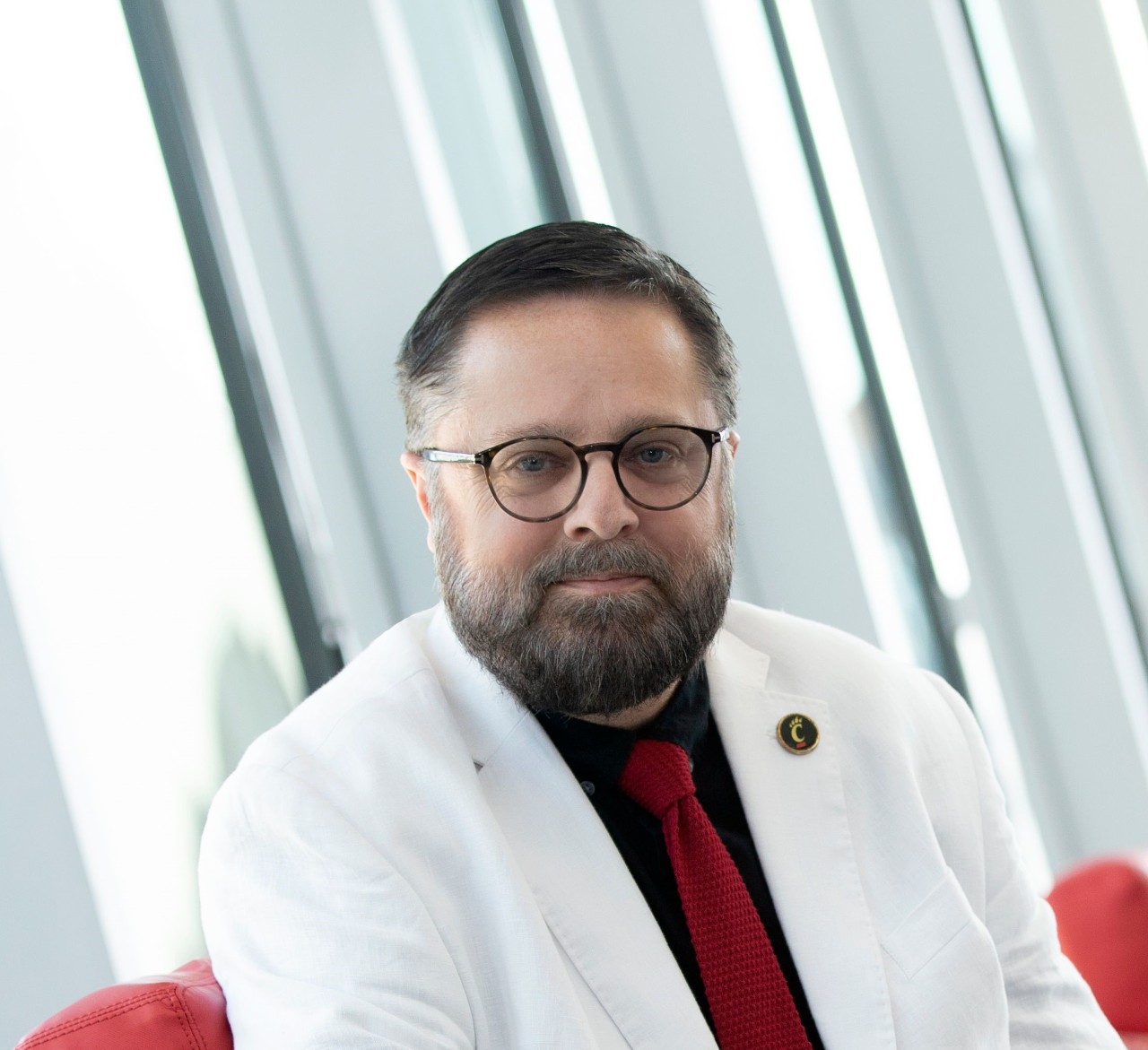
Jeffrey Blevins, PhD, is the o-author of “Social Media, Social Justice and the Political Economy of Online Networks”, a book that examines how information, including fake news, has been manipulated and shared on the internet. Photo/UC Creative + Brand/Colleen Kelley
Blevins, along with lead author Brian Calfano, a UC professor of journalism, undertook an experiment by presenting over 2,000 people with a news story on a zoning ordinance. Half of those surveyed were shown the reporter’s professional bio, which included the term “storyteller.” The control group saw the same news story without the reporter’s bio. All participants then took a survey.
Survey results showed that participants who were told the reporter identified as a “storyteller” were more likely to agree that the news story was biased; that the news site sensationalized the story, trivialized aspects of the story and failed to portray everyone fairly; and that the reporter himself was biased.
There was also an open-ended section for comments, in which most participants railed against the term storyteller, using language like “liar,” “fake news” and “Pinocchio” in their commentary.
Of note, in a random data sample, roughly 80% of the U.S.-based Twitter biographies that used the term “storyteller” belonged to journalists or former journalists, including reporters at The New York Times, BBC, CBS News, Al Jazeera, CBC News, the Associated Press, Fox News, NBC News, Washington Post and several local television news affiliates.
More eye-opening to the researchers, however, was that the negative assessments were bipartisan.
“For the me the biggest take away from the research was that people on both sides of the political aisle found the term storyteller to be problematic,” says Blevins, noting that one might expect a more slanted study result, given that the term “fake news,” which is akin to the term “storyteller,” has its origins in right-wing politics.
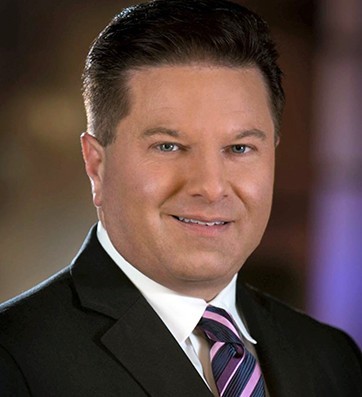
Brian Calfano, PhD, professor and interim head of the Department of Journalism. He has joint appointments in journalism and political science at UC and a political reporter and producer for Nexstar Media Group. Calfano appears regularly on CTV News Channel, Global News Toronto and Sky News. Photo/provided.
Calfano addresses the political aspect in the NiemanLab article by saying: “I really assumed the negative view of ‘storyteller’ was a Republican-driven outcome given how closely ‘fake news’ is linked to Trump’s rhetoric,” he said. “But, as we show in the paper, Democrats are just as likely to offer a negative view of the term.”
“That people on both sides of the political spectrum found the term problematic was surprising to us, but it also emphasized the importance of our study,” says Blevins.
Another takeaway, both say, is that journalists need to be more conscientious about how the public perceives journalism as a profession, which may be different than the industry’s perception.
“Perhaps, more practically, I'd ask fellow journalists to consider having someone who is an outsider (someone not in the news business) read their online and social media bios and ask them about their perceptions. Invite them to speak candidly,” says Calfano, with Blevins adding: “We should all be open to constructive criticism.”
The study’s third co-author is UC alumna Alexis Straka, ’21. She is a graduate of UC’s political science doctoral program and now works in private industry as a market researcher. Straka set up the code for the Twitter data mining.
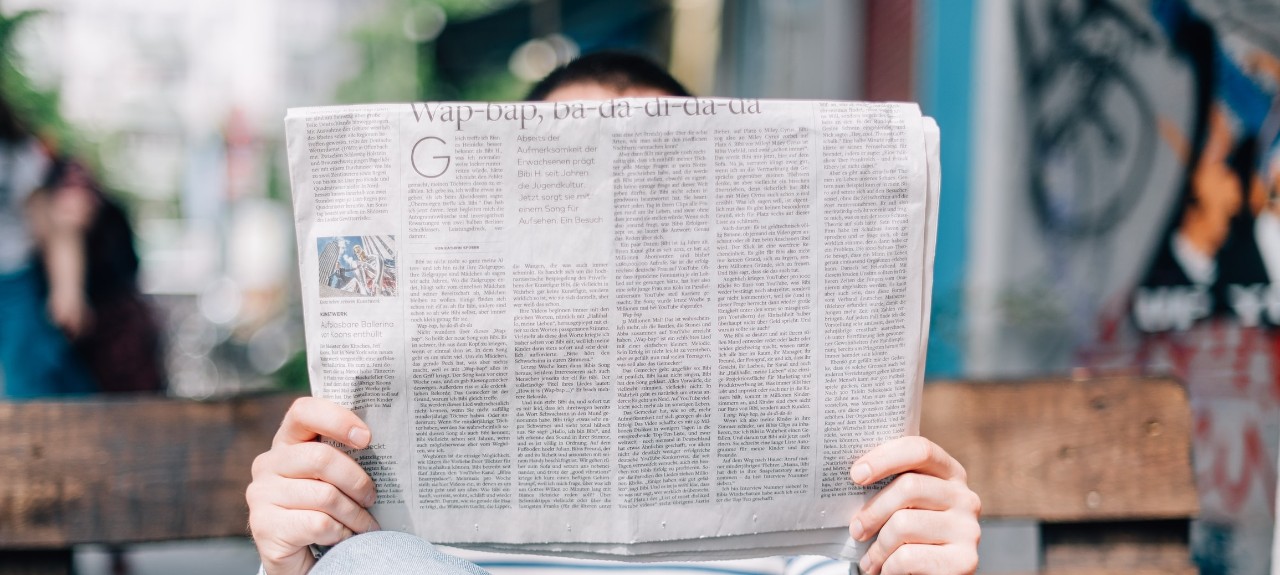
Featured image at top of man reading a newspaper courtesy of Unsplash/Kraft.
Impact Lives Here
The University of Cincinnati is leading public urban universities into a new era of innovation and impact. Our faculty, staff and students are saving lives, changing outcomes and bending the future in our city's direction. Next Lives Here.
Related Stories
A passion for integrative health and teaching
September 10, 2026
For Dan Asimus, MD, Med ’72, as the founder of Life Fitness Center, Inc., a private health clinic specializing in integrative medicine—education and whole-person care have been the foundation of his life’s work.
UC 1819 Innovation Hub ranked No. 23 in Top 100 Best Workplaces for Innovators by Fast Company
September 10, 2026
UC 1819 Innovation Hub is nationally ranked as one of the top 100 Best Workplaces for Innovators.
Could a whale really swallow a person whole?
September 10, 2026

Science News turns to a University of Cincinnati biologist to learn about animals that can swallow people whole as Hollywood gives moviegoers another reason to stay out of the water with the release next month of "Whalefall."