
WVXU: A new University of Cincinnati study traces the impact of mass incarceration on young people and families
UC research finds poorer physical and mental health outcomes in children of parents in jail

A study by a UC College of Nursing researcher examines the impact of mass incarceration on young people and their families. Samantha Boch, PhD, worked as a nurse in several correctional systems in Ohio, which sparked an interest in the role mass incarceration has on prisoners and their families. Boch was interviewed for the WVXU program Cincinnati Edition.
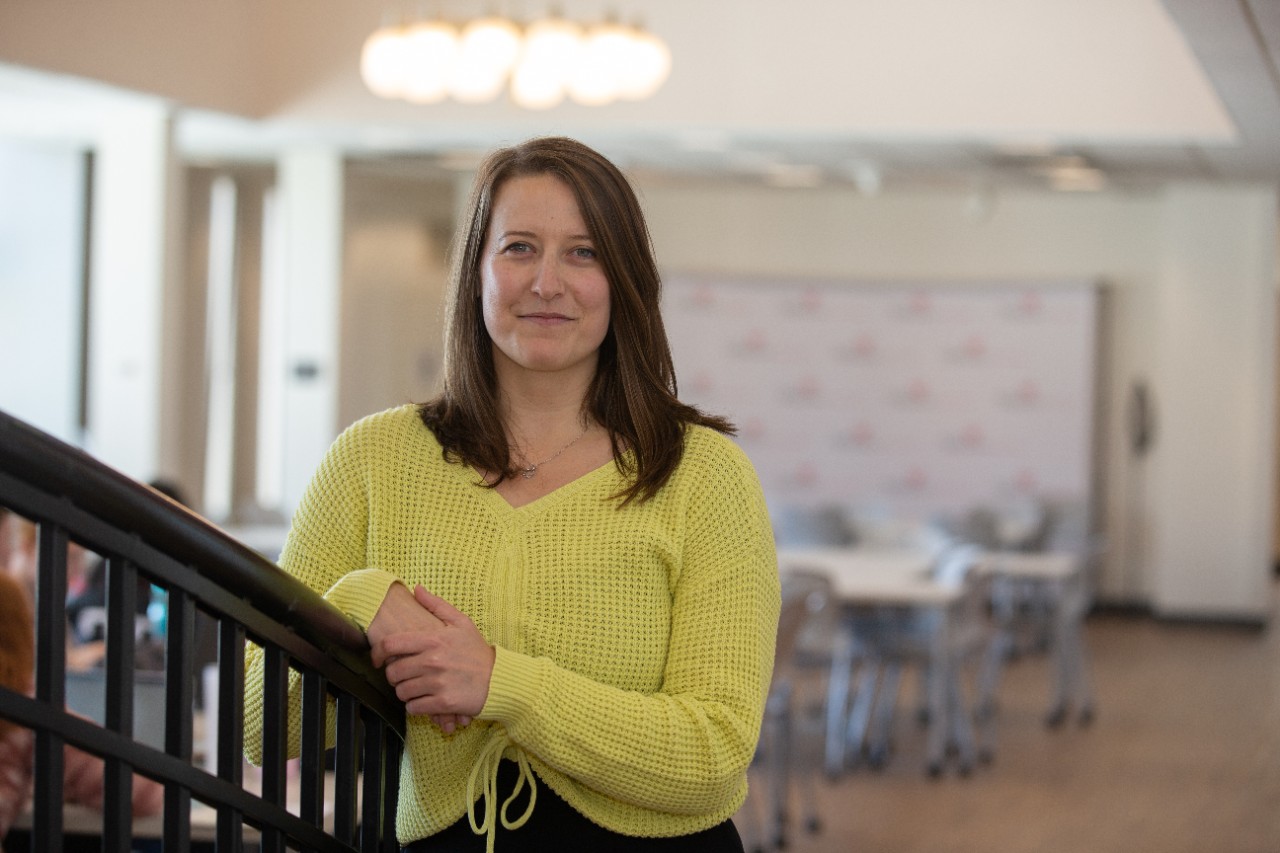
Samantha Boch, PhD, of the University of Cincinnati College of Nursing/Photo/Andrew Higley/UC Creative + Brand
"A lot of my research today is motivated by my time I spent working in prison as a nurse," Boch says. "I started looking, first in grad school, about the effect of parental incarceration and realized that Ohio was ranked fourth in the nation for the number of children who have incarcerated parents but newer data suggests we are now sixth."
Boch told WVXU that one in every 14 children in Ohio have had an incarcerated parent.
"Health care systems don't routinely identify kids who have an incarcerated parent or a parent on parole or probation," Boch says. "We decided, because of the advent of big data, searching for the terms prison, parole, probation, jail, and the electronic medical records at Nationwide Children's Hospital. When we searched for these keywords, about 2% of kids had some sort of justice keyword in their chart, but they made up over half of all mental health disorders, selected mental health disorders ever diagnosed at this institution across a 14-year time span."
Access the WVXU interview here.
Read more about Boch's research here.
Lead photo/Pixabay
Next Lives Here
The University of Cincinnati is classified as a Research 1 institution by the Carnegie Commission and is ranked in the National Science Foundation's Top-35 public research universities. UC's medical, graduate and undergraduate students and faculty investigate problems and innovate solutions with real-world impact. Next Lives Here.
Related Stories
Cancer Center plays key role in lab research, clinical trials for new pancreatic cancer drug
September 1, 2026

WLWT and WCPO highlighted the contributions of University of Cincinnati Cancer Center researchers that helped lead to the recent FDA approval of daraxonrasib, a new treatment for pancreatic cancer.
An expert pieced together this Roman document like a puzzle
September 1, 2026

National media highlighted a new project by UC Classics Assistant Professor Matthijs Wibier to piece together and translate an ancient Roman text from fragments buried in the desert for more than 1,600 years.
Cancer Center physician receives $150,000 New Investigator Research Grant to study treatment-resistant leukemia
September 1, 2026
The University of Cincinnati Cancer Center’s Sarah Skuli, MD, PhD, received a two‑year, $150,000 Leukemia Research Foundation New Investigator Grant to study TP53‑mutated leukemia, a treatment‑resistant subtype with very poor outcomes.