NIEHS director visits to discuss environmental health concerns
Hears from College of Medicine faculty and community organizations

Richard Woychik, PhD, director of the National Institute of Environmental Health Sciences (NIEHS) visited the UC Center for Environmental Genetics (CEG) on May 10 and also met with community members to discuss environmental health issues in Cincinnati.
“I really enjoyed meeting the investigators behind the work that we support at the University of Cincinnati,” Woychik said. “I greatly appreciated the time that Dean Andrew Filak, Dr. George Leikauf, and Dr. Susan Pinney spent with me, and I thoroughly enjoyed hearing about the work of investigators Drs. Katherine Burns, Senu Apewokin and Angelico Mendy, who are clearly very capable and will help drive the future of environmental health sciences.”
Pinney, professor in the Department of Environmental and Public Health Sciences (DEPHS) and director of the CEG, coordinated Woychik’s visit.
Burns, associate professor in the DEPHS, discussed her research on endocrine disrupting chemicals and endometriosis. Apewokin, associate professor in the Department of Internal Medicine, Division of Infectious Diseases, addressed per- and poly-fluoroalkyl substances and response to pneumococcal vaccination. Mendy, assistant professor in the DEPHS, discussed air pollution and COVID-19.
Woychik and Liam O’Fallon from NIEHS joined several DEPHS faculty members in visiting two locations in Cincinnati to discuss health issues. Stops included Smale Park along Cincinnati’s waterfront, where Dave Schmitt, executive director of the Mill Creek Alliance, led a discussion on water issues, and Groundwork Ohio River Valley in Price Hill, where Alan Edwards, chief executive officer of the organization, presented their air pollution monitoring project.
“I was especially impressed by the Community Engagement Core that’s under the direction of Dr. Nick Newman,” Woychik said. Newman also is assistant professor in the Department of Pediatrics.
“And, I was really inspired by the community member presentations from Urban Health Pathway director Dena Cranley and Center for Closing the Health Gap CEO Renee Mahaffey. Visiting the neighborhoods and talking with residents just reinforced the importance that community engagement plays in helping us achieve our mission at NIEHS,” Woychik added.
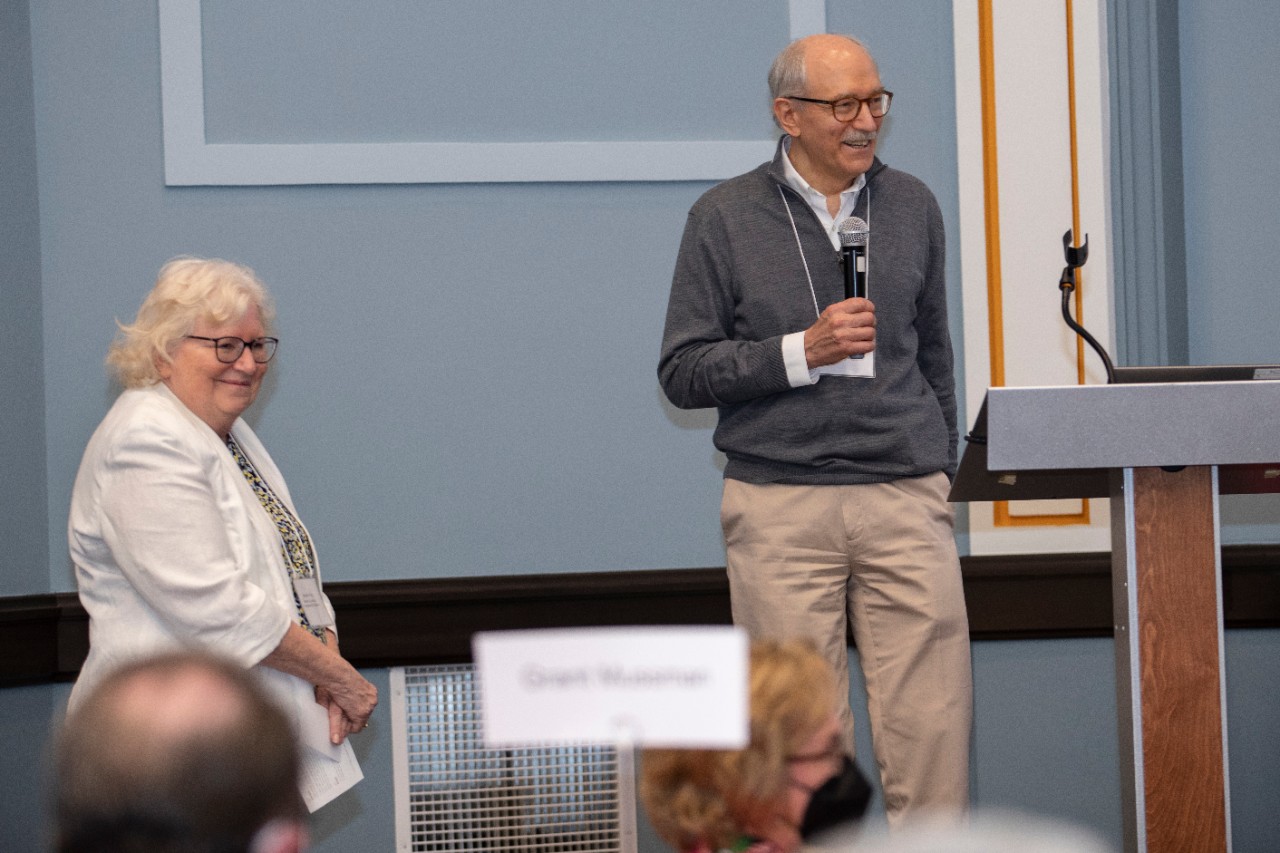
Richard Woychik, PhD, director of the National Institute of Environmental Health Sciences, speaks during a May 10 community forum held by the UC Center for Environmental Genetics (CEG). Susan Pinney, PhD, professor in the Department of Environmental and Public Health Sciences and CEG director, looks on.
The afternoon community forum, which was attended by local government and public health officials and community leaders to discuss precision environmental health and its significance for the region, attracted more than 80 people.
“Dr. Woychik presented an exciting lecture on his vision of Precision Environmental Health,” says Leikauf, DEPHS chair and Jacob G. Schmidlapp Chair of Environmental Health.
Based in the DEPHS and working strongly with Cincinnati Children’s, the CEG is funded by the NIEHS and conducts research on gene-environment interactions and translates discoveries into regional and global disease prevention creating healthier environments. The CEG also works closely with the community on projects that have included the Fernald superfund site in Cincinnati and local water systems to eliminate perfluorinated chemicals from drinking water.
Photos by Lisa Ventre.
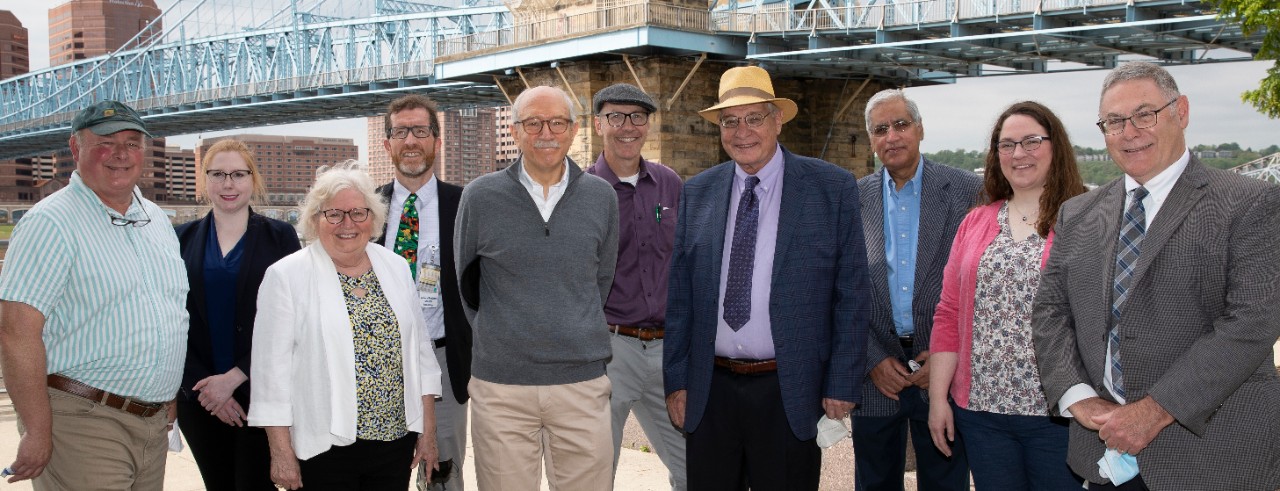
Pictured in the featured photo, left to right: Dave Schmitt, executive director of the Mill Creek Alliance; Michelle Burbage, PhD, assistant professor, DEPHS; Susan Pinney, PhD, professor and CEG director; Nick Newman, DO, assistant professor, Department of Pediatrics; Richard Woychik, PhD, director, National Institute of Environmental Health Sciences; Liam O’Fallon, health specialist, NIEHS Human Population Branch; George Leikauf, PhD, DEPHS chair and Jacob G. Schmidlapp Chair of Environmental Health; Jagjit Yadav, PhD, CEG deputy director and professor, DEPHS; Katherine Burns, PhD, associate professor, DEPHS; and Chuck Doarn, professor, DEPHS.
Related Stories
'Discovery, mentorship, momentum': UC College of Medicine's graduate programs celebrate year of success
September 22, 2026
From new mentorship honors to a growing research pipeline, see how the University of Cincinnati College of Medicine's graduate programs made this a standout year.
Tina Cheng, MD, receives American Academy of Pediatrics’ highest honor
September 22, 2026
UC Pediatrics chair Tina Cheng, MD, has received the American Academy of Pediatrics' highest honor for her decades of advancing child health.
President Pinto’s 2nd glow party brings first-year Bearcats together
September 20, 2026
UC President Neville Pinto and team hosted the second annual Bright Beginnings glow party for first-year students