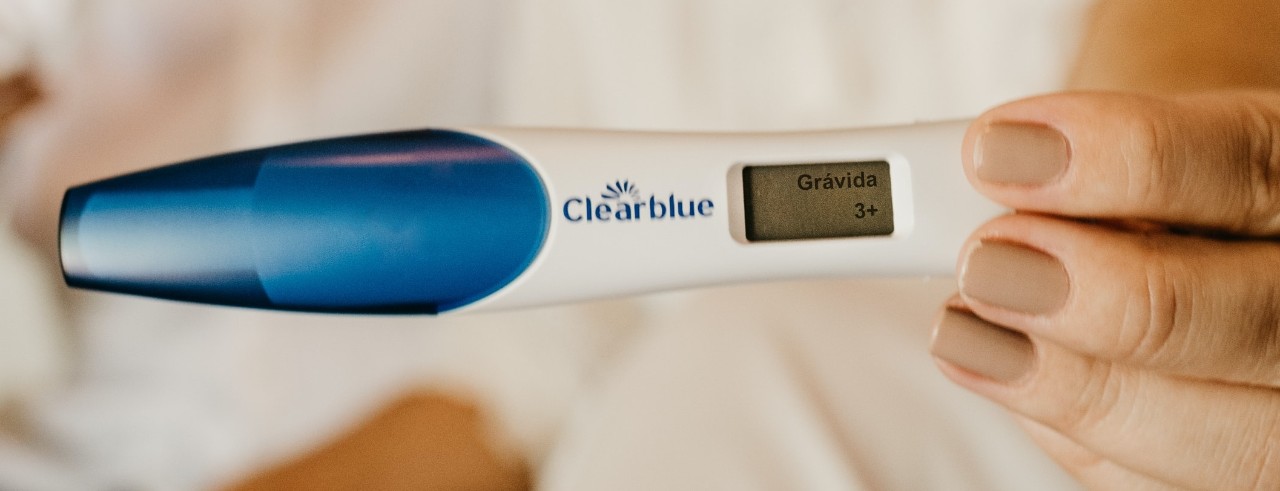
Study: Most Ohioans received abortion care after 6 weeks
Many unaware they’re pregnant until after the state’s newly enacted cutoff

Prior to Ohio’s new six-week cutoff for legal abortions, about 9 in 10 people seeking care in Ohio had abortions later than the current law allows, new research suggests.

Danielle Bessett is an abortion care researcher and teaches courses on medicine, family, and reproduction at the University of Cincinnati. Photo/provided
“This study demonstrates how impactful Ohio’s current abortion restrictions are, as the majority of Ohioans who received care did so after six weeks — which is also just two weeks after a missed period,” says study co-author Danielle Bessett, an associate professor of sociology at the University of Cincinnati and affiliate faculty in the Department of Women’s Studies, Gender and Sexuality Studies.
The study, published in the American Journal of Obstetrics and Gynecology, was done as part of the work of the Ohio Policy Evaluation Network, or OPEN, a multi-university reproductive health care research group that Bessett co-leads.
The findings come from a survey conducted in 2020 and 2021 that included 1,141 abortion patients. Since then, following this summer’s Supreme Court ruling overturning Roe v. Wade, Ohio has banned abortions after six weeks, or 42 days of pregnancy.
What researchers found is that 1 in 4 patients didn’t know they were pregnant before six weeks of gestation. Among those who did know they were pregnant before six weeks, 86% still had their abortions after the six-week mark.
Obviously everyone who doesn’t know they’re pregnant until after six weeks gestation can’t get an abortion in our state.
Abigail Norris Turner Researcher, Ohio State University
Lead author Abigail Norris Turner, a professor in the colleges of medicine and public health at Ohio State University, said the study suggests that a large percentage of pregnant people who want to terminate a pregnancy will now not be able to do so in Ohio.
“Regardless of when pregnancy is discovered, six-week bans disrupt care for nearly all patients,” she said. “Obviously everyone who doesn’t know they’re pregnant until after six weeks gestation can’t get an abortion in our state. But when you also consider the requirement of at least two clinic visits, a mandatory 24-hour waiting period, staff shortages and high demand, among other factors, some people who know they are pregnant before six weeks are likely still not going to be able to get abortions before the six-week limit.”
The researchers also wanted to understand whether people who knew they were pregnant before six weeks had a different “deliberation window” than those who learned they were pregnant later. Their findings showed that the two groups of patients reported approximately the same number of days — two to three — between finding out they were pregnant and contacting the abortion clinic.

Photo/Unsplash
The median gestation when a person discovered a pregnancy was 34 days — about a week before the current ban renders abortion illegal in Ohio. The median time between pregnancy discovery and termination was about triple that — 22 days.
The study also found that later pregnancy discovery was more common for those who had fewer educational and financial resources.
This law is not only inconsistent with medical decision-making, but it will make the process harder for abortion seekers, says Bessett. “The evidence is very clear that some folks after 6 weeks gestation will incur significant hardship to obtain care out of state; their care will likely be delayed as they make arrangements and raise funds to travel further for care. Others will not get care at all,” she says.
Additionally, Bessett says, others may feel time pressure to obtain an abortion before cardiac activity can be detected, which is equally cruel, since abortion patients have had a high degree of what researchers call decisional certainty (confidence in their choice).
The researchers say that the findings underscore the importance of keeping pregnancy tests on hand, taking them early and scheduling any pregnancy-related appointments as soon as possible.
Study co-authors include Alison Norris and Katherine Rivlin of Ohio State University and Jeremy Brenner-Levoy, Zoe Muzyczka and Tamika Odum of the University of Cincinnati.
Featured photo at top courtesy of Unsplash.
Impact Lives Here
The University of Cincinnati is leading public urban universities into a new era of innovation and impact. Our faculty, staff and students are saving lives, changing outcomes and bending the future in our city's direction. Next Lives Here.
Related Stories
UC student veterans explore engineering careers
August 19, 2026

Stars and Stripes magazine highlighted the co-op experience of a University of Cincinnati mechanical engineering student who is working with the U.S. Army Corps of Engineers.
UC expert helps rehome endangered Ohio bats
August 19, 2026

UC College of Education, Criminal Justice, and Human Services Assistant Professor Joe Johnson is helping an Ohio marine rehome bats to make way for renovations. He launched a new tracking project that uses tiny transmitters that record bat migration using the internet of things.
Helping first-generation students explore the world
August 19, 2026
When Penny Wills, CECH ’74, began her undergraduate degree at the University of Cincinnati’s College of Education, Criminal Justice, and Human Services, every experience was fresh and exciting.