Medical News Today: Gene mutation may be a key to lung cancer treatment

Medical News Today highlighted University of Cincinnati research recently published in the journal Nature Communications that found targeting components of lipid metabolism and synthesis could lead to an effective lung cancer treatment.
The research focused on lung cancer with a mutated KRAS gene, an oncogene that works as a gas pedal to help cancer cells grow. The team found that lung cancer with the KRAS gene had a unique lipid profile and was dependent on an enzyme called FASN that is involved in fatty acid synthesis.
The researchers found that blocking FASN promoted the death of specific lung cancer cells. Pier Paolo Scaglioni, MD, corresponding author on the study, told Medical News Today there are exciting potential treatments that could come as a result of this research.
"There is a great interest in developing drugs that target the metabolisms of cancer cells. Thus, yes, there are therapeutic implications," said Scaglioni, associate director for translational research at the University of Cincinnati Cancer Center, professor and division chief of hematology oncology in the Department of Internal Medicine in UC’s College of Medicine and a UC Health physician. "We have carried out a phase I trial with a FASN inhibitor and are performing a phase II trial in lung cancer patients with the KRAS mutation.”
Read the Medical News Today article.
Read more about Scaglioni's research.
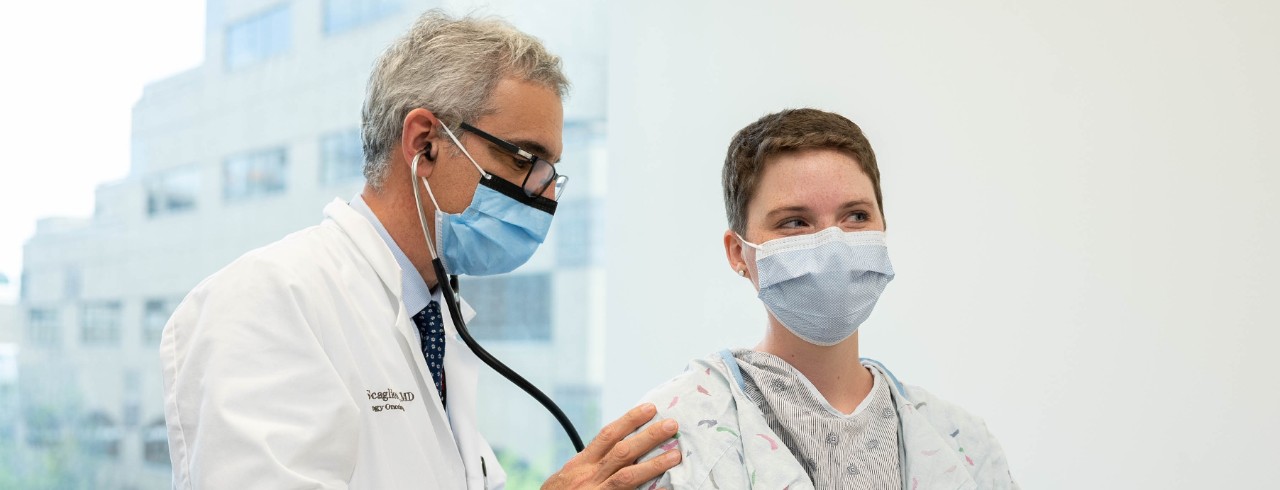
Featured photo at top of Dr. Scaglioni with a patient courtesy of UC Health.
Related Stories
DAAP appoints Joseph Heathcott as new associate dean for research
August 27, 2026
DAAP appoints new associate dean for research Joseph Heathcott, who will bring a nationally recognized voice in urban development, design and research to the University of Cincinnati starting this fall 2026.
Ride Free UC offers free transportation options this fall
August 21, 2026
Ride Free UC: UC students, faculty and staff can take advantage of free UC Metro Pass and the Bearcats Shuttle for convenient travel between campuses and throughout Cincinnati.
What is electroacoustic music?
August 21, 2026

Professor Mara Helmuth spoke with Cincinnati Spotlight about her upcoming faculty recital on Cincinnati Spotlight.