
WVXU: New year means new airlines, tech for CVG
UC grad helps predict crowding at airports to shorten lines

WVXU highlighted one of the ways the University of Cincinnati is helping Cincinnati Northern Kentucky International Airport improve the travel experience.
UC College of Engineering and Applied Science doctoral graduate Javier Viaña is using artificial intelligence to help the airport's data tracker better predict when it could see longer lines at the terminal and security.
The system considers factors such as whether a passenger will use long-term parking, check a bag or travel with family to predict surges in foot traffic.
Airports already know how many passengers to expect from flight reservations. But Viaña said that doesn’t tell them how many people to expect in a terminal at any given time.
“There’s a big difference between the flight schedule and the actual flow of people,” he said. “You might be able to say 10,000 people will be taking off at 10 a.m. But they don’t show up at 10 a.m. Some might show up at 8:45 or 9:20.”
His algorithm more precisely predicts how many people will filter through check-in and security in 15-minute intervals, Viaña said.
“It’s an exciting project. We’ve been getting good results,” Viaña said.
Featured image at top: UC students pick up their bags at Cincinnati Northern Kentucky International Airport. Photo/Joseph Fuqua II/UC
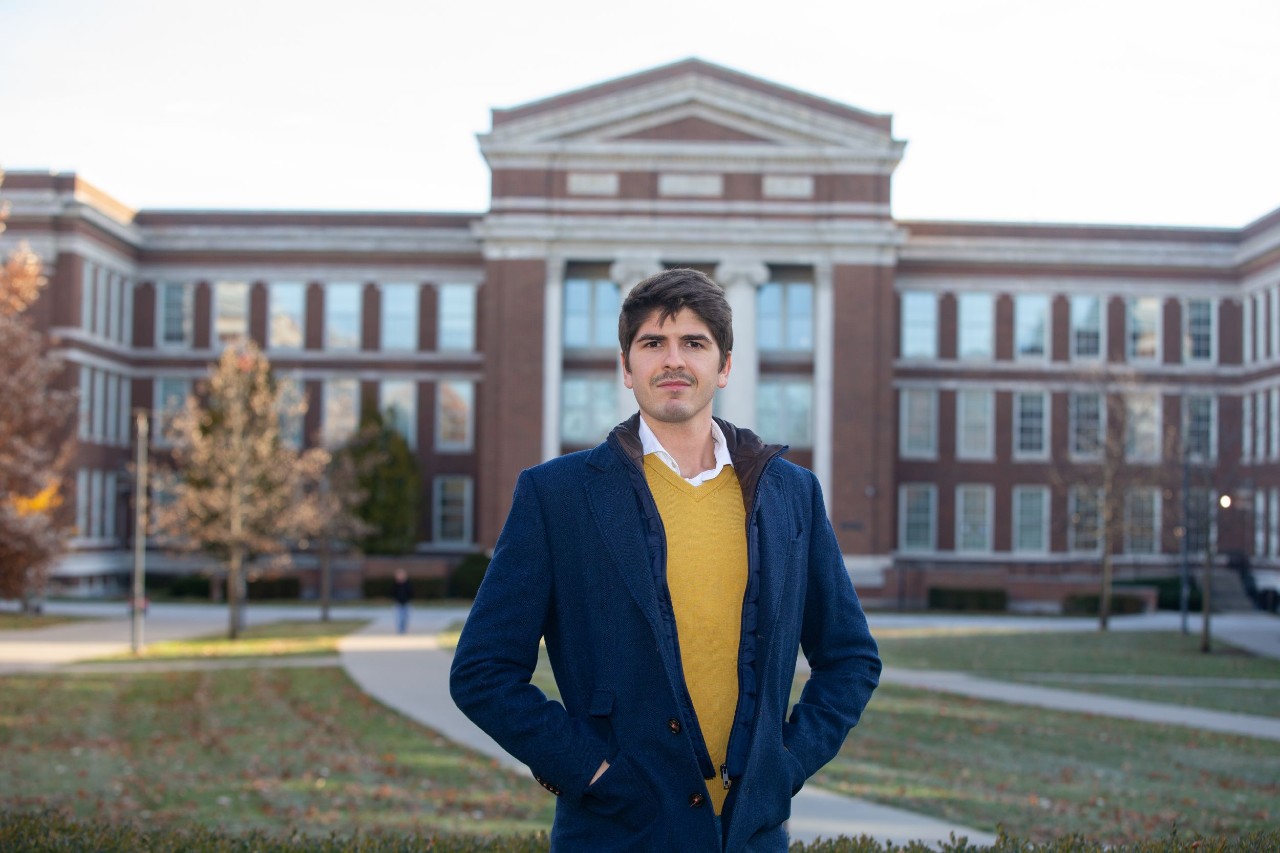
UC College of Engineering and Applied Science graduate Javier Viaña developed an algorithm to help airports predict crowding. Photo/Andrew Higley/UC Marketing + Brand
Related Stories
What to know about lung adenocarcinoma following Pope Leo diagnosis
October 14, 2026

The University of Cincinnati Cancer Center's Robert Van Haren, MD, was featured in a Medical News Today article discussing the diagnosis, risk factors, symptoms and treatment of lung adenocarcinoma in light of Pope Leo XIV's recent diagnosis.
UC researchers help demonstrate proof-of-concept gene therapy for hydrocephalus
October 14, 2026
A proof-of-concept study led by UC’s Agnes (Yu) Luo, PhD, and collaborators at UC Davis shows that an adeno-associated virus (AAV) gene therapy can reduce hydrocephalus-associated tissue damage in animal models, pointing to a potential new treatment strategy.
1819 leaders share innovation insights at StartupCincy Week 2026
October 13, 2026
Entrepreneurship and innovation experts from the University of Cincinnati’s 1819 Innovation Hub shared tips throughout StartupCincy Week 2026. Discover their thoughts, predictions and tips.