
CVG and UC put AI to work to shorten airport lines
UC engineering student's algorithm helps airport predict crowding

The University of Cincinnati is teaming up with Cincinnati/Northern Kentucky International Airport to address crowding.
UC College of Engineering and Applied Science doctoral student Javier Viaña used airport technology that identifies the number of people entering the terminals to build a custom algorithm that can help the airport predict surges of travelers in 15-minute increments.
This information could help the Transportation Security Administration anticipate when to open new lines, Viaña said.

UC College of Engineering and Applied Science student Javier Viaña. Photo/Andrew Higley/UC Creative + Brand
“The main objective of this work is to improve the passenger experience and inform operational decision-making at the airport," said Candace McGraw, CEO of Cincinnati/Northern Kentucky International Airport.
“The modelling done by Javier provides the airport and our business partners reliable data to prepare our operations based on passenger arrival predictions, potentially reducing crowding and wait times along the travel journey from parking and check-in to security screening and concessions.”
UC used an artificial intelligence based on fuzzy logic, a type of computer decision making that relies on degrees of truth rather than a binary true-false dichotomy. As a result, the algorithm is explainable and transparent, Viaña said.
“A lot of AI algorithms we use are opaque. They’re a black box,” he said. “Neural networks are difficult to understand from a human perspective. We understand the mathematical logic behind them, but they’re difficult to visualize. And that lack of transparency can create suspicion.”
This collaboration led to the Nov. 17 signing of a three-year memorandum of understanding between UC and the Kenton County Airport Board to collaborate on research and technology projects. Among other projects, UC is studying driverless vehicles, autonomous drones and autonomous robots that might prove useful for future applications at the airport.
Airports already know how many passengers to expect from flight reservations. But Viaña said that doesn’t tell them how many people to expect in a terminal at any given time.
“There’s a big difference between the flight schedule and the actual flow of people,” he said. “You might be able to say 10,000 people will be taking off at 10 a.m. But they don’t show up at 10 a.m. Some might show up at 8:45 or 9:20.”
His algorithm more precisely predicts how many people will filter through check-in and security in 15-minute intervals, Viaña said.
“It’s an exciting project. We’ve been getting good results,” Viaña said.
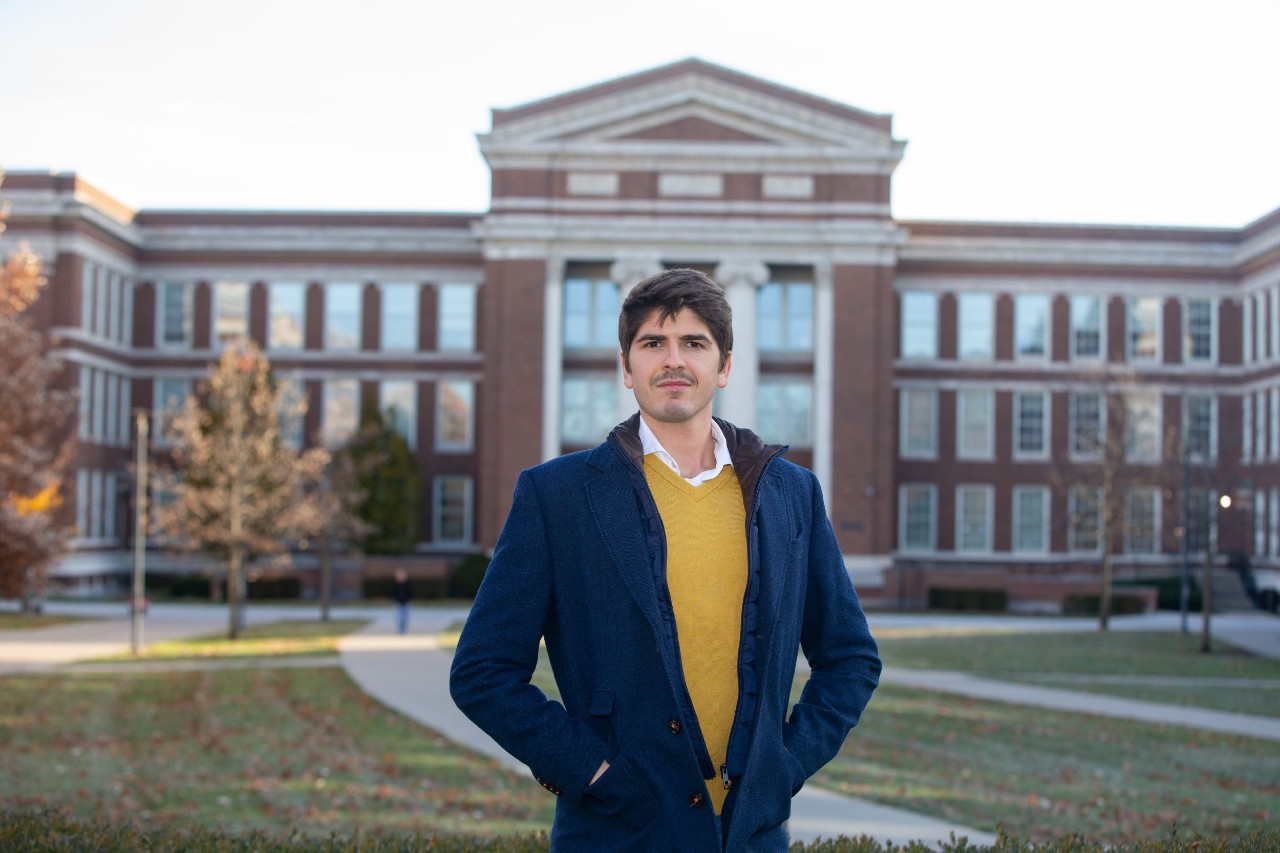
UC College of Engineering and Applied Science student Javier Viaña developed an algorithm to help predict crowds at Cincinnati/Northern Kentucky International Airport. The system he developed could help other airports predict crowding to prevent long lines. Photo/Andrew Higley/UC Creative + Brand
UC’s work is funded in part through a grant from the Airport Cooperative Research Program, an industry-driven network that develops near-term practical solutions to airport challenges.
“Everyone else who has gotten this grant award has gone on to great success, so there is a lot of pressure,” Viaña said. “But it’s a nice feeling to be counted among them.”
Knowing more about whom is in the building at any time also could help advertisers in the airport target particular groups of travelers on digital billboards, Viaña said.
“If you know at some point in the airport you’ll have passengers traveling to Hawaii, you could make better advertisements targeting those passengers based on their destinations,” he said.
Viaña and the airport plan to offer UC’s predictive algorithm to other airports interested in improving their efficiency and their passengers’ travel experience.
Featured image at top: UC College of Engineering and Applied Science students from China arrive at Cincinnati-Northern Kentucky International Airport in this 2018 photo. Photo/Joseph Fuqua II/UC Creative + Brand
Impact Lives Here
The University of Cincinnati is leading public urban universities into a new era of innovation and impact. Our faculty, staff and students are saving lives, changing outcomes and bending the future in our city's direction. Next Lives Here.
Related Stories
AI breast cancer survival model from Cancer Center could improve accuracy and personalize care
October 23, 2026
UC Cancer Center researchers, including lead author Wedad Alatebi, developed a deep learning survival model for breast cancer that combines detailed clinical and genetic information, potentially offering physicians a more accurate tool to guide treatment decisions.
UC Biomedical Engineering student launches mobile healthcare platform
October 22, 2026
As a fifth-year biomedical engineering student at the University of Cincinnati College of Engineering and Applied Science, Amelia Wares has been a trailblazer in nearly every area imaginable — and this is only the beginning of her journey.
UC aerospace engineer leads global computational fluid dynamics taskforce
October 21, 2026
The American Institute of Aeronautics and Astronautics' CFD 2030 Integration Committee has announced the formation of the Computational Fluid Dynamics (CFD) Vision 2045 Team, a multi-institution working group tasked with defining where the field of computational fluid dynamics should be by 2045 to align with the changing and evolving needs of the aerospace industry. The University of Cincinnati's Prashant Khare, Bradley Jones professor and head of the Department of Aerospace Engineering, is leading this specialized group.