
Sky News: Could interstitial fluid replace blood?
UC graduate discusses new frontier of health monitoring

Sky News highlighted University of Cincinnati research into the next frontier of continuous health monitoring.
UC College of Engineering and Applied Science graduate Mark Friedel developed a prototype sensor that monitors chemicals found in the interstitial fluid just under your skin. The sensor uses tiny microneedles that pick up information about your health that can be tracked over time.

UC biomedical engineering graduate Mark Friedel and his research collaborators developed wearable technology in UC professor Jason Heikenfeld's Novel Devices Lab. Photo/Andrew Higley/UC Marketing + Brand
He co-authored a study looking at the potential for interstitial fluid in continuous health monitoring that was published in the journal Nature Biomedical Engineering.
Interstitial fluid contains many of the same chemicals and biomarkers that doctors use in blood to diagnose disease or track health and wellness, Friedel told Local 12.
Friedel developed the sensor in UC professor Jason Heikenfeld's Novel Devices Lab.
“Why we see it as a valuable diagnostic fluid is continuous access. With blood, you can’t easily take continuous readings,” Friedel said.
Featured image at top: UC's Mantei Center is a cornerstone of the College of Engineering and Applied Science. Photo/Andrew Higley/UC Marketing + Brand
More UC biomedical engineering in the news

University of Cincinnati biomedical engineers say sensors that monitor interstitial fluid could be the next frontier for wearable technology. Photo/Mark Friedel
- National Science Foundation: Getting under your skin for better health
- Technology Networks: Advantages and challenges of using interstitial fluid in diagnostics
- Laboratory Equipment: Interstitial fluid could better monitor health
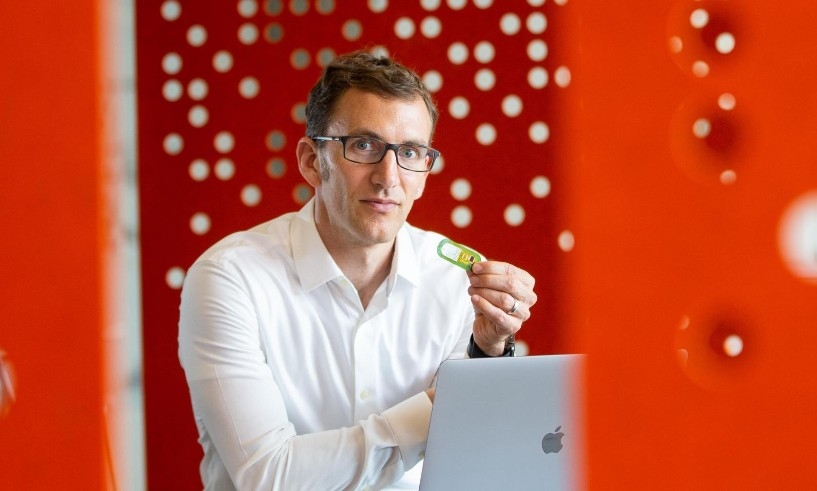
UC College of Engineering and Applied Science professor Jason Heikenfeld and his students develop wearable technology in his Novel Devices Lab. Photo/Andrew Higley/UC Marketing + Brand
Related Stories
Simple ways to find a deeper sense of happiness and well being
October 8, 2026

UC assistant professor Suzie White, featured in an AARP story on practical ways to live a happier, healthier life, shared research-backed strategies for increasing well-being through gratitude and service to others. White teaches Happiness in Action, a course that helps students apply the science of happiness in everyday life.
New vending machine helps people with addiction
October 8, 2026

The University of Cincinnati's Daniel Arendt was featured in a Spectrum News report on a new harm reduction vending machine installed at the IPM Food Pantry in partnership with the Hamilton County Mental Health and Recovery Services Board.
Defying the demographic cliff
October 7, 2026

Despite the looming demographic cliff, the University of Cincinnati and five other major Greater Cincinnati universities grew enrollment this fall, with UC reaching a record 54,437 students, helped by strong first-year demand.