WaPo: Cavefish offer clues to future of human couch potatoes
UC biologist explains sedentary behavior of blind cavefish

The Washington Post turned to a University of Cincinnati biologist to explain how the evolution of Mexican blind cavefish could offer clues to our future evolution given people's increasingly sedentary lifestyles.

UC associate professor Joshua Gross. Photo/Andrew Higley/UC Marketing + Brand
Even people who are active every day had trouble maintaining their lifestyle during the COVID-19 pandemic when gyms, parks, playgrounds and group activities were shut down for social distancing, the Post said.
But UC College of Arts and Sciences associate professor Joshua Gross told the Post that our sedentary lifestyle does not compare to that of the Mexican blind cavefish.
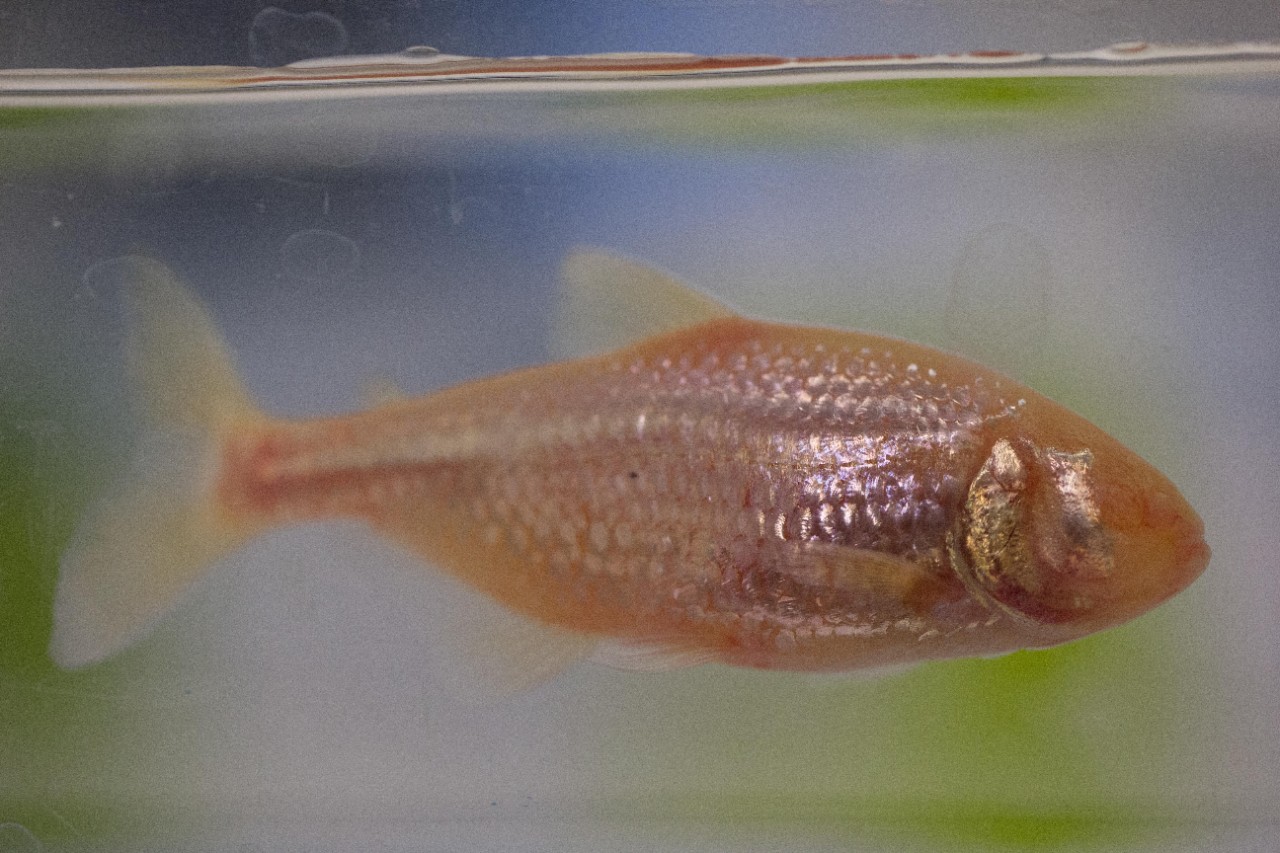
Gross studies the fish and their interesting evolutionary path in his biology lab. The fish were swept deep underground by flooding more than 160,000 years ago and over thousands of generations evolved in dark world that had little food to offer. They lost eyes that had become useless in their dark world while developing other characteristics that help them survive.
Meanwhile, their ancestors continue to thrive on the surface, giving scientists a unique opportunity to compare the animals side by side to see how they diverged.
The Post turned to Gross to explain a new study in the Proceedings of the National Academies of Science that examined how the fish evolved to swim slowly, starve for long periods and get by with less muscle mass and more fat. He was not part of the research.
“What I felt was interesting is that in humans, it has been long understood that a sedentary lifestyle leads to pretty negative health outcomes, but those come within a lifetime,” Gross told the Post. “This study provides an idea of how inactivity can play out not just in a lifetime, but in long-term evolutionary changes.”
In his biology lab, Gross and his students have learned more about how cavefish survive and navigate their low-nutrient, low-oxygen environment.
Read the Washington Post story.
Read more about UC's blind cavefish research.
Featured image at top: A Mexican blind cavefish swims in a UC biology lab. Photo/Andrew Higley/UC Marketing + Brand
Related Stories
Playbill ranks CCM in Top 10 most represented colleges on Broadway
September 14, 2026

The University of Cincinnati College-Conservatory of Music has once again been named as one of Playbill’s Top 10 most represented schools on Broadway.
Parakeet males, females equally likely to fight
September 14, 2026
Researchers from the University of Cincinnati and Duke University studied captive monk parakeets and found that sex has little effect on who starts fights, who is targeted or who rises in the dominance hierarchy, as reported in Integrative & Comparative Biology.
UC researchers seek to combat youth weight gain from bipolar medication
September 14, 2026

Cleveland.com highlighted a University of Cincinnati initiative approved for funding by the Patient-Centered Outcomes Research Institute (PCORI) to expand the implementation of healthy lifestyle interventions and metformin prescription to help manage weight gain in overweight or obese youth taking second-generation antipsychotic medications.