
WVXU: Football helmets don't protect back of head as well
UC biomedical engineer studies concussions in football

WVXU highlighted concussion research by the University of Cincinnati that explored how well helmets protect players from hits at different angles.
Eric Nauman, a professor of biomedical engineering in UC's College of Engineering and Applied Science, put popular football helmets made by leading brands through impact testing and found that no single design demonstrated superior reduction of potential concussion incidence or consistent energy absorption at every part of the helmet.
Concussions from football are a health concern across all age groups from youth sports to professional leagues.
Nauman's study was published in the Journal of Biomechanical Engineering.
Nauman's tests showed that players are especially vulnerable to potential concussions from hits to the back of their helmets such as when their head hits the ground.
“The classic one is that Tua Tagovailoa, when he's playing the Bills. He fell backwards and hit his head on the ground,” Nauman told WVXU. “He clearly was impaired after that. We think that's largely because that helmet doesn't absorb a lot of the energy when it's a blow to the back of the head.”
Nauman says he doesn't want to prevent anybody from playing football, he just wants to make the game safer for those who do want to play.
Featured image at top: UC biomedical engineering professor Eric Nauman is studying ways to make helmets safer in his lab. Photo/Andrew Higley/UC Marketing + Brand
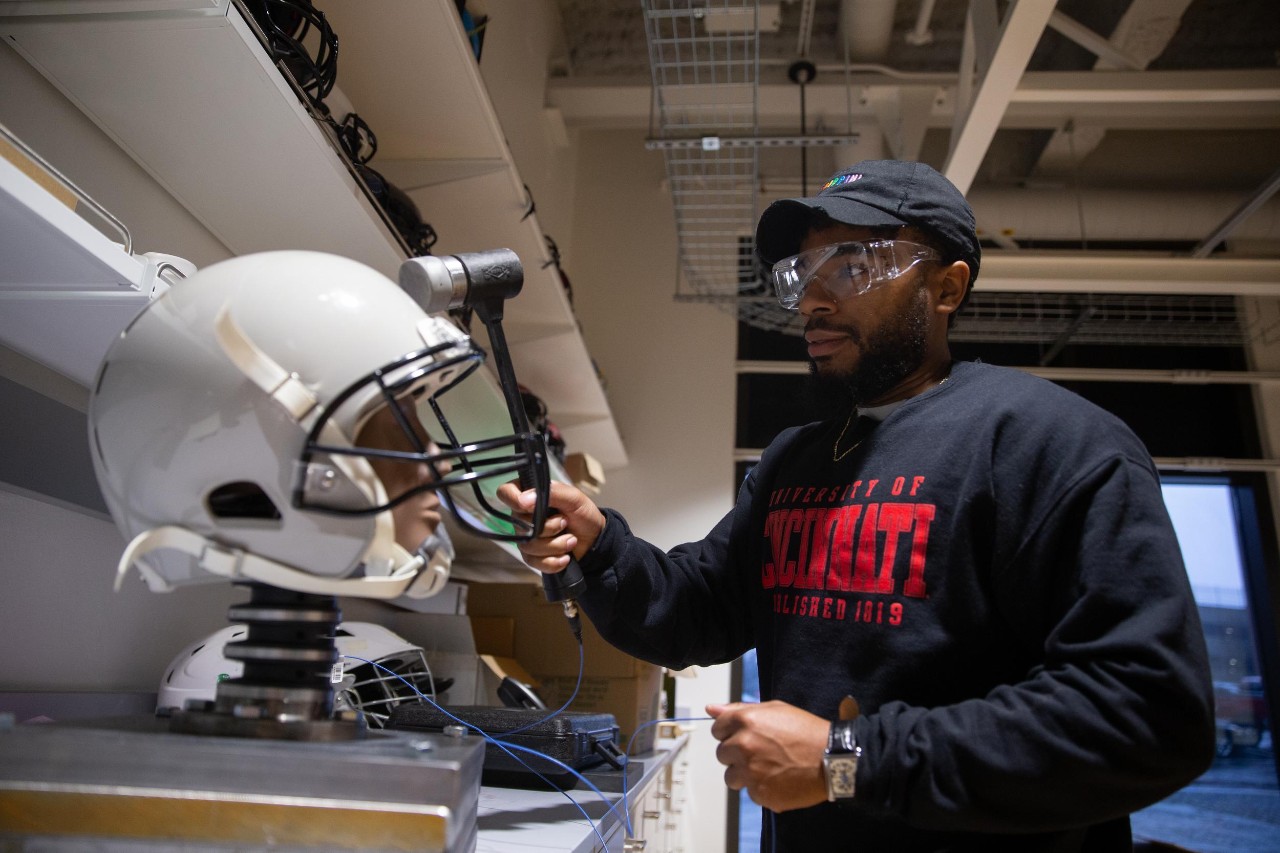
UC student Christopher Boles uses a modal hammer to strike a helmet. Photo/Andrew Higley/UC Marketing + Brand
Related Stories
UC Speech & Hearing Clinic serves patients while acting as training site
September 30, 2026

The University of Cincinnati's Speech & Hearing Clinic provides graduate students in audiology and speech-language pathology with hands-on experience while delivering care to patients across the region. Located on the university's medical campus, the clinic serves patients of all ages and was recently featured on Spectrum News 1 Ohio.
UC economist warns of higher heating costs this winter
September 30, 2026

David Brasington explains why home heating will cost so much this winter and how to save money.
Former mistress of convicted pastor and former American Idol contestant likely won’t face criminal charges
September 30, 2026

Mark Godsey, a criminal law professor in the Donald P. Klekamp College of Law at the University of Cincinnati spoke with NBC News about a criminal case that has attracted national attention.