PBS NewsHour: Why tracking these pollution indicators is key after the East Palestine train derailment
UC expert says after such a disaster, a coordinated effort to determine exposure is the key

Two months after a train carrying hazardous chemicals derailed in East Palestine, Ohio, state and federal agencies are monitoring air, water and soil samples in and around the derailment site for signs of pollution. Some are wondering how long will those steps be necessary to ensure the safety of the community?
In a story produced by PBS NewsHour, one of the experts interviewed was Glenn Talaska, PhD, professor emeritus in the Department of Environmental and Public Health Sciences in the UC College of Medicine.
Talaska was chosen by Ohio Sens. Sherrod Brown and J.D. Vance to offer his expert take on what a robust public health response in the community should look like. He said he thinks in the aftermath of a disaster, a coordinated effort to get “a better handle on exposure” among residents is key.

Glenn Talaska, PhD, professor emeritus in the Department of Environmental and Public Health Sciences/Photo/Colleen Kelley/UC Marketing + Brand
“It’s a relatively easy process of just collecting a urine sample from individuals who you may be evacuating, getting a sample from them so that we could assess – with whatever biomarkers are going to be available and appropriate – what the exposures were,” Talaska said.
Immediate biomonitoring after disasters like the East Palestine train derailment would both help fill in gaps in exposure assessments in subsequent epidemiological studies, Talaska said. CNN reported in late March that the Ohio Department of Health was poised to offer blood and urine testing to first responders who worked at the derailment site.
The lingering uncertainty in the absence of that type of data collection exacerbates fear and anxiety about their long-term future, he added. But quick-turnaround biomonitoring wasn’t pursued in East Palestine or, generally, during the myriad similar crises that have come before or after it.
That’s because it’s not mandatory for officials to incorporate tools that can help assess exposure early on – like urine sampling – as part of their standard practice in the aftermath of disasters like the one in East Palestine, Talaska said. That’s a problem, in his view, given that the incident in East Palestine is not an isolated event.
“It will happen again. We will have some sort of chemical exposure from this or that or the other thing that we have to deal with as a nation,” he said. “And I think the key takeaway is that we’re not quite ready.”
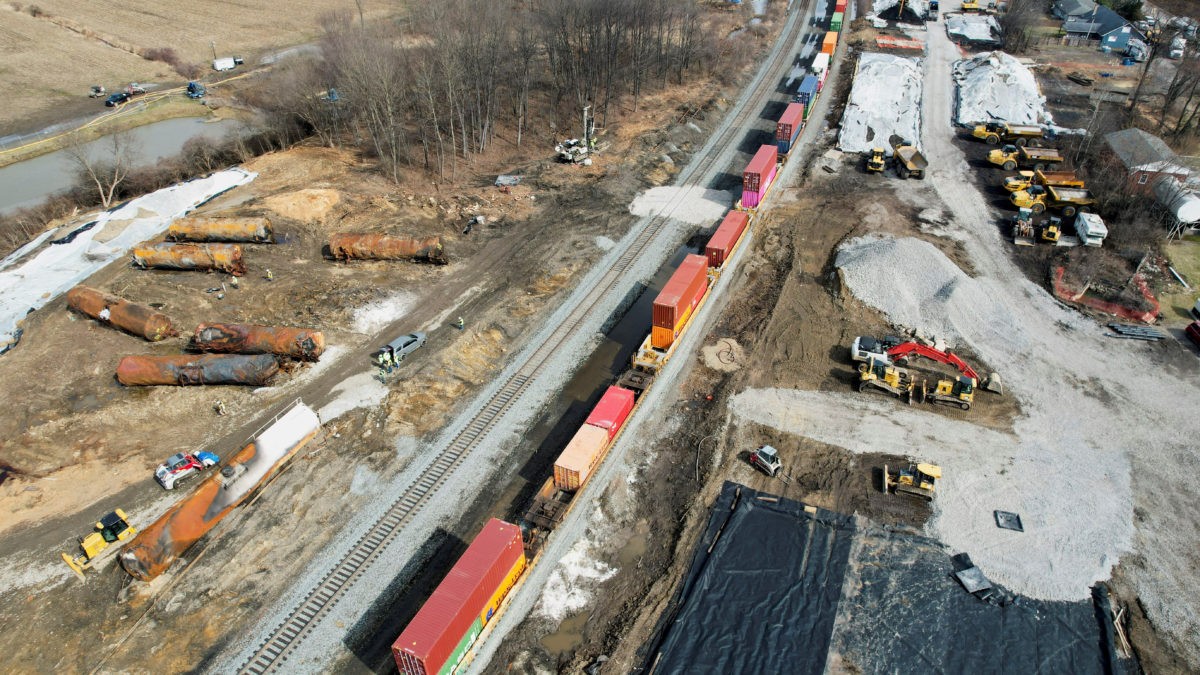
Lead photo of the East Palestine derailment/Alan Freed/Reuters
Next Lives Here
The University of Cincinnati is classified as a Research 1 institution by the Carnegie Commission and is ranked in the National Science Foundation's Top-35 public research universities. UC's graduate students and faculty investigate problems and innovate solutions with real-world impact. Next Lives Here.
Related Stories
These teeny spiders are social media stars
August 28, 2026

The New York Times turned to a University of Cincinnati professor to explain the appeal of jumping spiders on social media.
An internal divide among unions on AI impacts the Wisconsin gubernatorial race
August 28, 2026

Anne Lofaso, a professor in the Donald P. Klekamp College of Law at UC, spoke with Wisconsin Public Radio, about the schism among unions over AI and whether it is a plus, a negative, or somewhere in between when looking at job creation.
On-site training in Speech & Hearing Clinic sets UC’s programs apart
August 27, 2026
At the University of Cincinnati’s Speech & Hearing Clinic, Doctor of Audiology and Speech-Language Pathology graduate students gain real-world experience while providing free speech and hearing services to the community.