What do moms and roaches have in common?
UC research finds both undergo amazing transformations to prepare for babies

Researchers are studying the dramatic physical transformation that some insects undergo to give birth to live young.
This includes suppressing their immune systems to accommodate babies, which is something some insects and people have in common. Understanding how these systems work can help improve treatments for fibromyalgia and other immune disorders.
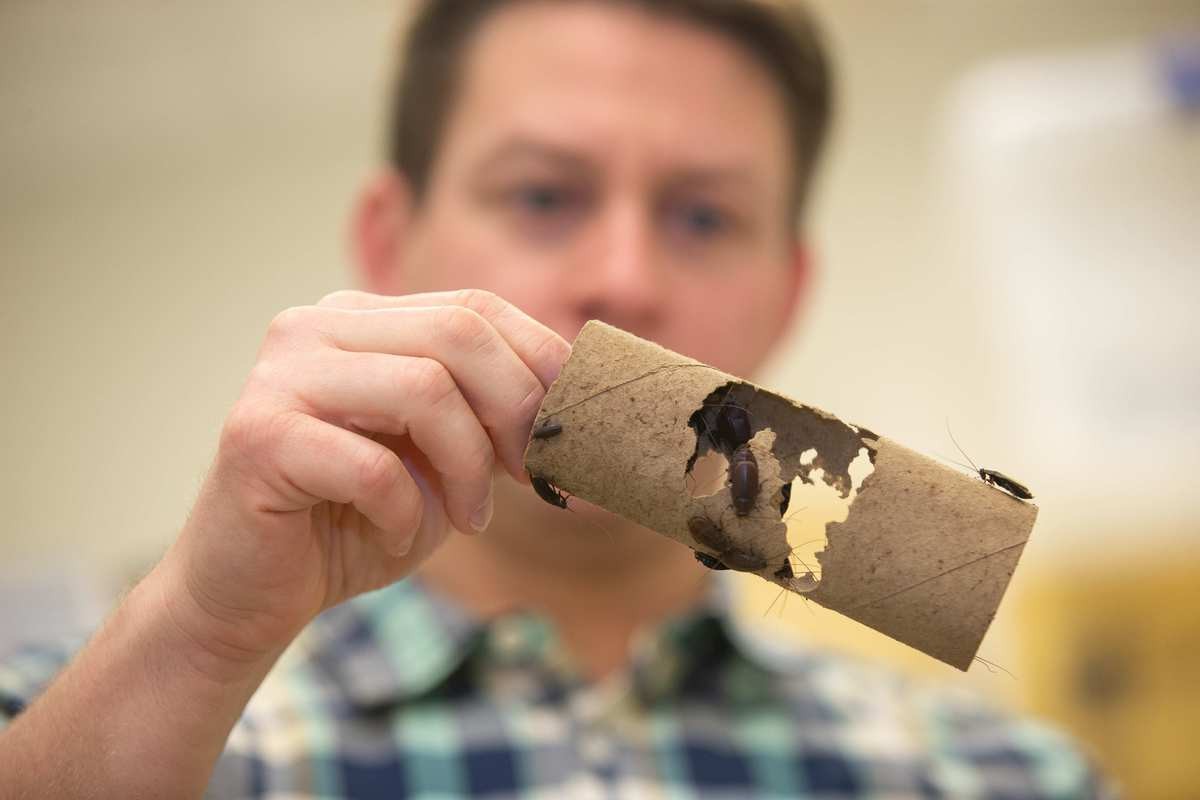
Biologists at the University of Cincinnati were part of an international team examining the complex structural and physiological changes that take place in Hawaii’s beetle-mimic cockroaches, which give birth to live young. Researchers included multiple students from UC, including contributions from graduate students Emily Jennings and Ezemuoka Chiamaka and undergraduate Ronja Frigard.
“It’s not just immunology,” co-author and UC College of Arts and Sciences Professor Joshua Benoit said.
Biologists see similar changes in the insect’s trachea, its immune system and the outer layer of its exoskeleton called a cuticle, which transforms to make room for the babies.
The study was published in the journal iScience.

UC Professor Joshua Benoit studies Pacific beetle-mimic cockroaches in his lab. Photo/Andrew Higley/UC Marketing + Brand
Cockroach mothers not only incubate their babies until they are the equivalent size of a 2-year-old human toddler, but they also feed them a milk-like nutrient they produce through secretory glands.
Nature has devised a myriad of reproductive strategies across the animal kingdom, said Bertrand Fouks, a postdoctoral fellow at the University of Muenster and the study’s lead author. From birds and reptiles to fish, lots of animals lay eggs. In mammals, egg laying is limited to echidnas, sometimes known as spiny anteaters, and the platypus.
“The beetle-mimic cockroach is one of the rare insects which has developed a complex structure to host the growing embryo similar to placenta in mammals, which made it a perfect model to investigate the evolution of live-birth,” Fouks said.
The class of predators really narrows when you give birth to live young.
Joshua Benoit, UC College of Arts and Sciences
For the study, researchers sequenced the genome of the Pacific beetle-mimic cockroach, just the third species of cockroach studied in this way, Fouks said.
“This is really a low number of cockroach species with their genome sequenced, considering their high diversity,” he said.
While many people are familiar with German cockroaches and a handful of other species that are universal symbols of squalor in the United States, Fouks said these pests represent a tiny fraction of the 4,500 species found globally.
“Cockroaches are not restricted to the pest species that most people know. They can be really colorful, come in various shapes and live in different ecosystems,” he said. “The high diversity of cockroaches makes them a perfect system to study the evolution of their traits.”

The Pacific beetle-mimic cockroach undergoes profound structural and physiological changes before giving birth to live young. Photo/Andrew Higley/UC Marketing + Brand
Baby roaches have big advantages compared to those that hatch from eggs, Benoit said. Tinier babies that hatch from eggs are exposed to the elements where they’re vulnerable to far more parasites and predators and must immediately find food on their own.
“The class of predators really narrows when you give birth to live young,” Benoit said.
But live births require a far bigger parental commitment.
“It’s a pretty big investment. They can produce 10 juveniles per reproductive cycle compared to 70 to 150 eggs for other roaches,” Benoit said. “So their strategy is to produce fewer higher-quality individuals compared to more individuals with less investment.”
Researchers found that the biological changes that allow beetle mimic cockroaches to give birth to live young are similar to those found in aphids and tsetse flies, demonstrating convergent evolution, Benoit said.
Whether it’s a cow, a lizard or a roach, all undergo remarkably similar urinary and genital organ remodeling, enhanced heart development and altered immunity to accommodate their growing babies, the study found.
Researchers are interested in the link between our immune system and pregnancy. Women are less susceptible to infectious diseases but are far more likely than men to have autoimmune disorders such as lupus.
Benoit said some genes dealing with the immune system are down-regulated (the process of reducing or suppressing a response to a stimulus) during pregnancy. That can explain why some women who suffer from autoimmune disorders might see symptoms go away during pregnancy.
Benoit said they see similar effects in the cockroaches.
“These changes may facilitate structural and physiological changes to accommodate developing young and protect them from the mother’s immune system,” he said.
Featured image at top: UC Professor Joshua Benoit studies beetle-mimic cockroaches in his biology lab. Photo/Andrew Higley/UC Marketing + Brand

UC Professor Joshua Benoit and his students are studying the immune response of beetle-mimic cockroaches, which undergo massive physiological changes before giving birth. Their findings could have implications in the treatment of fibromyalgia and other autoimmune disorders in people. Photo/Andrew Higley/UC Marketing + Brand
Next Lives Here
The University of Cincinnati is leading public urban universities into a new era of innovation and impact. Our faculty, staff and students are saving lives, changing outcomes and bending the future in our city's direction. Next Lives Here.
Related Stories
UC emergency physicians safely eliminate thousands of unnecessary CT scans
September 28, 2026

An emergency medicine-led initiative has helped the University of Cincinnati eliminate thousands of unnecessary computed tomography (CT) scan requests, saving about $6.2 million, as Radiology Business recently reported.
UC researchers examine ethics of evolving AI
September 28, 2026

Spectrum News highlighted research by the University of Cincinnati to examine questions about harm, trust and fairness surrounding artificial intelligence.
Stroke rates nearly double in younger adults
September 28, 2026

National media including CNN, Newsweek and U.S. News & World Report highlighted new research from University of Cincinnati experts that found strokes among adults ages 20 to 54 nearly doubled over almost three decades, even as short-term survival after stroke improved.