
NYT: Collective force increases odds of football concussions
UC biomedical engineer talks about latest study on chronic traumatic encephalopathy

The New York Times turned to a University of Cincinnati biomedical engineer to explain the significance of a new study linking the collective force of hits in football to concussions.
In his lab, UC College of Engineering and Applied Science Professor Eric Nauman studies ways to prevent concussions in contact sports, particularly football.
The Times reported on a study by Harvard Medical School published this month in Nature Communications that found that repeated small hits, not just a single devastating one, can lead to chronic traumatic encephalopathy. The study also found that the intensity of hits is a better predictor of concussion than counting the number of hits.
“Yes, all these hits matter. They all add up,” Nauman told the Times.
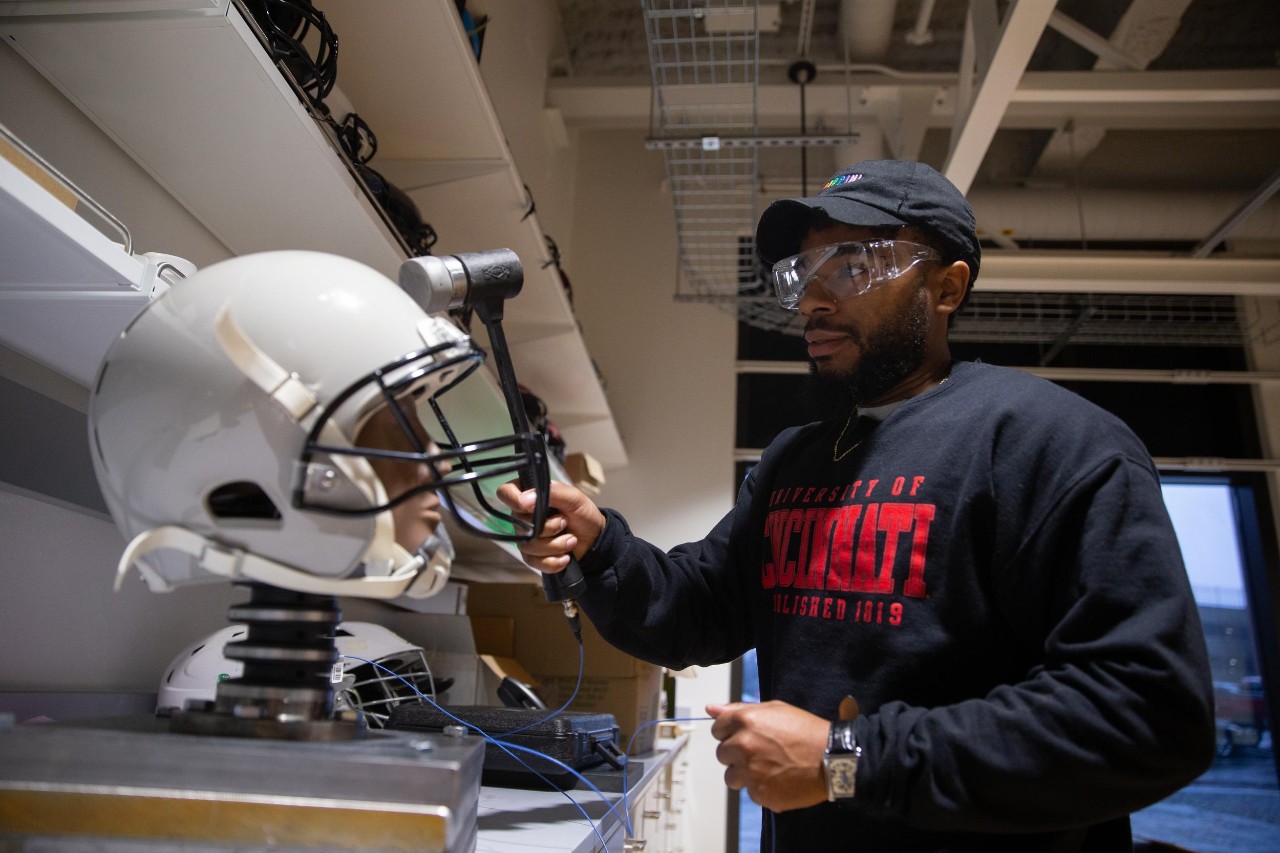
UC student Christopher Boles uses a modal hammer to strike a helmet. Photo/Andrew Higley/UC Marketing + Brand
Nauman said the findings also demonstrate the need for better safety equipment and policies such as no-contact practices that could reduce the risk of injury.
He co-authored a study this year in the Journal of Biomedical Engineering with his former students at Purdue University that tested how well helmets made by four leading manufacturers minimized the impact of hits to the head.
“None of the helmets was uniformly good or uniformly bad, except on the back of the helmet where they were all uniformly bad,” Nauman said.
“The helmets are generally designed to withstand the maximum possible impact. But that’s a 99th percentile type of hit. If you can design a helmet to protect players from the smaller, more typical hits, that would be ideal.”
Featured image at top: UC College of Engineering and Applied Science Professor Eric Nauman studies ways to prevent concussions from contact sports in his biomedical engineering lab. Photo/Andrew Higley/UC Marketing + Brand
Related Stories
How can Cincinnati provide more affordable housing? This new lab aims to find out
October 16, 2026

The University of Cincinnati Real Estate Center helped launch a new regional research and development initiative designed to identify, test and scale solutions to the region’s housing challenges called the Housing Innovation Lab. The project is built around a simple idea: What if communities approached housing challenges the way leading companies approach innovation?
Environmental engineer researching methods to monitor river quality
October 16, 2026
Pradeep Ramtel has been conducting research on river water since he was an undergraduate student in Nepal. He is currently a PhD student at the University of Cincinnati and is studying under Associate Professor Dongmei Feng. His research uses collected data and machine learning to better assess risks to river water quality and prepare for problems before they arise. Recently, he was named Graduate Student Engineer of the Month by UC's College of Engineering and Applied Science.
Collaboration over consultation
October 16, 2026
New University of Cincinnati research published in the journal Health Expectations found stroke survivors participating in rehab research desire an approach that prioritizes shared decision-making, peer relationships and a focus on what they can accomplish rather than their deficits.