
WVXU: What are those dents in the forest?
UC geologist explains why some Cincinnati parks have such bumpy terrain

WVXU turned to a University of Cincinnati geologist to answer a reader question about why many parks in southwest Ohio have hilly moguls like you might see on a BMX course.
Jane Goode of Harrison asked in particular about the Badlands Trail at Miami Whitewater Forest, which features hills and depressions in an oak forest.
“I see a lot of chipmunks coming around and that brings me a lot of joy,” Great Parks of Hamilton County interpreter Jack Fogle told WVXU.
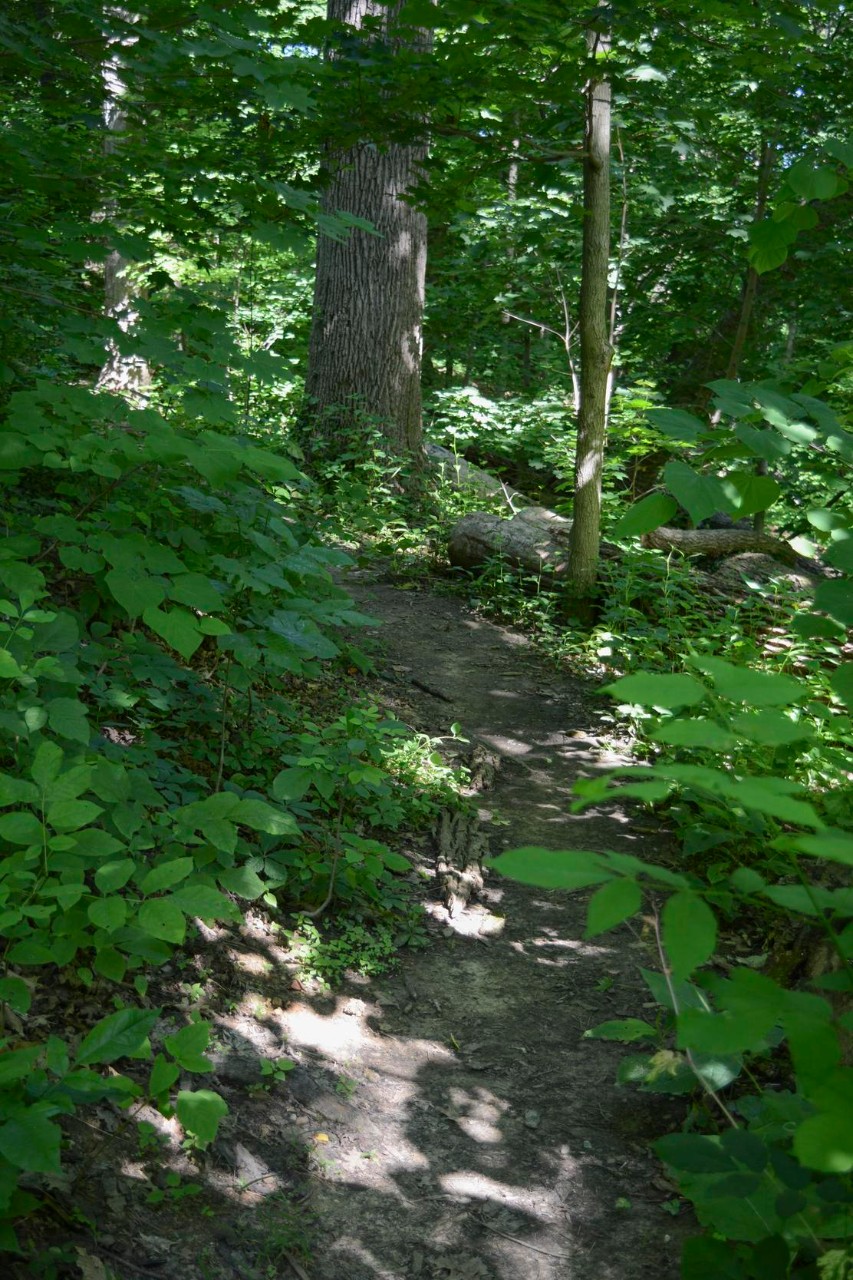
Many trails in southwest Ohio have little hills and depressions in the woods. UC geologist Dylan Ward said often they're caused by sinkholes in the limestone. Photo/Lisa Britton/UC
But why is the trail so bumpy like someone threw a rumpled quilt over an unmade bed?
UC College of Arts and Sciences Associate Professor Dylan Ward said Ohio's geology is to blame.
“Those formed by rainwater trickling through the limestone. Rainwater is slightly acidic, naturally,” Ward told WVXU. “That dissolves the calcium carbonate mineral in the limestone and it creates voids.”
The voids cause the ground to sag and droop in these areas over thousands of years, Ward said.
Miami Whitewater Forest is home to UC’s Center for Field Studies, a former farm that has classrooms and gives students a chance to do research on topics such as the monarch butterfly migration.
While investigating WVXU's question, Ward grew curious about the abundance of steep gullies found in the park. So he examined digital contour maps of the area’s hills and valleys created using light detecting and ranging, which bounces a laser from an airplane over the ground to map the terrain.
This part of Ohio was covered by ice sheets that dumped sediment onto the limestone and shale bedrock thousands of years ago. But that doesn't explain why the park has so many gullies, steep ravines that you sometimes see at the edges of creeks, Ward told WVXU.
Ward said he suspects the park was clearcut at some point, which exposed the bare hills to severe erosion that created the gullies found there, he said. Today, the park is covered in mature oak forest.
Featured image at top: A chipmunk peeks out of a knothole in a fallen log on the Badlands Trail at Miami Whitewater Park. Photo/Michael Miller

UC Professor David Lentz talks about science projects students work on at UC's Center for Field Studies at Miami Whitewater Forest. Photo/Jay Yocis/UC
Related Stories
UC 1819 Innovation Hub ranked No. 23 in Top 100 Best Workplaces for Innovators by Fast Company
September 10, 2026
UC 1819 Innovation Hub is nationally ranked as one of the top 100 Best Workplaces for Innovators.
Could a whale really swallow a person whole?
September 10, 2026

Science News turns to a University of Cincinnati biologist to learn about animals that can swallow people whole as Hollywood gives moviegoers another reason to stay out of the water with the release next month of "Whalefall."
UC student ties his own world record in competitive speedcubing
September 10, 2026

Speedcuber's Digest highlighted University of Cincinnati computer science student's two-time 2x2 speedcubing world recor.d At a recent competition in Mississippi, Sujan Feist recorded a 0.86 second average, tying the previous world record, which he set.