UC launches training for new Intel jobs
Consortium of Ohio universities is getting workers ready for new high-tech careers

The University of Cincinnati is training some of the approximately 20,000 workers Intel Corp. plans to hire at the microchip fabrication plants it is building in southwest Ohio.
To support the growing workforce needs of Intel in Ohio, UC last year organized a consortium of 15 partnering colleges and universities to train both students and workers in semiconductor technology and manufacturing.
So far, about 300 undergraduate and graduate students have registered this spring for the micro-credentials. The course consists of a series of modules and videos that cover training on the fundamentals and safety of working in clean rooms used in microchip manufacturing.
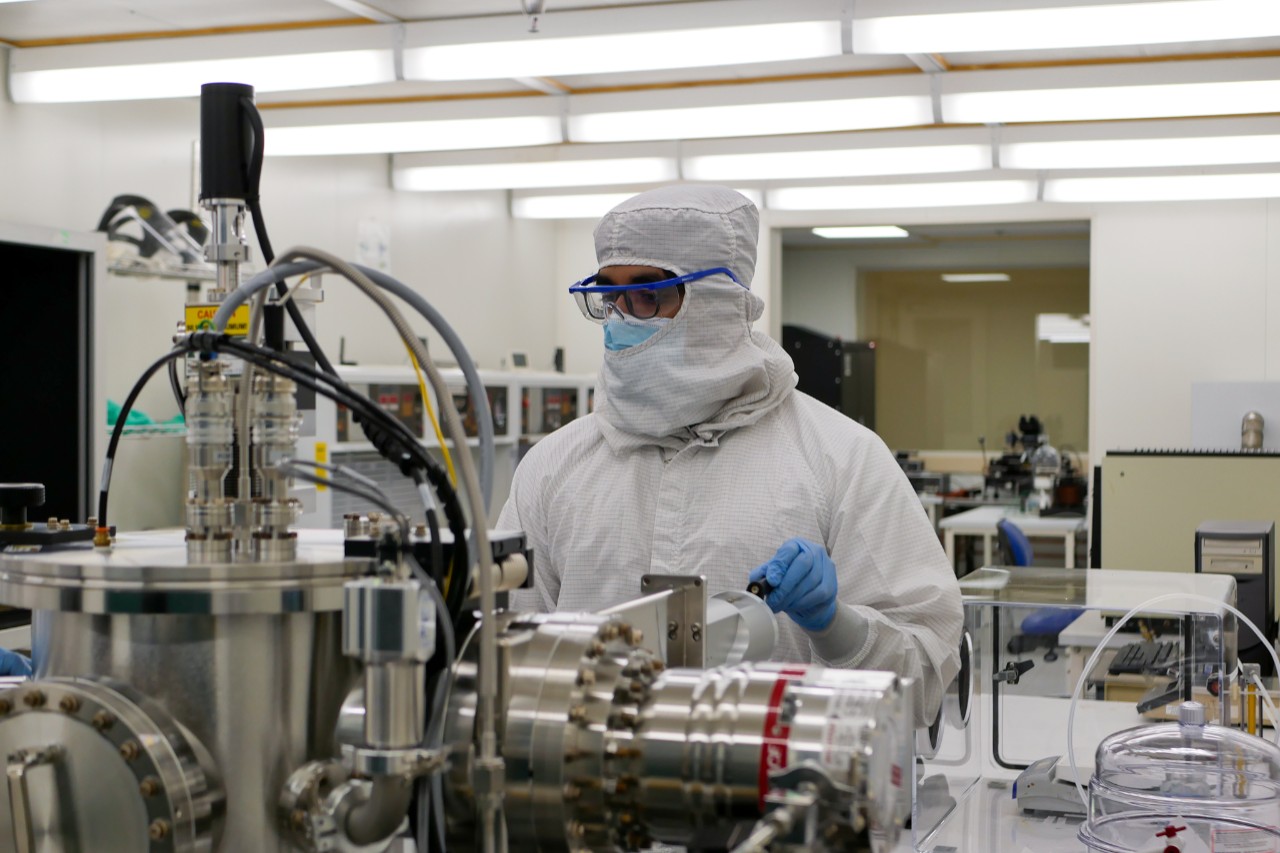
A clean room is a controlled environment that filters pollutants like dust, airborne microbes and aerosol particles to provide the cleanest area possible. The experience also requires the students to participate in three hours of training in a clean room at UC, the University of Dayton or Wright State University.

UC College of Engineering and Applied Science Professor Rashmi Jha is director of the Mantei Center Cleanroom, where students learn about microchip fabrication. Photo/Joseph Fuqua II/UC
“The curriculum will be openly available, per Intel’s requirements, so it can be exported to universities across the state and to other places where Intel has fabrication plants,” said Gautam Pillay, associate dean of UC’s College of Engineering and Applied Science.
Professor Marc Cahay, head of UC’s Department of Electrical and Computer Engineering, said the training introduces Ohio students to other courses offered at the OASiS partner institutions dealing with aspects of semiconductor manufacturing, devices and circuits. These classes augment the longer in-house training that Intel provides its employees.
UC and the other members of the OASiS consortium plan to expand the micro-credentialing certifications with short courses that address other needed skills, he said.
Cahay said the training program could encourage some students to pursue engineering degrees at UC, particularly by establishing articulation agreements with community colleges. In the future, the OASiS partners propose to work on an expansion of the clean room micro-credentials. This expansion is called the Accelerated Program for Enhanced Competence in Semiconductors.
It would include a contribution from the 15 partner institutions involved in OASiS. They will create a portfolio of micro-credentials to shorten the time needed for future Intel employees to be efficient in their job, saving money by considerably reducing the time typically required for this training, which can take as long as two years.
Students in UC’s College of Engineering and Applied Science are also preparing for jobs in Ohio’s growing high-tech fields. In UC’s Department of Electrical and Computer Engineering, students get practical experience working in the Mantei Center Cleanroom under the direction of Professor Rashmi Jha.
We are providing hands-on experiential learning grounded by theory in semiconductors.
Rashmi Jha Professor, UC College of Engineering and Applied Science
“In this lab, students work on various semiconductor process equipment and handle silicon wafers and learn the job responsibilities of technicians and process engineers working in a semiconductor fabrication facility, similar to the ones Intel is building in Ohio,” Jha said.
“When it comes to semiconductor manufacturing, hands-on experience is very critical so students know how to operate equipment and develop new processes that they learn in the classroom,” Jha said.
Students learn topics such as:
- How circuits and other electronics are designed.
- The working principles and installation of manufacturing equipment.
- Advanced testing and measuring.
“We are providing hands-on experiential learning grounded by theory in semiconductors,” Jha said.
Students also learn about the supply chain for semiconductors, security and trust issues and the sustainability of materials and processes used in making them.
Co-op is our signature program. We take the principles of classroom instruction and apply them to real-world problems.
Gautam Pillay Associate Dean, UC College of Engineering and Applied Science
UC is also part of a Midwest Semiconductor Network composed of 31 universities across four states. This group collaboration is designed to support the development of microchip manufacturing and help the United States compete. To that end, this month they established a new advisory board for the semiconductor industry to harness their collective research potential.
UC has a long tradition of meeting industry needs dating back to 1906 when it established the world’s first cooperative education program, dean Pillay said.
Today, UC is a leader in co-op in which students divide the year between dedicated classroom instruction and full-time employment in their chosen field. During their co-op, students earn $10,500 per semester on average.
“Co-op is our signature program. We take the principles of classroom instruction and apply them to real-world problems,” Pillay said.
Besides semiconductors, Pillay said UC is partnering with industry in robotics manufacturing, microelectronics, industrial artificial intelligence and predictive analytics, among other fields.
“That positions us not just to respond to Intel but to other manufacturers who are choosing to relocate to Ohio,” Pillay said.
Featured image at top: UC students work in the Mantei Center Cleanroom, where they learn the fundamentals of microchip fabrication and other skills. Photo/Corrie Mayer/CEAS Marketing

Intel Corp. plans to build microchip-fabrication plants in southwest Ohio off I-71 just north of Cincinnati. Photo/Andrew Higley/UC Marketing + Brand
Next Lives Here
The University of Cincinnati is leading public urban universities into a new era of innovation and impact. Our faculty, staff and students are saving lives, changing outcomes and bending the future in our city's direction. Next Lives Here.
Related Stories
Co-op broadens horizons for architectural engineer
August 17, 2026
UC architectural engineering graduate Jeremy Ackley turned his co-op rotations with CMTA, a national engineering consulting firm in Texas, into a full-time role, showcasing the University of Cincinnati’s national co-op footprint.
Emeritus professor honored for gas turbine research
August 17, 2026
Mark Turner has been part of the University of Cincinnati's College of Engineering and Applied Science for 25 years. His work in the field of gas turbine simulation and design continues to leave a significant impact on the industry. He was honored by the American Society of Mechanical Engineers with the International Gas Turbine Institute Scholar Award. Turner is part of the Department of Aerospace Engineering and Engineering Mechanics at UC.
UC scholarship honoring a family’s matriarch continues
August 17, 2026
“I get chills thinking about what she means to our family,” says Norma Wellman Cobb’s grandson, Thomas Beach, reflecting on how his grandmother’s perseverance and unwavering belief in the power of education shaped generations.