
The New York Times: This tiny snake has a big mouth
UC biologist discovers surprising distinction for harmless little African snake

The New York Times highlighted a discovery by a University of Cincinnati biologist that a harmless little African snake can eat the biggest prey relative to its size of any known snake.
UC Professor Bruce Jayne has spent years studying the extreme limits of snake abilities in his lab in UC's College of Arts and Sciences. His work has revealed surprising ways that snakes move and the incredible ways they hunt and swallow prey without benefit of hands, paws or claws.
His latest discovery revealed that the champion eater among snakes appears to be a drab little nonvenomous species, Dasypeltis gansi, or the Gans' egg-eater. True to its name, the snake swallows eggs whole before cracking them with its spine and spitting out the broken shell.
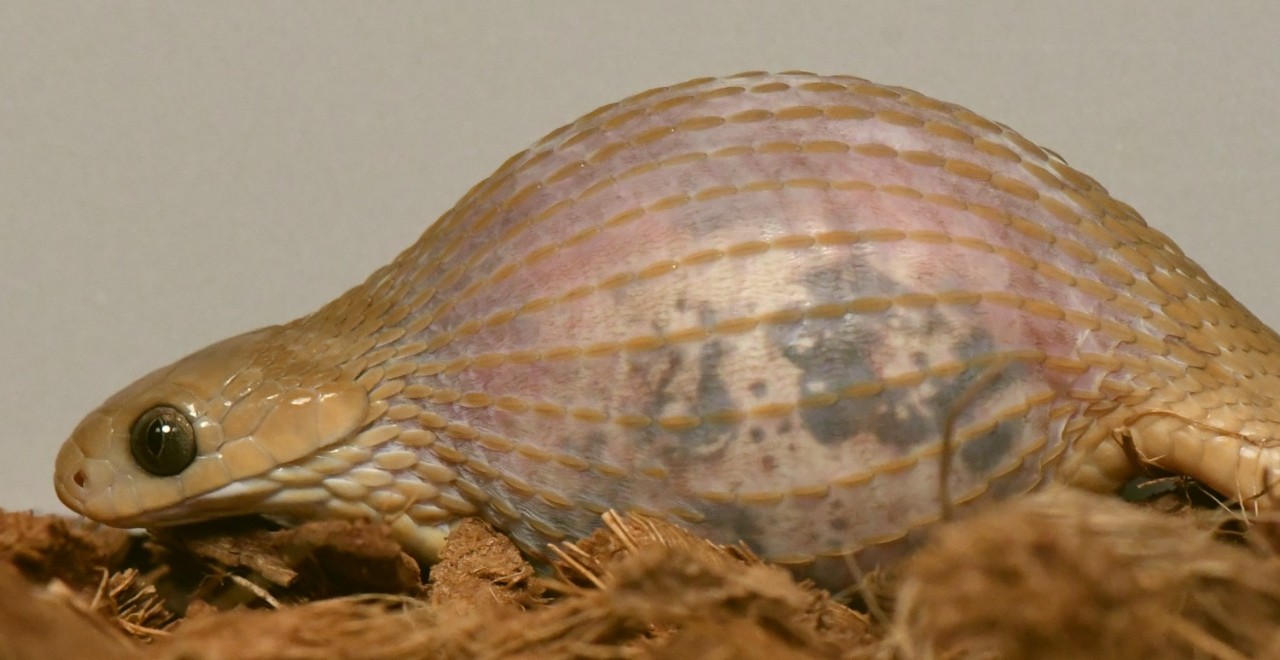
The Gans' egg-eater swallows a quail egg far larger than its head. The snake has the largest mouth relative to its size of any known snake, according to a new study by UC biologist Bruce Jayne. Photo/Bruce Jayne
While Burmese pythons can consume deer and 100-pound alligators, these meals still don't measure up to those consumed by the little egg-eater relative to either its length or mass.
Jayne presented his findings in the Journal of Zoology.
“This particular group of snakes may be No. 1 when it comes to big mouths in the snake kingdom,” Jayne told the Times.
Associate Professor Bryan Maritz at the University of the Western Cape in South Africa was not part of the study but has been conducting similar research on snake abilities, particularly “how the hell does a tiny, tiny snake like this swallow a bird egg?”
Maritz told the Times that Jayne's study stands out because it upends traditional thinking when it comes to estimating the size of prey a snake can swallow.
“We’ve always just relied on proxies for snake gape,” Maritz told the Times. “We’ve said, ‘Well, gape is correlated broadly with head length, and so you can measure a snake’s head length and you can estimate its gape.’ And this study really shows that that’s not the case.”
Read the New York Times story.
Featured image at top: A quail egg is just a snack for a Gans' egg-eater in a UC biology lab. Photo/Andrew Higley/UC Marketing + Brand

UC Professor Bruce Jayne holds a Gans' egg-eater in his biology lab. Jayne discovered that this unassuming little snake holds the distinction of having the biggest mouth for its size of any known snake. Photo/Andrew Higley/UC Marketing + Brand
Related Stories
UC Speech & Hearing Clinic serves patients while acting as training site
September 30, 2026

The University of Cincinnati's Speech & Hearing Clinic provides graduate students in audiology and speech-language pathology with hands-on experience while delivering care to patients across the region. Located on the university's medical campus, the clinic serves patients of all ages and was recently featured on Spectrum News 1 Ohio.
UC economist warns of higher heating costs this winter
September 30, 2026

David Brasington explains why home heating will cost so much this winter and how to save money.
Former mistress of convicted pastor and former American Idol contestant likely won’t face criminal charges
September 30, 2026

Mark Godsey, a criminal law professor in the Donald P. Klekamp College of Law at the University of Cincinnati spoke with NBC News about a criminal case that has attracted national attention.