
UC economist finds strong link between park funding, home values
House prices higher in Ohio communities that vote to renew tax levies for recreational areas

Ohio residents who vote against tax renewals for parks and recreation spending could be costing themselves a significant amount of wealth in the form of their homes' value, a University of Cincinnati economist found.

David Brasington
David Brasington, PhD, the James C. and Caroline Kautz Chair in Political Economy and professor of economics in UC's Carl H. Lindner College of Business, studied the effect of cutting funding for the maintenance of local parks and recreational areas on housing values for a research article that was published in Journal of Regional Science.
Brasington found Ohio communities that vote to renew parks and recreation spending see 13% higher home values three years after the vote than similar communities that voted against the tax renewals. For the typical household, a vote against tax renewals saves $70 a year in taxes but costs $30,000 in house values.
“I was surprised by how strong the magnitude was,” Brasington said. “A 13% difference in house prices is really big. I was surprised a relatively small change in park funding could cause such a big change in house prices over time.”
In his research, Brasington focused on communities that according to data from the U.S. Census Bureau share similar demographic and economic characteristics. The only discernible difference was that some of them narrowly voted to renew tax levies while others narrowly voted against renewing their levies.
Using a housing data set, Brasington compared home values in the communities from 1991 through 2016.
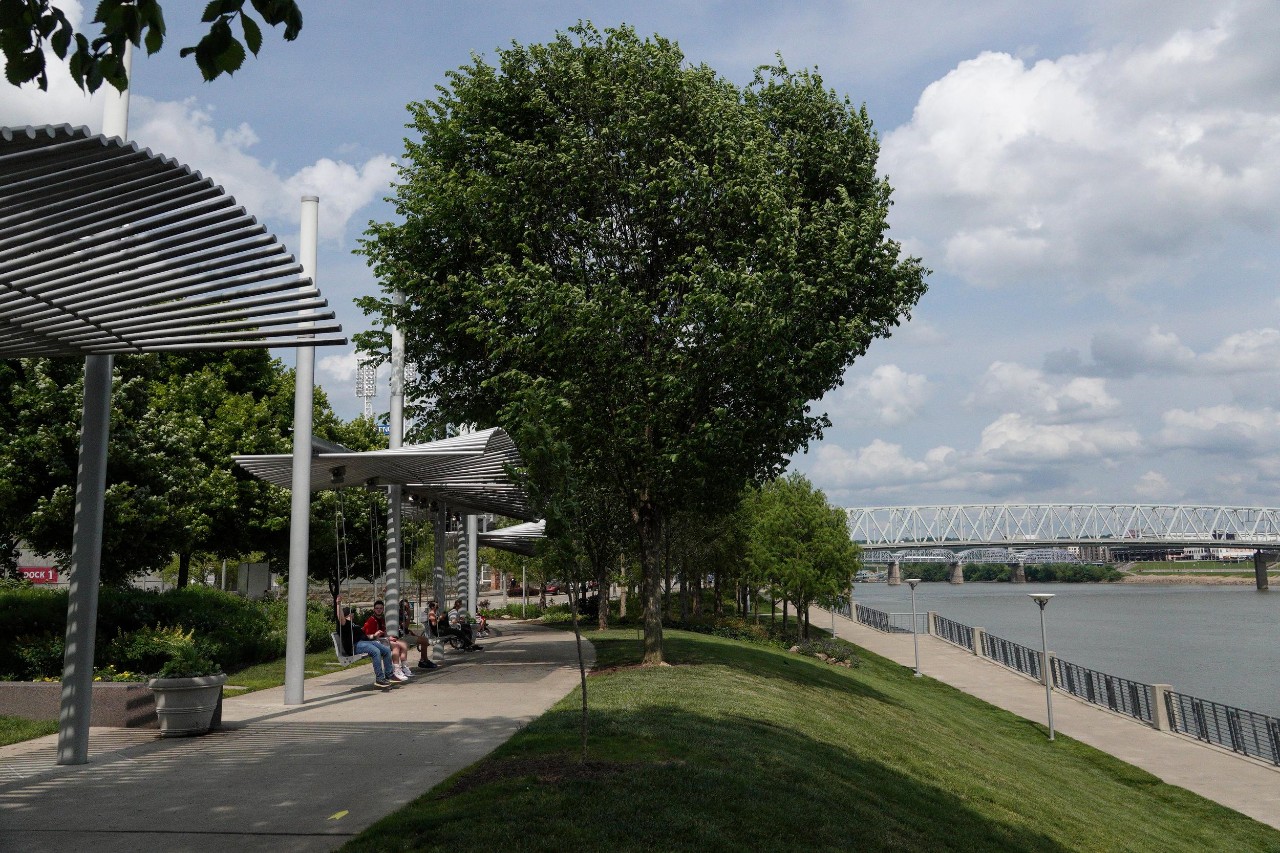
University of Cincinnati student orientation leaders tour Smale Riverfront Park in downtown Cincinnati. Photo/Angie Bolan
While house prices didn't reflect a change immediately, three years after the votes the communities that approved the park and recreation maintenance saw 13% higher house values compared to the communities that voted against their levies. In subsequent years, the gap continued to grow.
“I didn't find any effects the first year after the vote or the second year after the vote, but they were noticeable three years later,” Brasington said. “The findings I have are consistent with the idea that right after you vote to cut parks and recreation taxes and funding, you don't notice any effects on house prices, but as time goes on, maybe this decrease in maintenance funding starts to be noticeable and maybe it's reflected in house prices.”
The data doesn't mean that communities that vote against renewing tax levies see a 13% decrease in housing values or that communities that vote in favor of their levies see a 13% increase. Rather, an example could be one community seeing a 7% increase in housing values while another sees a 20% increase, Brasington said.
“When a local government offers services, they're competing with other local governments for residents and businesses to build their tax base, so they want to offer good services that people care about,” he said.
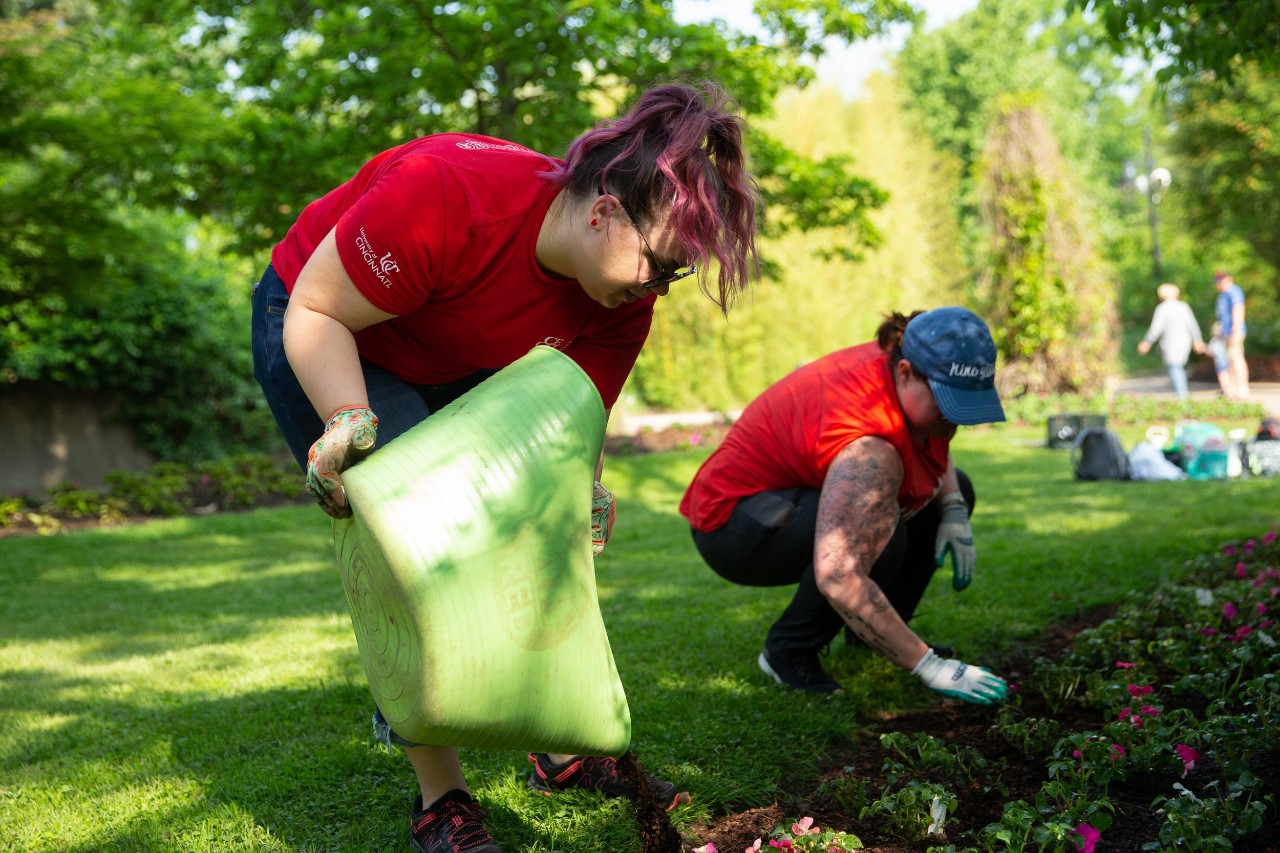
UC Serves brings together staff and faculty from across the University of Cincinnati to work on projects proposed by local non-profit partners. Photo/Andrew Higley/UC Marketing + Brand
The data shows parks are a service that people care about, Brasington said. It also shows that Ohio's local parks might be underfunded.
“Parks and recreation spending seems worth it in Ohio,” he said. “There may be places where it isn't, there may be places where it's really, really worthwhile. But overall the parks and recreation spending is worth it in Ohio because the estimate is just an average across all the communities.”
Brasington's findings on home prices aligns with his previous research on the value of local park funding. In a research article published in 2021, Brasington found communities that renewed tax funding for local parks had more residential development than those that cut park taxes and funding.
Featured image at top: UC Serves brings together staff and faculty from across the University of Cincinnati to work on projects proposed by local non-profit partners. Photo/Andrew Higley/UC Marketing + Brand
Impact Lives Here
The University of Cincinnati is leading public urban universities into a new era of innovation and impact. Our faculty, staff and students are saving lives, changing outcomes and bending the future in our city's direction. Next Lives Here.
Related Stories
UC Foundation celebrates 2026 philanthropy winners
October 23, 2026
The University of Cincinnati Foundation recognized its Outstanding Philanthropic Volunteer Award honorees at the George Rieveschl Recognition Dinner on October 22, 2026.
AI breast cancer survival model from Cancer Center could improve accuracy and personalize care
October 23, 2026
UC Cancer Center researchers, including lead author Wedad Alatebi, developed a deep learning survival model for breast cancer that combines detailed clinical and genetic information, potentially offering physicians a more accurate tool to guide treatment decisions.
UC aerospace engineer leads global computational fluid dynamics taskforce
October 21, 2026
The American Institute of Aeronautics and Astronautics' CFD 2030 Integration Committee has announced the formation of the Computational Fluid Dynamics (CFD) Vision 2045 Team, a multi-institution working group tasked with defining where the field of computational fluid dynamics should be by 2045 to align with the changing and evolving needs of the aerospace industry. The University of Cincinnati's Prashant Khare, Bradley Jones professor and head of the Department of Aerospace Engineering, is leading this specialized group.