WCPO: Middletown man hopes prostate cancer diagnosis inspires other to get screened
UC expert discusses prostate cancer

Reverend Michael Bailey and the University of Cincinnati Cancer Center's Nilesh Patil, MD, recently spoke with WCPO about the importance of screening during Prostate Cancer Awareness Month.
After being diagnosed with prostate cancer five years ago following years of routine checkups, Bailey is now cancer free following treatment.
"One of the reasons why this is a cancer where we advocate screening is because there is no symptoms of this condition,” said Patil, Cancer Center member and associate professor of surgery in the UC College of Medicine. "Prostate cancer is the most common cancer in men in most of the world if you rule out skin cancers, and so the incidences of prostate cancer is pretty high."
Patil said Black men are disproportionately affected by prostate cancer, with the Centers for Disease Control and Prevention reporting Black men are more likely to be diagnosed and twice as likely to die from prostate cancer, and are additionally more likely to be diagnosed at a younger age and with more advanced stages of the disease.
“Getting a blood test is probably the most important part of the screening because we do have a test that can alert you to if something is abnormal,” Patil said. “If you catch this disease early, you can treat it early, you can cure it early. And if you don’t diagnose it, the consequences to your lifestyle, to your quality of life are quite detrimental.”
“If you love life, you’re better off being here than being somewhere else,” Bailey said. “We only have a season and we need not to expedite it because we failed to do those checkups.”
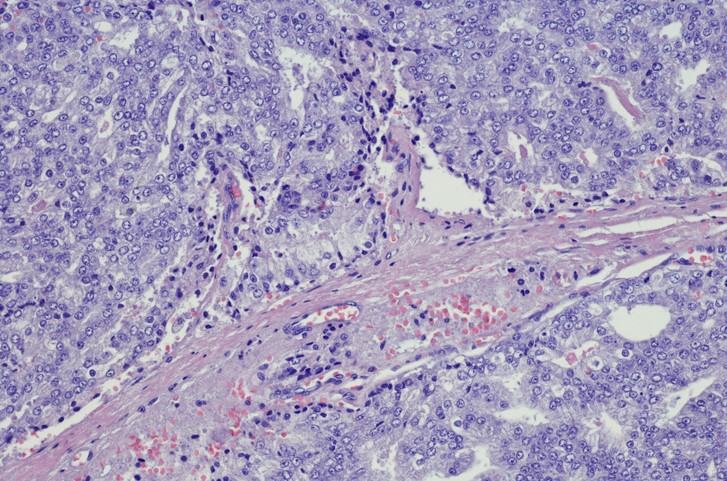
Featured photo at top of prostate cancer cells. Photo/iStock/OGphoto.
Screening can save lives
Current guidelines state men should get screened for prostate cancer if they are:
- Ages 50-70
- Ages 40 or older if a first-degree relative, including a father, uncle or grandfather, has had prostate cancer
Related Stories
Cancer Center plays key role in lab research, clinical trials for new pancreatic cancer drug
September 1, 2026

WLWT and WCPO highlighted the contributions of University of Cincinnati Cancer Center researchers that helped lead to the recent FDA approval of daraxonrasib, a new treatment for pancreatic cancer.
An expert pieced together this Roman document like a puzzle
September 1, 2026

National media highlighted a new project by UC Classics Assistant Professor Matthijs Wibier to piece together and translate an ancient Roman text from fragments buried in the desert for more than 1,600 years.
Cancer Center physician receives $150,000 New Investigator Research Grant to study treatment-resistant leukemia
September 1, 2026
The University of Cincinnati Cancer Center’s Sarah Skuli, MD, PhD, received a two‑year, $150,000 Leukemia Research Foundation New Investigator Grant to study TP53‑mutated leukemia, a treatment‑resistant subtype with very poor outcomes.