WVXU: 'Cheaper and safer' battery holds promise for green energy storage
UC chemistry students develop a more efficient battery for wind and solar power

WVXU highlighted chemistry research at the University of Cincinnati that could improve large-scale batteries needed by solar and wind farms.
UC College of Arts and Sciences Associate Professor Jimmy Jiang and his students developed a cheaper and more efficient battery that can generate more voltage than traditional batteries. They wrote about their project in the the journal Nature Communications.
Innovations such as UC’s will have profound effects on green energy, Jiang said. Batteries store renewable energy for when it’s needed, not just when it’s produced. This is crucial for getting the most out of wind and solar power, he said.
“You'll see hospitals and schools that will run on batteries. So we won't have to depend on fossil fuels,” UC postdoctoral researcher Rajeev Gautam said. He was lead author of the study.
Jiang and his team are still in the early stages of this new technology and expect it to be several years before it's implemented in the real world. However, the team has submitted a provisional patent application on the promising research they've conducted so far.

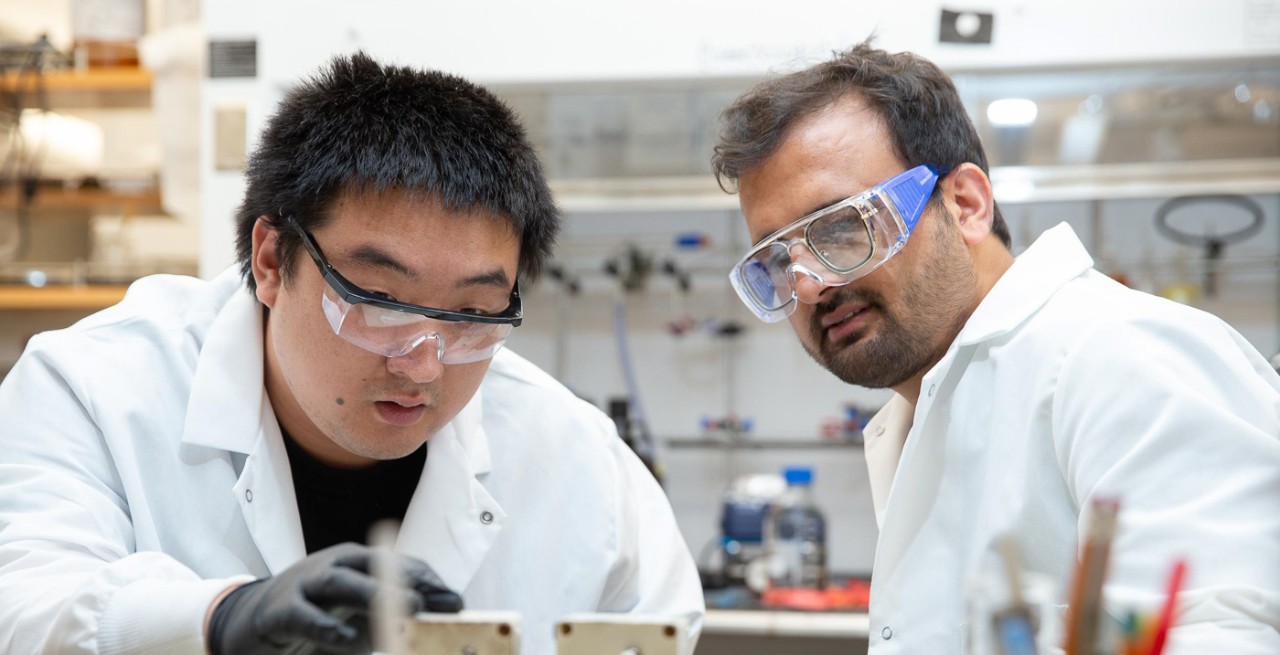
UC Associate Professor Jimmy Jiang and his students have developed a cheaper and more efficient battery in his chemistry lab. Photo/Andrew Higley/UC Marketing + Brand
More UC chemistry in the news

UC postdoctoral researcher Rajeev Gautam works in a chemistry lab. Science and chemistry publications shared the news of UC's new redox-flow battery design. Photo/Andrew Higley/UC Marketing + Brand
- Yahoo! Finance: Invention could herald 'battery revolution'
- Interesting Engineering: Membrane-free lithium ion batteries could help power grid
- AZO CleanTech: Novel battery design promises a brighter future
- Tech Xplore: Chemists develop more efficient battery design
- The Independent (UK): New invention could herald 'battery revolution,' scientist says
Related Stories
Bidirectional link between oral, kidney health calls for patient education, access
August 4, 2026

Despite growing awareness of the connection between oral health and chronic health conditions, patient awareness and access to dental care remain limited, according to University of Cincinnati experts who recently spoke with Healio | Nephrology News & Issues.
UC-built detector at CERN looks for enticing evidence to explain dark matter
August 4, 2026
A physicist from the University of Cincinnati and his research partners from around the world conducted an experiment at CERN’s Large Hadron Collider in Switzerland to look for evidence that might help explain one of science’s most baffling questions: dark matter.
The subtle changes in hearing you should never ignore
August 4, 2026

It’s easy to dismiss changes in hearing as minor. But as The Washington Post recently reported, these symptoms could also signal a medical emergency that many people don’t recognize — known as sudden sensorineural hearing loss, a rapid decline in hearing that occurs suddenly or over a few days.