WVXU: 'Cheaper and safer' battery holds promise for green energy storage
UC chemistry students develop a more efficient battery for wind and solar power

WVXU highlighted chemistry research at the University of Cincinnati that could improve large-scale batteries needed by solar and wind farms.
UC College of Arts and Sciences Associate Professor Jimmy Jiang and his students developed a cheaper and more efficient battery that can generate more voltage than traditional batteries. They wrote about their project in the the journal Nature Communications.
Innovations such as UC’s will have profound effects on green energy, Jiang said. Batteries store renewable energy for when it’s needed, not just when it’s produced. This is crucial for getting the most out of wind and solar power, he said.
“You'll see hospitals and schools that will run on batteries. So we won't have to depend on fossil fuels,” UC postdoctoral researcher Rajeev Gautam said. He was lead author of the study.
Jiang and his team are still in the early stages of this new technology and expect it to be several years before it's implemented in the real world. However, the team has submitted a provisional patent application on the promising research they've conducted so far.

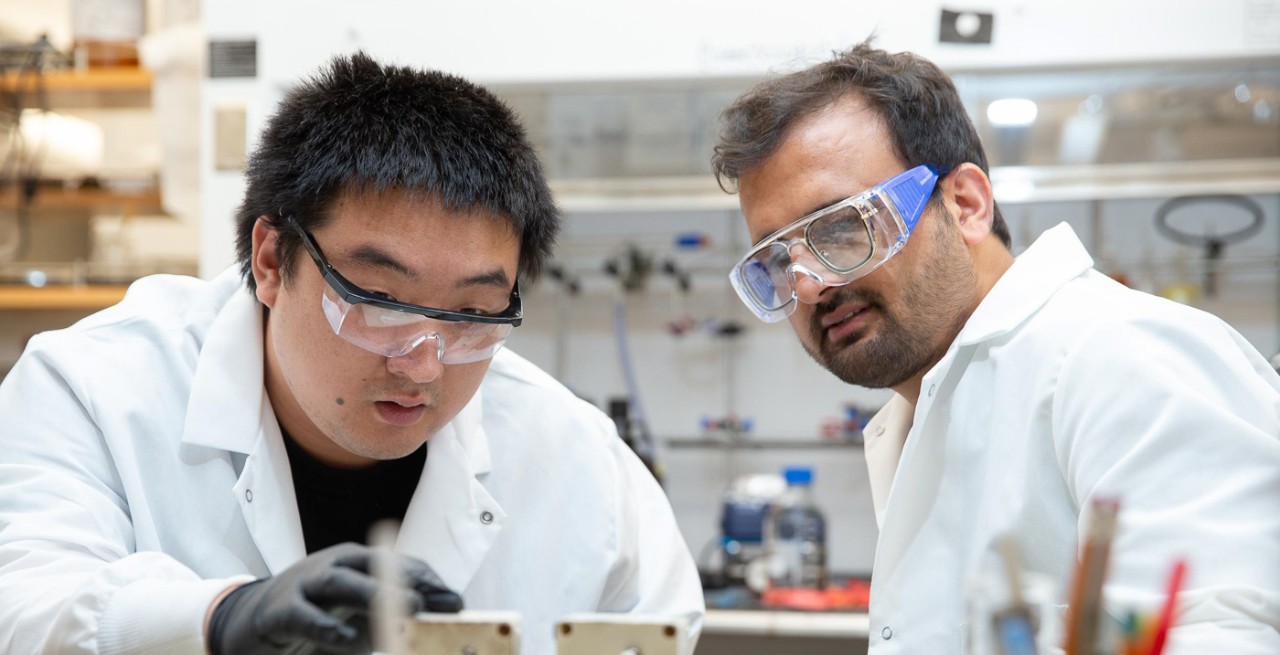
UC Associate Professor Jimmy Jiang and his students have developed a cheaper and more efficient battery in his chemistry lab. Photo/Andrew Higley/UC Marketing + Brand
More UC chemistry in the news

UC postdoctoral researcher Rajeev Gautam works in a chemistry lab. Science and chemistry publications shared the news of UC's new redox-flow battery design. Photo/Andrew Higley/UC Marketing + Brand
- Yahoo! Finance: Invention could herald 'battery revolution'
- Interesting Engineering: Membrane-free lithium ion batteries could help power grid
- AZO CleanTech: Novel battery design promises a brighter future
- Tech Xplore: Chemists develop more efficient battery design
- The Independent (UK): New invention could herald 'battery revolution,' scientist says
Related Stories
UC doctoral student shares his journey with Spectrum News
July 27, 2026

UC doctoral student Amota Ataneka spoke with Spectrum News about his educational journey. Ataneka, a native of the Pacific island nation of Kiribati, is one of 35 emerging scholars across the United States to win the National Academy of Education/Spencer Dissertation Fellowship.
How scammers can persuade you with AI
July 27, 2026
Spectrum News recently dove into how cloning voices with artificial intelligence is making it easier to scam people over the phone. The news outlet spoke with Kimberly Hyun, assistant professor of marketing at UC’s Lindner College of Business, to examine why AI is making it so much easier to trick people.
Decade of discovery
July 27, 2026
Every summer, UHP Discover has connected undergraduate students in the University Honors Program (UHP) to a unique array of opportunities in original interdisciplinary research. This year, the program celebrates its 10th anniversary.