Healio: Q&A: New imaging method enables quick lung infection identification
Federally funded research led by Nalinikanth Kotagiri highlighted in medical news publication

Nalinikanth Kotagiri, PhD, associate professor of pharmaceutical sciences at University of Cincinnati James L. Winkle College of Pharmacy, is hoping to speed up the diagnosis of lung infections by creating a new imaging method that identifies these infections in real time.

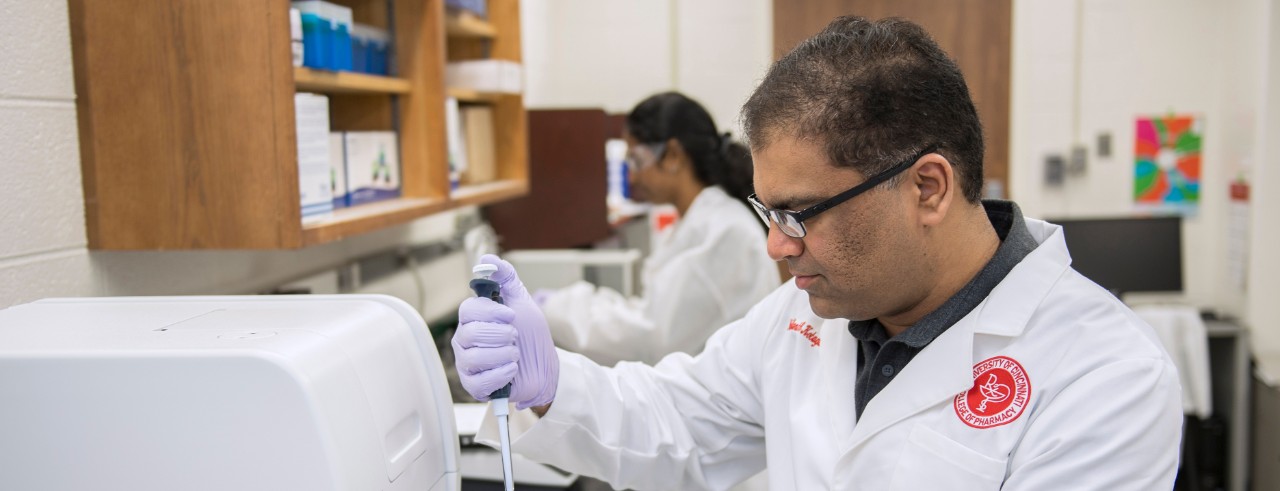
Nalinikanth Kotagiri aims to develop innovative and advanced solutions to treat human disease through a highly multidisciplinary approach. Photo/UC Marketing + Brand
With the current chest imaging technology, patients with suspected lung infections are unable to receive a specific diagnosis unless they undergo an invasive procedure and wait 2 to 3 days for their results.
In a Q & A with Healio news, Kotagiri explains the research, which is funded by the grant from the National Heart, Lung, and Blood Institute.
The collaborators on this project include experts in COPD and lung diseases: Francis McCormack, MD, a pulmonologist, and Michael Borchers, PhD, at the University of Cincinnati. Changchun Xie, PhD, at the University of Cincinnati is the team’s biostatistician, and Suzanne Lapi, PhD, at the University of Alabama-Birmingham will provide the radiochemistry expertise to optimize contrast agent development.
Read more about Kotagiri and his research in a UC web story.
Featured image at top of Kotagiri by Andrew Higley/UC Marketing + Brand.
Impact Lives Here
The University of Cincinnati is leading public urban universities into a new era of innovation and impact. Our faculty, staff and students are saving lives, changing outcomes and bending the future in our city's direction. Next Lives Here.
Related Stories
DAAP appoints Joseph Heathcott as new associate dean for research
August 27, 2026
DAAP appoints new associate dean for research Joseph Heathcott, who will bring a nationally recognized voice in urban development, design and research to the University of Cincinnati starting this fall 2026.
Co-op broadens horizons for architectural engineer
August 17, 2026
UC architectural engineering graduate Jeremy Ackley turned his co-op rotations with CMTA, a national engineering consulting firm in Texas, into a full-time role, showcasing the University of Cincinnati’s national co-op footprint.
UC co-op earnings climb to $99.5 million
August 17, 2026
University of Cincinnati co-op students earned $99.5 million in 2025-26, a 5.69% increase, with 9,614 co-op enrollments and 1,798 employers across top industries.