UC students and faculty flex to meet needs of Morocco’s earthquake
Need meets opportunity as A&S capstone class pivots to provide support
What happens when world events turn the best-laid study plans upside down? Last semester, students and their professors and UC’s College of Arts and Sciences found out first-hand.

Service-Learning capstone students present their pivoted plans for non-profit organization, Resilient Communities. Photo/Abbey Willmann.
Students in a communication capstone class were prepared to spend the semester in an interdisciplinary exercise supporting communities in Morocco, partnering with Cincinnati-based non-profit Resilient Communities.
The students, taught by Michael Sharp and Willie Clark, professors in UC’s School of Communication, Film and Media Studies, had a goal: Fundraising, developing local and overseas partnerships, and mastering those logistics, in a project that would teach them teamwork and help them learn the intricacies of assisting communities overseas.
”Resilient Communities is an organization focused on the development of communities of Morocco through the use of collaborative projects in which we have been working with UC students since 2016," says Eastman Johnson, director.
Sharp, Clark and Johnson partnered to develop a comprehensive curriculum for students, which included assignments aimed at supporting the initiatives of Resilient Communities. “This is a fantastic way for students to learn the facets of teamwork,” says Johnson.
But tectonics had another plan.
Enter the earthquake

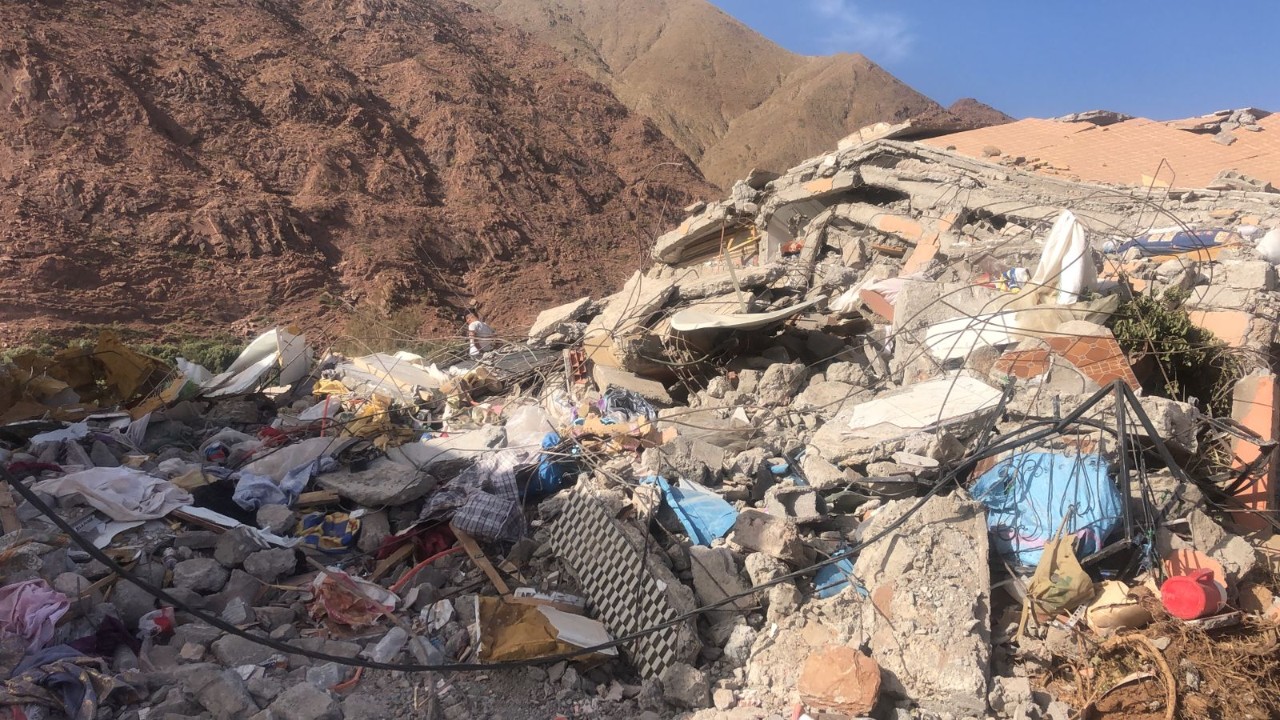
Disaster strikes in Ourika Valley of the Moroccan High Atlas. Photo/Provided
On September 8, 2023, what had been a curriculum carefully crafted between professors and directors, was suddenly turned upside-down by an earthquake. The 6.8 temblor, with an epicenter of just 44 miles from Marrakesh, reportedly left some 2,000 people dead, and injured around 2,400.
As the catastrophe left many in Morocco without food, shelter and health care, the students of the service-learning capstone class and Resilient Communities needed to pivot to garner additional support to the areas impacted.
It's a cultural shock. It's adapting, going out and helping communities in need.
Afia Acheampong Communication major

Relief efforts take place in Ourika Valley of the Moroccan High Atlas. Photo/Provided
The urgency and real-world relevance of the students’ work heightened. The team shifted its focus to raising funds for essential building equipment required for efficient disaster relief operations.
"With this class, we're learning to adapt to changes so we can help people, and that is a learning experience in itself," says Acheampong.
The marketing team realigned its focus to assist the funding team in their mission. In a parallel effort, the study-abroad logistics team now operated with heightened urgency, seeking extra students’ help in their efforts.
"Getting people there, getting supplies there, obtaining resources, and logistics. In times of crisis, communication becomes vital, and marketing emerged as the linchpin for ensuring streamlined communication and student project with disaster relief principles,” Clark says.
What is service learning?

Service-Learning capstone students engage in project development plans. Photo/Abbey Willmann
Service learning integrates meaningful community service with instruction and reflection to enrich the learning experience, teach civic responsibility, and strengthen communities. It is designed to foster a sense of social responsibility and civic engagement in students by providing them with opportunities to apply their academic knowledge and skills to address real-world issues.
“In the collaboratory course this year, all of the different teams had to work together due to their interconnected projects,” says Johnson.
A real-world curriculum
As the curriculum shifted to emphasize real-life experiences, students were no longer just studying theory; they were actively contributing to disaster relief efforts.
Regarding the adjustments to the original curriculum, Sharp states, “Life changed the structure - instead of what we normally see in academia in which curriculum typically dictates life. Even the structure is adaptive because of real-life happenings - we are teaching theory and life skills, but we are adding new things to our curriculum because of this experience.”
To find out more and support Resilient Communities, you can visit resilient-communities.com or contact Robert Eastman Johnson at ejohnson@resilientcommunitiesngo.org.
Featured image at top: Ourika Valley of the Moroccan High Atlas. Photo/Provided

By Abbey Willmann
Graduate Assistant, A&S Department of Marketing and Communication
artscinews@ucmail.uc.edu
Related Stories
UC co-op helps build career pathways at AtriCure
July 28, 2026
AtriCure, a global medical device company in Mason, Ohio, is UC’s largest biomedical engineering co-op employer, turning University of Cincinnati co-op students into full-time innovators.
UC doctoral student shares his journey with Spectrum News
July 27, 2026

UC doctoral student Amota Ataneka spoke with Spectrum News about his educational journey. Ataneka, a native of the Pacific island nation of Kiribati, is one of 35 emerging scholars across the United States to win the National Academy of Education/Spencer Dissertation Fellowship.
Decade of discovery
July 27, 2026
Every summer, UHP Discover has connected undergraduate students in the University Honors Program (UHP) to a unique array of opportunities in original interdisciplinary research. This year, the program celebrates its 10th anniversary.