
UC expands popular STEM program across Ohio
Biology Meets Engineering starts high school students off on path toward science

A University of Cincinnati program is so successful at recruiting high schoolers to pursue education in STEM that the National Science Foundation will spend $3.4 million to expand the program in collaboration with three other universities.
The grant will allow UC to share its Biology Meets Engineering curriculum on animal-inspired robotics with more high schools in the Tristate and expand its internship program in collaboration with Bowling Green State University, Ohio University, and the University of Akron.
UC’s novel program brings high school students to UC’s campus for three weeks each summer to learn about the unique ways animals sense the world and integrates that curriculum into high schools across the Tristate. Students apply what they learn about animal senses to building custom robots that use similar sensory information to navigate.
UC also offers high school students a chance to work in labs as paid summer interns. The other universities likewise will adopt this internship program.
Since it started in 2018, students from 19 schools have participated in UC’s program, UC Professor Stephanie Rollmann said.
“With this grant, UC becomes an innovation hub for STEM transdisciplinary education,” said Rollmann, who teaches biological sciences in UC’s College of Arts and Sciences.
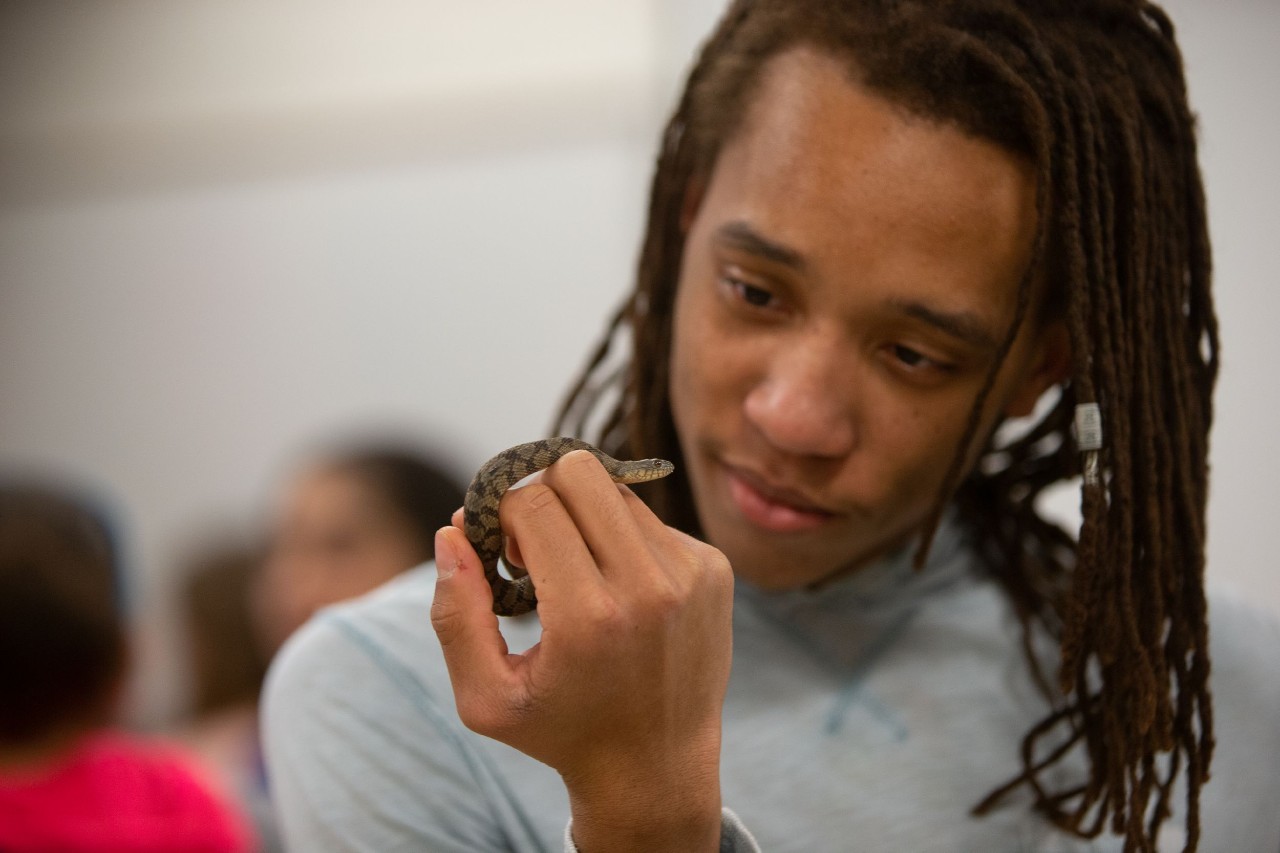
A high school student examines a snake from UC Professor Bruce Jayne's lab to learn about animal movement as part of the Biology Meets Engineering program. Photo/Andrew Higley/UC Marketing + Brand
Students take part in exercises about how animals perceive the world. For example, for an exercise on color vision, students wear glasses with different colored lenses and must work together to complete a simple color flashcard exercise.
In another exercise, students wear virtual-reality goggles to learn how vision affects spatial orientation. After learning about animal senses, the students build and program robots that can navigate autonomously using sensors that can follow a lined path, recognize lights of different colors, or avoid obstacles by touch or sound.
The three-week UC summer program often includes a visit to the Cincinnati Zoo & Botanical Garden. And in some classes, the UC Police Department’s K9 team demonstrates the amazing ability of their dog to find a well-hidden toy using scent alone.
A lot of disciplines come together in animal senses and robotics.
Dieter Vanderelst, UC Associate Professor
Likewise, robotics draws from virtually every discipline in engineering, Associate Professor Dieter Vanderelst said.
“A lot of disciplines come together in animal senses and robotics,” he said. “That gives faculty a lot of freedom to come up with a novel lesson plan and for their students to buy into the subject.”
Vanderelst has studied a variety of topics, including the fascinating way bats can bounce sound off leaves to find hidden prey.
He holds joint appointments in biological sciences in UC’s College of Arts and Sciences and mechanical and electrical engineering in UC’s College of Engineering and Applied Science. Also leading the project are Associate Professors Anna DeJarnette in UC’s College of Education, Criminal Justice, and Human Services and John Layne in biology.
Among his other projects, Layne studies the vision and behavior of fiddler crabs, which can see in three colors like us. The crabs are especially sensitive to movement above the horizon line where predators such as gulls are most likely to strike. And they have the extraordinary ability to map out every step and turn they make to find their way back to the same hole in the sand in a hurry.
The Biology Meets Engineering course teaches students to think about scientific and societal questions rather than subjects, Vanderelst said.
“We need multiple disciplines to help solve big problems,” he said. “We tell students to find problems that interest them. If it doesn’t fit in a narrow field that exists today, you could invent a field to meet that problem.”
Rollmann said the NSF grant award is a gratifying recognition of the program’s success. Vanderelst credited his colleague for the work she did coordinating with schools and refining the curriculum in keeping with state educational standards.
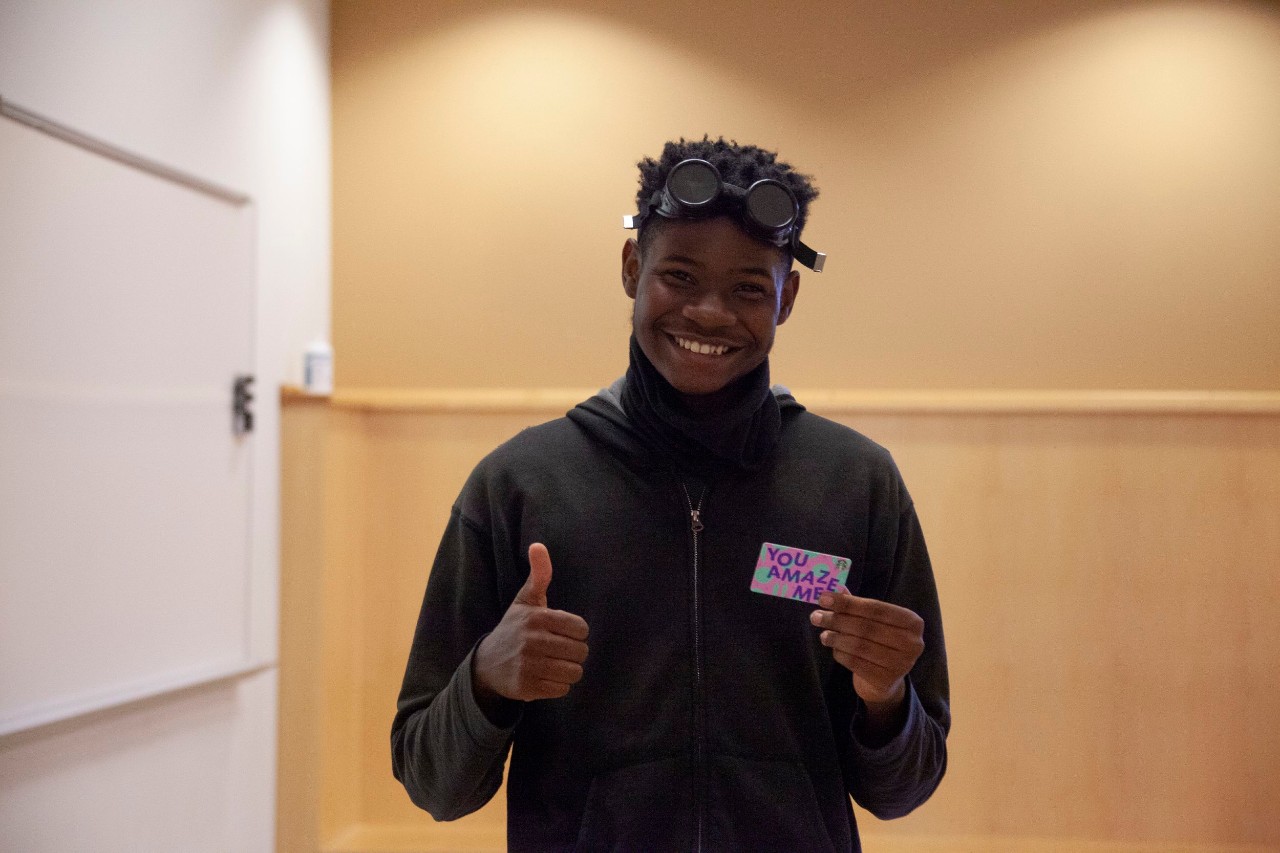
A high school student wins a gift card during a competition as part of the Biology Meets Engineering program. Photo/Ravenna Rutledge/UC Marketing + Brand
Impact Lives Here
The University of Cincinnati is leading public urban universities into a new era of innovation and impact. Our faculty, staff and students are saving lives, changing outcomes and bending the future in our city's direction. Next Lives Here.
Related Stories
'There's a strong community here:' UC transfer student finds place in College of Arts and Sciences
October 23, 2026
This week marks National Transfer Students Week, and the College of Arts and Sciences celebrated those students Thursday. Olivia White, assistant director of recruitment, said around 13-15% of students at UC are transfer students, and with that comes its own set of challenges.
AI breast cancer survival model from Cancer Center could improve accuracy and personalize care
October 23, 2026
UC Cancer Center researchers, including lead author Wedad Alatebi, developed a deep learning survival model for breast cancer that combines detailed clinical and genetic information, potentially offering physicians a more accurate tool to guide treatment decisions.
UC Biomedical Engineering student launches mobile healthcare platform
October 22, 2026
As a fifth-year biomedical engineering student at the University of Cincinnati College of Engineering and Applied Science, Amelia Wares has been a trailblazer in nearly every area imaginable — and this is only the beginning of her journey.